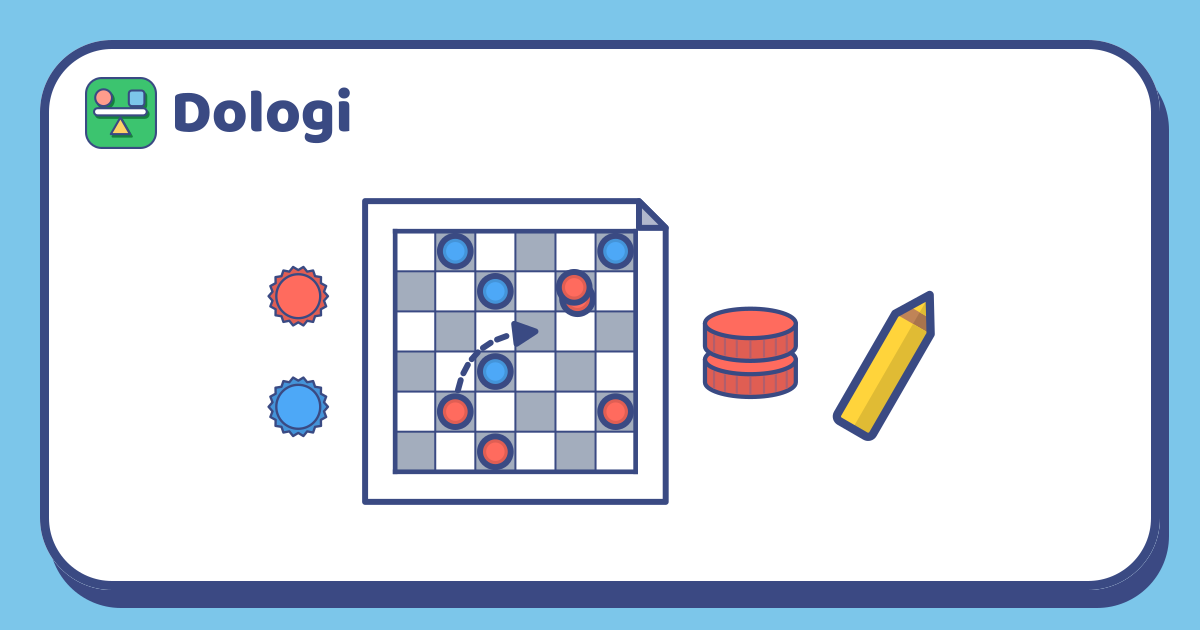
Checkers is one of the oldest board games around, and you can make a set at home in a few minutes: draw the board on paper and use bottle caps as pieces. The rules are short, yet every move asks a real question: if I go here, can my piece be jumped?
This guide is for children from about 6. Start on a small 6 × 6 board so a game stays short, then move up to the full 8 × 8 board once the rules feel easy. Below is how to make the set, how the game works, which house rules to agree on, and how to help your child think one move ahead.
Making the board and pieces
You need:
- A large sheet of paper, the inside of a cardboard box, or two sheets taped together.
- A ruler and a pen or crayon.
- Bottle caps in two colors: 6 per player for the small board, 12 for the big one, plus a few spares for kings.
Draw a square grid with squares a little wider than a cap, about 4 cm. Shade every other square like a chessboard, so no two shaded squares share a side. Turn the board so each player has a shaded square in their bottom-left corner. The whole game is played on the shaded squares; the light ones stay empty.
| Board | Caps per player | Starting position | Good for |
|---|---|---|---|
| 6 × 6 | 6 | shaded squares of the 2 rows nearest you | first games, around 6–7 |
| 8 × 8 | 12 | shaded squares of the 3 rows nearest you | once the rules are easy, around 7 and up |
On both boards, two rows in the middle start empty. No caps in two colors? One player puts their caps the right way up and the other turns theirs upside down.
How pieces move and jump
- Taking turns: players make one move each in turn. Agree who starts, then swap for the next game.
- Moving: a piece moves one square diagonally forward, onto an empty shaded square.
- Jumping: if an opponent's piece is diagonally next to yours and the square right behind it is empty, your piece jumps over it and lands on that empty square. The piece you jumped over comes off the board.
- Jumping again: if, after landing, your piece can jump another piece, it carries on in the same turn. You can take several pieces in one go.
- Forward only: an ordinary piece moves and jumps forward only, never backwards.
- Winning: you win when the other player has no pieces left, or none of their pieces can move.
Becoming a king
When a piece reaches the far row, the one nearest the other player, it becomes a king. Put a second cap of the same color on top so everyone can see it. Reaching the far row ends that turn, even in the middle of a run of jumps.
A king still moves one square diagonally, but it can go forwards or backwards, and it can jump backwards too. That makes it much stronger, so it is worth protecting, and worth stopping the other player from getting one. A simple way is to keep a couple of pieces on your back row for as long as you can: a piece can only be crowned by landing on an empty square of that row.
House rules to agree on first
Families play checkers in slightly different ways, and that is fine. Agree before you start:
- Do you have to jump? In the usual rules, if a jump is possible you must take it. For first games, many families make jumping optional, then switch to "must jump" once the child spots jumps easily. The must-jump rule brings a nice trick: you can offer a piece on purpose to pull the other player where you want them.
- Touching a piece: can you change your mind after touching a piece? For young children, allowing a change until the hand lets go keeps the game friendly.
- Taking back a move: in practice games, a parent can allow one take-back and say why: "Look, now my piece can jump yours. Do you want to try another move?"
- Draws: when only a few pieces are left and nobody can win, call it a draw.
The question before every move
The habit that matters most in checkers is one question: "Can my piece be jumped?" Before your child moves, ask them to look at the square they want to go to and check two things:
- Is an opponent's piece diagonally next to that square?
- If so, is the square straight behind my piece, on the same diagonal line, empty?
If both answers are yes, the piece will be taken. Two simple ideas help a lot:
- A piece on the side edge cannot be jumped, because there is no square behind it to land on.
- Pieces in pairs protect each other. If one of your pieces stands right behind another on the same diagonal, the landing square is taken, so nobody can jump along that line.
Once that question is easy, add a second one: "If I move here, what will you do next?" Seeing the board from the other player's side is a real step in reasoning, and checkers practices it in every game. Think out loud on your own turns too ("If I go here, your piece can jump mine, so I'll go there instead"), so your child hears what thinking ahead sounds like.
If your family uses Dologi, the "Push the boxes" puzzles in the Space topic build the same habit: a box pushed into a corner stays stuck, so children learn to picture a few moves before they make the first one.
In short
- A paper board and bottle caps are all you need: start on 6 × 6 with 6 caps each, then move up to 8 × 8 with 12.
- Pieces move one square diagonally forward, jump over a piece to take it, and become kings on the far row.
- Agree on house rules first, especially whether jumping is required.
- Before each move, ask "Can my piece be jumped?", then "What will the other player do next?"
Read more: The peg-jumping puzzle for one player: draw the board, use beans, leave just one