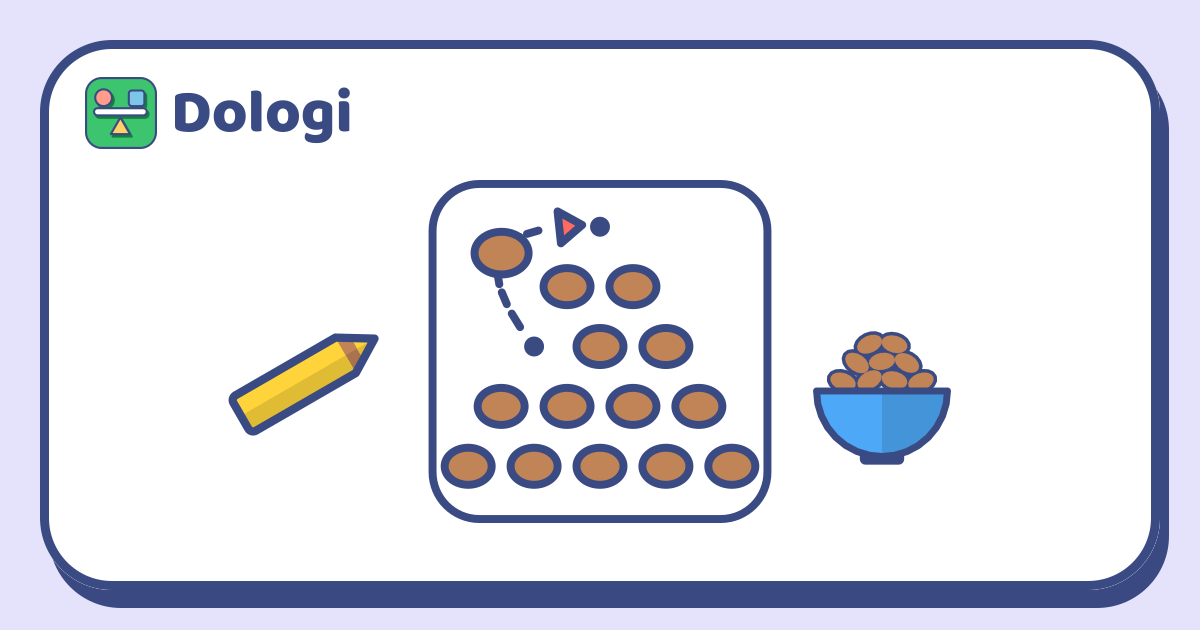
The peg-jumping puzzle is one of the oldest puzzles for one player. You need a board with holes, pegs in all of them except one, and a single rule: jump a peg over its neighbor into an empty hole, then take the jumped peg away. The goal is to finish with just one peg on the board.
You don't need to buy anything: paper, a pencil and a handful of dried beans make a perfectly good board. Below are puzzles for children aged roughly 8 to 12, from short strips up to the classic fifteen-hole triangle, with answers checked move by move.
How to make the board and play
Draw a row of dots, or a triangle of dots, big enough for a bean to sit on each one. Put a bean on every dot except the ones the puzzle says to leave empty.
The rule:
- A jump: a bean jumps over the bean right next to it, in a straight line, and lands on the empty dot just beyond.
- The jumped bean is removed. Put it back in the bowl.
- No jumping over empty dots or over two beans at once.
- The goal: one bean left. Two or three is a good start.
In a triangle, beans can jump along the rows and along both slanting sides, so there are six directions. Number the dots so you can talk about moves: in a triangle, 1 is the top dot, 2 and 3 the second row, 4 to 6 the third row, 7 to 10 the fourth, and 11 to 15 the bottom row, always from left to right. "4 over 2 to 1" means the bean on 4 jumps over 2 and lands on 1.
Warm-up: puzzles on a strip
On a strip, the dots are numbered from left to right. ● is a bean, ○ an empty dot.
| Puzzle | Strip | Goal |
|---|---|---|
| 1 | ●●○● | One bean left |
| 2 | ○●●○● | One bean left |
| 3 | ●●○●● | Can you leave just one? |
Puzzle 3 is a trap. Let your child try for a while before checking the answers.
The triangles
Once the strips feel easy, move on to triangles.
| Puzzle | Board | Goal |
|---|---|---|
| 4 | Ten dots (four rows), only dot 5 empty | What is the first move? |
| 5 | Ten dots, only dot 2 empty | One bean left |
| 6 | Fifteen dots (five rows), only dot 1 empty | One bean left |
| Bonus | Fifteen dots, only dot 1 empty | One bean left, and it ends on dot 1 |
Before puzzle 6, point out a useful fact: every jump removes exactly one bean. Fourteen beans down to one means exactly thirteen jumps, no more and no fewer. Ask your child to keep a tally to check.
Tips for thinking ahead
- Clear the corners early. A bean in a corner can never be jumped over, because there is no dot beyond it. The only way to remove it is for it to jump out itself, so don't leave it until the end.
- Don't strand a bean. A bean with no neighbors can't jump and can't be jumped. Before each move, look at which bean would end up alone.
- Look two moves ahead. Ask "after this jump, what can I do next?" before lifting the bean.
- Work backwards. Picture the last move: two beans side by side and an empty dot. What did the board look like one move before that? Thinking from the end often shows where to aim.
Answers
- 2 moves: 1 over 2 to 3, then 4 over 3 to 2. One bean is left, on dot 2.
- 2 moves: 2 over 3 to 4, then 5 over 4 to 3. One bean is left, on dot 3.
- No, two is the best. There are only two possible first moves, and they mirror each other: 1 over 2 to 3, or 5 over 4 to 3. After 1 over 2 to 3, the only move left is 4 over 3 to 2, and then the beans on 2 and 5 are stuck far apart. The other side works the same way.
- There is no first move! Dot 5 is the middle of the ten-dot triangle, and no bean is two steps away from it in a straight line. The game is over before it starts, which is a nice surprise to discuss.
- 8 moves: 7 over 4 to 2, 1 over 2 to 4, 6 over 3 to 1, 4 over 5 to 6, 10 over 6 to 3, 1 over 3 to 6, 8 over 9 to 10, 10 over 6 to 3. One bean is left, on dot 3. (With the top dot empty instead, the best you can do is three beans.)
- Puzzle 6 and the bonus, 13 moves: 4 over 2 to 1, 6 over 5 to 4, 1 over 3 to 6, 7 over 4 to 2, 10 over 6 to 3, 12 over 8 to 5, 14 over 13 to 12, 11 over 12 to 13, 13 over 9 to 6, 3 over 6 to 10, 15 over 10 to 6, 6 over 5 to 4, 4 over 2 to 1. The last bean lands back on dot 1, where the empty hole was at the start.
Puzzle 6 has many other solutions. If your child finds a different one, check it together and write it down.
Make it your own
- Change the empty dot. On the fifteen-dot triangle, one bean can be left whichever dot starts empty. On the ten-dot triangle, it only works when one of the dots in the middle of a side starts empty.
- Swap roles. Your child sets a small strip puzzle for you, then checks your answer.
- Play backwards: start with one bean and "un-jump": a bean jumps over an empty dot into another empty dot and leaves a new bean on the dot it jumped over. Your child builds a puzzle they know can be solved.
In Dologi's Space topic, the "Push the boxes" puzzles call for the same kind of planning: a box pushed into a corner can't be pulled back out, so children learn to think a few moves ahead before they push.
In short
- A bean jumps over its neighbor into an empty dot and the jumped bean is removed; the goal is one bean left.
- Paper, a pencil and dried beans make a board; start with short strips, then the triangles.
- Clear corners early, don't leave a bean alone, and look two moves ahead.
- Not every start can be solved, and finding out why is part of the fun.
Read more: The 3×3 coin-flip puzzle: flip one coin and its neighbors flip too