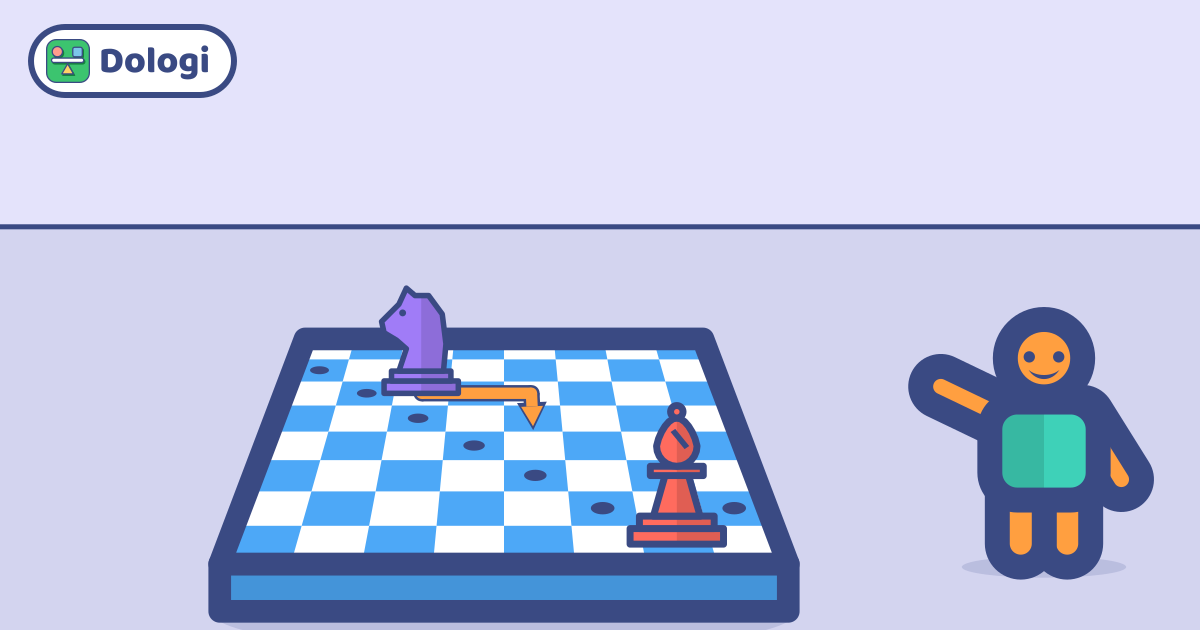
When kids first learn the knight, there's often a funny moment: they count "one, two, turn," then put it on the square right next to the one they meant. "The knight moves in an L" sounds simple, but to see where it lands, your child has to picture a shape in their head before their hand puts the piece down.
That's spatial thinking: picturing positions, directions, distances and paths. Here is where chess practices it, along with a few games on paper and on the board, no full game required.
Each piece has its own geometry
| Piece | How it moves | What your child has to picture |
|---|---|---|
| Rook | Straight along rows or columns | Straight lines, and where another piece blocks the way |
| Bishop | Along diagonals | Diagonals across the board, on one color only |
| Queen | Straight and diagonal | Eight directions fanning out from one square |
| King | One square in any direction | The eight squares around it |
| Knight | An L: two squares, then one to the side, jumping over pieces | A bent shape, a square that isn't "in line" |
| Pawn | Moves straight, captures diagonally | Different directions for moving and capturing |
Diagonals are where many kids struggle most. Young children are used to looking across and up and down, while a diagonal on the board means "hopping corners" from square to square. The bishop is a great way to practice seeing diagonals.
Surprising facts about paths
There are a few spatial facts on the chessboard that kids love discovering for themselves:
- Bishops never change color. A bishop that starts on a light square stays on light squares all game. Each side has one light-square bishop and one dark-square bishop.
- Knights always change color. A knight on a light square jumps to a dark one, then back to a light one, over and over.
- A knight in the corner is weak. In a corner, a knight can reach only two squares; in the middle, eight.
- Close but far. From the corner square a1, a knight needs four moves to reach b2, the square right next to it diagonally.
- Rooks get everywhere fast. On an empty board, a rook can reach any square in at most two moves.
Don't tell your child these ahead of time. Ask them as questions, let them try on the board and figure out the answer. That's when spatial thinking does the most work.
Square names as coordinates
Every square has a name: a letter for the file (a to h) and a number for the rank (1 to 8), like e4. Reading a square name means locating something with two pieces of information at once, a lot like reading a map grid or finding your seat at the movies.
Try "name it, place it": you say "c5" and your child puts a piece on that square. A bit harder: "From c5, go up two squares. Where are you?" "Go one square diagonally down and to the right. Which square is that?" Your child has to picture the direction first, then find the square.
Games on paper and on the board
- Draw the knight's moves. Draw a five-by-five grid on paper and mark the middle square. Your child marks every square a knight there could jump to, then connects them. The eight squares make a ring around the middle.
- The knight's two steps. Put a knight on a square, mark the squares it can reach in one move, then in two. Older kids are often surprised by how much of the board two moves can cover.
- The shortest route. Put a knight in a corner and a coin on another square. What's the fewest moves the knight needs to reach the coin? Try different routes and compare.
- Can the bishop get there? Put a bishop on a light square and a coin on a dark square. Ask, "Can the bishop ever reach the coin?" Let your child try, then explain why.
- Who's in the way? Set up a rook and a few pawns. Ask which squares the rook can reach and which are blocked. Your child practices seeing a path that's cut off.
A few minutes per game is plenty. Kids around six or seven often enjoy games 4 and 5; games 2 and 3 suit older kids, though every child is different.
Spatial thinking beyond the board
These skills show up in lots of places: reading maps, doing jigsaw puzzles, drawing symmetrical pictures, understanding coordinate grids in later grades. Chess is one of many ways to practice, not the only one, and it doesn't automatically carry over to other subjects unless someone helps make the link. You can do that: when your child reads a map grid, mention, "That's like the square names on a chessboard."
Once the Creative corner is turned on, Dologi's daily sessions sometimes include a chess puzzle like Where can it go? or How many moves?, asking which squares a piece can reach and how many moves it takes. In the Chess room, the Magnifier button shades the squares the other side is guarding, so your child can see each piece's paths on the board.
In short
- Each chess piece moves in its own shape; to move it correctly, children picture directions, diagonals and distances.
- Bishops never change color, knights always do, and a cornered knight has only two moves: let your child discover these instead of telling them.
- Square names are coordinates; "name it, place it" and direction questions practice locating things.
- Drawing knight moves on paper, finding the shortest route and asking whether a bishop can reach the other color are quick games to try today.
Read more: What is spatial thinking?, Does chess make kids better at math?