"Sign them up for chess, it's great for math." You've probably heard it at school pickup, in a parents' group chat or from a relative who loves the game. It sounds reasonable: chess is a game of calculation. But does being good at calculating chess moves make a child better at the math they do in class?
This post won't promise that. Instead, it points out where real math shows up on the chessboard, so you know how to make the most of it, and it is clear about what is still uncertain.
The short answer
Chess doesn't replace learning math, and nobody can say for sure that playing chess raises math grades. But a game of chess is full of real calculations with a reason behind them: adding and subtracting piece values in a trade, counting and comparing pieces, reading squares by file and rank. For a child who likes chess, that is math used because they want to win, not because it's homework. You can point those moments out; how much carries over to the classroom varies from child to child.
Piece values: adding and subtracting with a reason
Chess players usually give each piece an agreed value so they can compare trades:
| Piece | Usual value |
|---|---|
| Pawn | 1 |
| Knight | 3 |
| Bishop | 3 |
| Rook | 5 |
| Queen | 9 |
| King | Can't be traded; losing it loses the game |
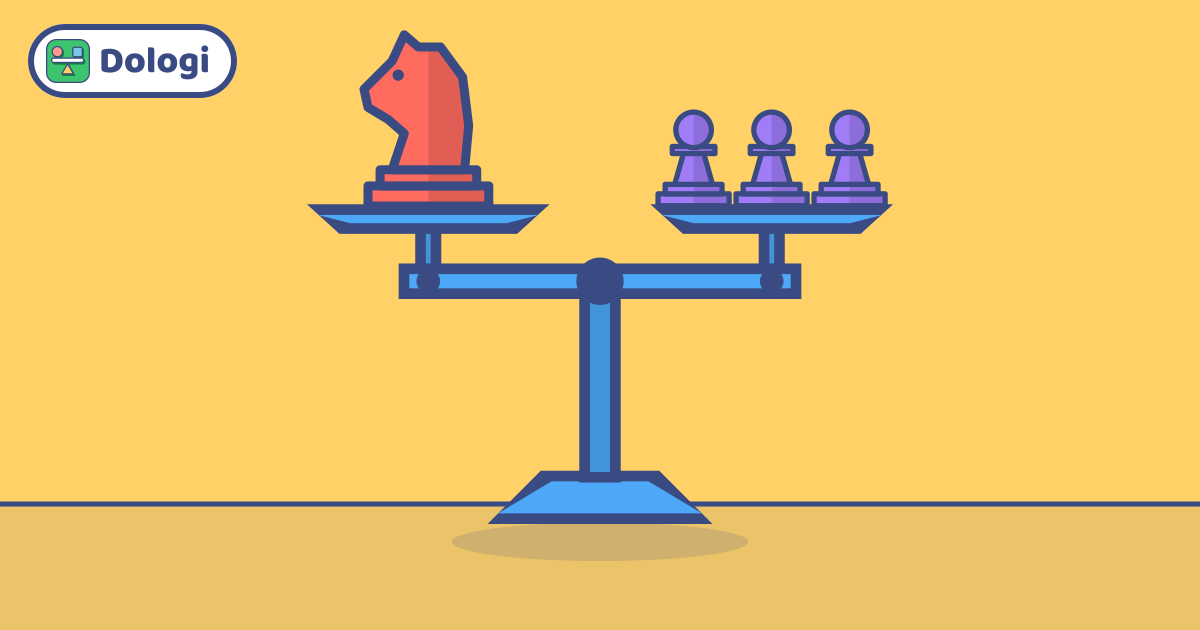
With this table, every capture is a little math problem. Your child takes a knight with a rook and then loses the rook: they got 3 and lost 5, so they're down 2. They take a bishop with a pawn and lose the pawn back: got 3, lost 1, up 2. Seven- and eight-year-olds can usually work these out on their own, and they love finding out they "came out ahead."
It's worth telling your child that these numbers are a handy rule of thumb, not a rule of the game. Sometimes a pawn about to promote is worth more than a knight. Learning that numbers help you think but don't decide for you is a good math lesson too.
Counting attackers and defenders
Before capturing, chess players often count: how many of my pieces are aiming at this square, and how many of yours are guarding it? If you have more attackers, the capture usually works; if you have fewer, watch out for a recapture.
That's counting and comparing, something first and second graders can do. To practice, point at one of the other side's pieces and ask, "How many pieces are protecting this one?" and then, "How many of yours are attacking it?" At first your child counts by tracing each piece's path with a finger; over time they start to see it at a glance.
Files and ranks: coordinates on the board
A chessboard has 8 files labeled with letters (a to h) and 8 ranks labeled with numbers (1 to 8). Every square has a name like e4 or b7: the letter is the file, the number is the rank. That's the same idea as coordinates, which your child will meet again when they start graphing points in later grades.
Naming squares is an easy game: you say "d5" and your child puts a pawn on that square; then switch. Older kids can write down the moves of a short game using square names and read them back to replay it.
Little math games with a chessboard
- Up or down? Set up a trade (a rook takes a knight and gets taken back) and ask whether your child came out ahead or behind, and by how much.
- How many squares can the knight reach? Put a knight in a corner and count the squares it can jump to (2), then put it in the middle (8). Ask why the numbers are so different.
- How many squares on the board? Younger kids count one by one; older kids notice 8 rows of 8 and look for a faster way while they're learning multiplication.
- Rice on the chessboard. An old story tells of someone asking a king for a reward in rice: one grain on the first square, and double the previous square on each one after that. Work out the first few squares together (1, 2, 4, 8, 16…) and watch how fast doubling grows.
- Is everything there? Each side has 16 pieces: how many pawns, how many other pieces? How many on both sides together?
What's still uncertain
- Chess doesn't replace math class. Fractions, division and word problems still need to be learned in their own way.
- Not every child who likes chess likes the math in it. Some just enjoy moving pieces and capturing. That's fine; don't turn every game into a math lesson.
- Pushing chess to boost math can backfire. Your child might end up tired of both.
In the Chess room in Dologi's Creative corner, Learn chess includes the lessons What pieces are worth and Attack and defend. During a game, the Magnifier button shades the squares the other side is guarding and marks your child's pieces that are under attack with no defender, so there is something to look at, count and compare before making a move.
In short
- Chess can't promise better math, but there is real math on the board.
- Piece values give your child a reason to add and subtract in trades; counting attackers and defenders is counting and comparing; square names are coordinates.
- Little games like "up or down?", "how many squares can the knight reach?" and "rice on the chessboard" turn the board into a place to play with numbers.
- Don't turn every game into a math lesson; let your child play because they enjoy it, and point out the math when they're curious.
Read more: Chess for children: what age to start, and what they really learn, Sea battle on paper: a grid guessing game that builds reasoning in older kids