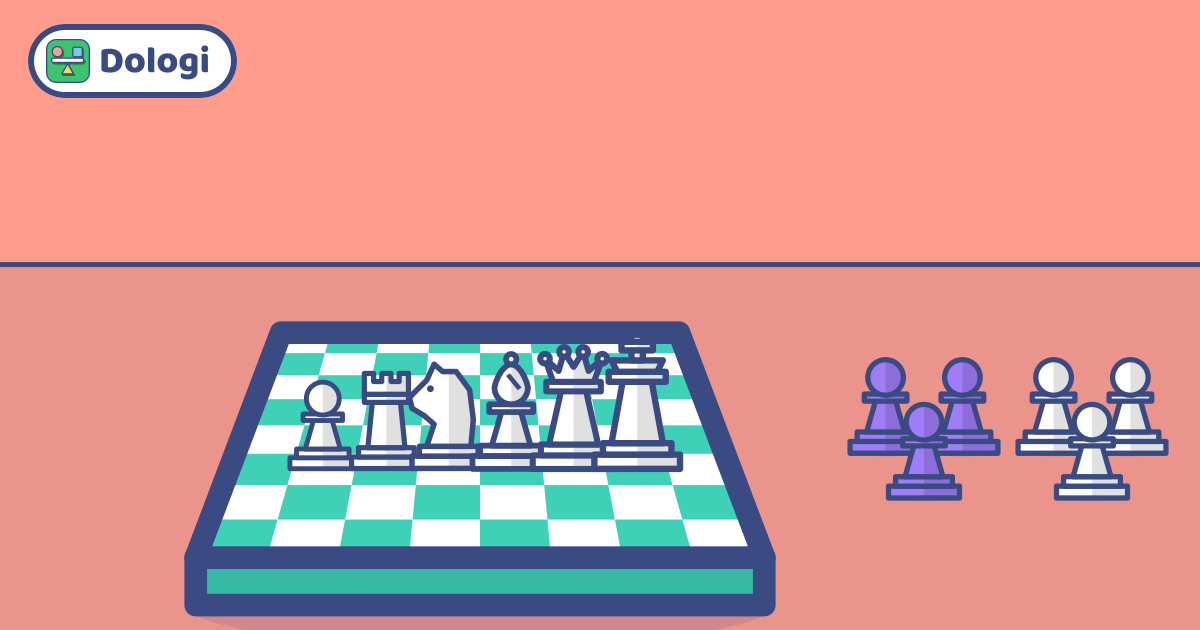
Big brother plays chess, so of course the four-year-old wants to play too. Pieces get dumped out, lined up any which way, and the knight gallops around the living room. You try to explain the rules and lose them in two minutes. Should you put the set away until they're older?
No need. At this age the rules of chess are usually too much, but a chessboard and pieces make a wonderful learning toy: colors, shapes, numbers, rows and columns. Here are games you can play right away, a few minutes each, without knowing how any piece moves.
Why there's no rush to learn the rules
Chess has six kinds of pieces, each with its own move, plus a few special rules, and a game usually takes a while. Most four- and five-year-olds can't hold all of that at once yet, and that's completely normal. Every child is different: some five-year-olds can play a little game with one or two kinds of pieces, others aren't ready until six or seven.
Playing with the board as a toy first helps your child get comfortable with the pieces, the squares and the look of the board, so the rules feel less overwhelming later. Along the way they practice skills that fit their age: sorting, comparing, counting, spotting patterns and understanding position words.
Sorting and lining up
| Game | How to play | What it practices |
|---|---|---|
| Sort by color | Dump out all the pieces and split them into white and black | Sorting by one feature |
| Find the family | "Find all the knights," "find all the pawns" | Matching shapes |
| Line up by size | Line them up from shortest to tallest: pawn, rook, knight, bishop, queen, king | Comparing and ordering |
| Count each kind | How many pawns does each color have? How many rooks? Which side has more? | Counting, comparing amounts |
| Two at once | "Find a black pawn," "find the tallest white piece" | Sorting by two features |
Name the pieces as you play ("this is the rook, it looks like a castle tower") and your child will pick up the names without memorizing them.
Light square, dark square games
A chessboard is a grid with a very clear alternating pattern, perfect for practicing patterns:
- Count the squares. How many squares in one row? How many rows? A five-year-old who counts one row correctly is doing great.
- Dark squares only. Your child puts a piece on a dark square, then hops to the next dark square diagonally. They'll discover that the dark squares connect along diagonals.
- Color the pattern. Draw a four-by-four grid on paper and have your child color it in like a chessboard. If they color one square wrong, they'll notice "two dark squares are stuck together here."
- Spot the odd one. Put a few pawns on light squares and sneak one onto a dark square. Your child finds the pawn "standing in the wrong place."
Hiding and guessing
- Which piece disappeared? Set out three or four different pieces. Your child closes their eyes while you take one away. They open their eyes and guess which piece is gone.
- Mystery bag. Put a few pieces in a cloth bag. Your child reaches in, feels one and guesses: "It's the knight, it has a curved head." This trains recognizing shapes by touch.
- Swap spots. Set out a row of pieces, let your child look, then have them turn around while you swap two pieces. They find what changed.
Placing pieces by instructions
The board is a great place to learn position words. You give the instruction, your child does it:
- "Put the pawn on a corner square."
- "Put the knight next to the king."
- "Put the rook in the row closest to you, right in the middle."
- "Put the queen behind the pawn."
Start with one instruction at a time, then try two in a row ("put a pawn in the corner, then put a knight next to it"). Then switch: your child gives the instructions, you follow them, and you make a mistake on purpose so they can correct you.
Keep it fun
- A few minutes per game, switch when they get bored, stop while they still want more.
- If your child wants the pieces to "fight," let them; kids learn a lot through pretend play.
- When your child asks, "How does the knight move?", that's your cue to teach one piece, with one little game.
When your child is ready to try a few rules, the Chess room in Dologi's Creative corner has six Little games, like Pawn race, Pawns and rook and Pawns and knights, made for kids around 4 to 7, each with just a few kinds of pieces. If a move isn't allowed, the app gently explains why, and losing a game just brings an invitation to play again, not a scolding.
In short
- Four- and five-year-olds don't need to learn chess rules yet; the board and pieces are still a great learning toy.
- Sorting by color and shape, lining up by size and counting each kind practice comparing and counting.
- Light and dark squares teach patterns; hiding games and the mystery bag train memory and shape recognition.
- Placing pieces by instructions builds position words; keep each game short and stop while it's still fun.
Read more: Chess for children: what age to start, and what they really learn, First board games for 4 and 5 year olds