Around four or five, many children start pulling up a chair when the grown-ups play. But most games on the shop shelf are made for older children: the cards need reading, you count to twenty, and one game lasts half an hour. Your child gets bored before the end, or cries after losing.
A first board game does not have to be bought. Below are four things to check before choosing one, three games you can make in an evening from old cardboard, bottle tops and felt-tip pens, and a few ways to practice taking turns and sticking to the rules.
What board games teach at this age
At four or five, the most useful part of a board game is not winning. It is the small things that repeat every turn:
- Waiting for a turn: sitting still while someone else moves, and knowing when it is your go.
- Following shared rules: the rules apply to everyone, parents included.
- Paying attention to the end: remembering where your counter is and which color you are looking for.
- Coping with luck: some turns take you far, some leave you where you are, and that is nobody's fault.
Every child is different: some four-year-olds play a full ten-minute game, some five-year-olds manage a few turns. Start from where your child is.
Four things to check
Whether you buy a game or make one, these four questions help you decide.
| What to check | Why it matters | How to tell |
|---|---|---|
| A game takes under 10 minutes | Your child can stay with it to the end and gets the feeling of finishing a game | Play one round with another adult and time it |
| No reading needed | Your child can play without waiting for someone to read | Cards and board use only colors, pictures and dots |
| Short waits | Other players' turns go by quickly, before impatience sets in | Each turn is one action: draw and move, or roll and find |
| Some luck | Your child sometimes wins for real, without anyone letting them | The result depends on the cards or dice, not only on skill |
Also, the rules should fit in one or two sentences and the pieces should be easy for small hands to hold. If a baby in the house puts things in their mouth, play at nap time and put everything away afterwards.
Game 1: Color path
You need: a piece of cardboard from an old box, felt-tip pens in four colors, a bottle top for each player as a counter, and about twenty small cards cut from card.
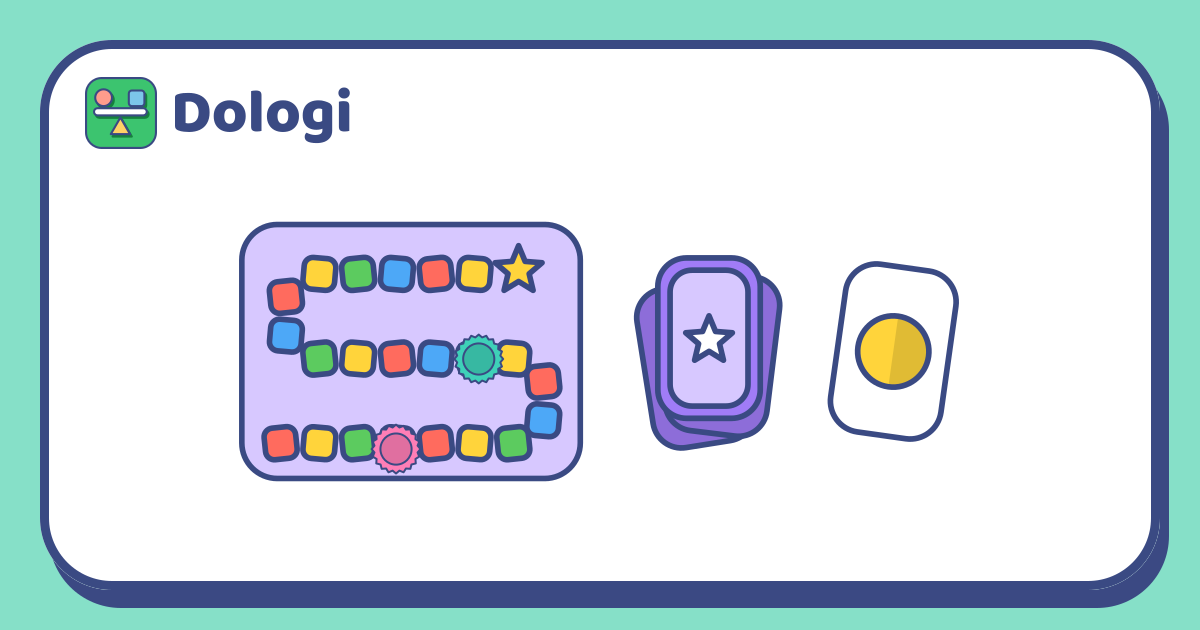
- Draw a winding path of about twenty squares on the cardboard and let your child color them in turn red, yellow, green and blue. Draw a star at the end as the finish.
- Color one side of each card in one of the four colors and leave the other side blank. Shuffle and stack them face down.
- On your turn, draw a card and move your counter to the next square of that color. The first to reach the star wins.
Your child does not need to count, only to recognize a color and find the next square. Once they have got the hang of it, add a few cards with two dots of the same color: move to the second square of that color.
Game 2: Color dice hunt
You need: a small wooden block or cardboard box with paper in six colors stuck on its six faces; a basket of small things in many colors (building bricks, clothes pegs, bottle tops); and for each player, a sheet of paper with six circles colored in the six colors.
- On your turn, roll the color dice.
- Take one thing of that color from the basket and put it on the circle of the same color on your sheet.
- If that circle is already filled, you miss this turn. The first to fill all six circles wins.
Turns are very short and each one is a single action, so small children hardly have to wait. When your child needs to move more, put the basket away: whatever color comes up, everyone has a moment to find something that color in the room and bring it back.
Game 3: Animal halves
You need: six pieces of card, each with one big animal drawn on it (a cat, a fish, a hen, an elephant, a turtle, a rabbit), each cut in half into a front half and a back half.
- Lay the twelve halves face down on the table in rows.
- On your turn, turn over two. If they are the front and back of the same animal, keep the pair. If not, turn them face down again in the same places.
- When all the cards are gone, count how many pairs each player has.
This one trains memory: which corner was the elephant's tail in? For the first games, lay everything face up and let your child pick two halves that make one animal. Afterwards, putting an elephant's head on a fish's tail and naming the new creature is just as much fun.
Practicing turns and rules
- Say the rule in one sentence and play one example turn before you start. Young children learn rules faster by watching than by listening.
- Use a turn marker: whoever's turn it is holds a wooden spoon and passes it on when they are done. Your child can see when it is their go without asking "is it me yet?".
- Change rules before a game, not during one. A new rule your child suggests can be tried next game.
- Don't always let them win. A game with luck already gives your child plenty of real wins. When they lose, name the feeling ("you're sad because you were nearly at the star") and offer one more short game. More on this in the article about crying after losing.
- Stop when your child is tired, even mid-game. A short happy game is better than a long one that ends in tears.
When your child wants to sit with a puzzle on their own, Dologi's puzzles have no opponents and no rankings. A wrong answer is never shown in red: your child simply changes the answer and tries again.
In short
- A good first board game takes under 10 minutes, needs no reading, keeps waits short and has some luck so your child sometimes wins.
- Three games to make in one evening: the color path, the color dice hunt and animal halves.
- Say the rule in one sentence, play an example turn, and use a turn marker so your child can see when it is their go.
- Keep rules fixed during a game, don't always let them win, and stop when your child is tired.
Read more: Draw your own race track board game: counting squares and adding in your head · My child cries every time they lose: teaching children to win and lose well