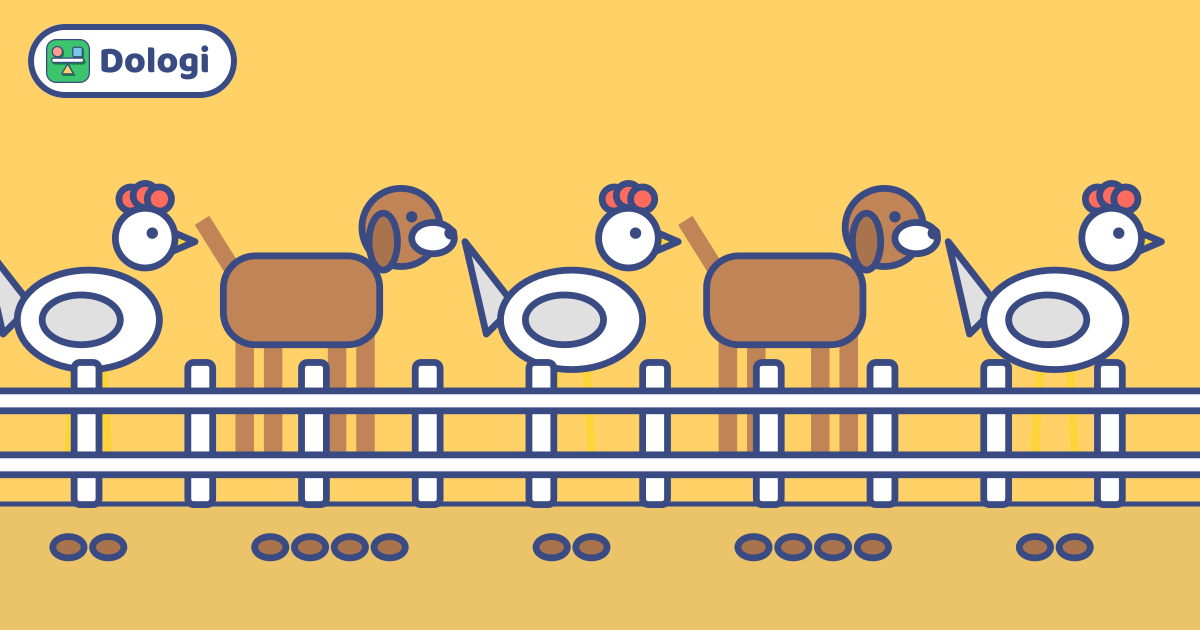
There's a puzzle that has been around for well over a thousand years. An old Chinese math book asks: some chickens and rabbits share a cage; there are 35 heads and 94 feet; how many of each? It's often called the chickens and rabbits problem: you know the total number of animals and the total number of legs, and you have to find how many of each kind. Older students solve it with equations. But children aged 8 to 11 can use three methods without equations that are clear and fun.
We'll use chickens and dogs, and start small: A yard has 5 animals, some chickens and some dogs, with 14 legs in total. How many chickens and how many dogs?
Method 1: Draw it
- Draw 5 circles, one for each head.
- Every animal has at least 2 legs. Give each one 2 legs: that's 10 legs used.
- There are 14 − 10 = 4 legs left. Only dogs get extra legs, 2 each. Add 2 legs to one animal, then to another: all 4 used.
- Two animals have 4 legs: 2 dogs. The rest are 3 chickens.
This suits 8-year-olds best, because they can see every leg.
Method 2: Assume they're all chickens, then adjust
- Suppose all 5 animals are chickens: 5 × 2 = 10 legs.
- There are really 14 legs, so we're 4 legs short.
- Each time a chicken is swapped for a dog, the legs go up by 2.
- We need 4 more legs, so swap 4 ÷ 2 = 2 animals to dogs. That's 2 dogs and 3 chickens.
It works the other way too: suppose they're all dogs, 5 × 4 = 20 legs, 6 too many. Each dog swapped for a chicken removes 2 legs, so swap 6 ÷ 2 = 3: 3 chickens, 2 dogs. Both assumptions give the same answer, which is a check in itself.
Method 3: An ordered table
Make a table with the number of dogs going up from 0:
| Dogs | Chickens | Legs |
|---|---|---|
| 0 | 5 | 10 |
| 1 | 4 | 12 |
| 2 | 3 | 14 |
| 3 | 2 | 16 |
| 4 | 1 | 18 |
| 5 | 0 | 20 |
The row with 14 legs: 2 dogs, 3 chickens. The table also shows a pattern: one more dog (one fewer chicken) adds exactly 2 legs. That's the idea behind method 2.
Try it with beans
Before solving on paper, let your child do it by hand. Use 5 bottle caps as 5 heads and 14 dried beans as 14 legs. Your child gives each cap 2 beans first, then hands out the leftovers to make some caps up to 4 beans. Caps with 4 beans are dogs.
Building up
| Puzzle | Answer | Check |
|---|---|---|
| 10 animals, 28 legs | 6 chickens, 4 dogs | 12 + 16 = 28 |
| 10 animals, 32 legs | 4 chickens, 6 dogs | 8 + 24 = 32 |
| 35 heads, 94 feet (the old chickens and rabbits) | 23 chickens, 12 rabbits | 46 + 48 = 94 |
For the old puzzle: if all 35 were chickens there would be 70 feet, 94 − 70 = 24 short; each rabbit adds 2 feet, so 24 ÷ 2 = 12 rabbits and 23 chickens.
Change the story so your child can make up puzzles
Once your child is comfortable, swap "chickens and dogs" for other stories of the same shape:
- Bikes and cars: a parking lot has 8 vehicles and 22 wheels. Answer: 5 bikes, 3 cars.
- Three-legged and four-legged stools: a room has 7 stools with 25 legs altogether. If all were three-legged there'd be 21 legs, 4 too few, so there are 4 four-legged stools and 3 three-legged ones.
Then let your child invent puzzles for you. A great question for older kids: "What about 5 animals and 15 legs?" There's no answer, because chickens and dogs both have an even number of legs, so the total can't be odd. Or "5 animals and 22 legs?" Also impossible, since 5 dogs only have 20 legs. Knowing when a puzzle makes no sense is part of math too.
The Math topic in Dologi has a puzzle called Fruit swap: "Both sides of every card are worth the same. Which number goes on the bottom card?" Just like swapping a chicken for a dog, your child has to track how each swap changes the total.
In short
- Chickens and dogs: you know the number of animals and legs, and find how many of each.
- Method 1, draw it: give every animal 2 legs first, then hand out the extras to dogs, 2 each.
- Method 2, assume they're all chickens: the missing legs divided by 2 is the number of dogs; assume the opposite to check.
- Method 3, an ordered table; then switch to bikes and cars or stools, and look for impossible puzzles too.
Read more: Word problems: helping your child understand the question, Finding the missing number with a balance