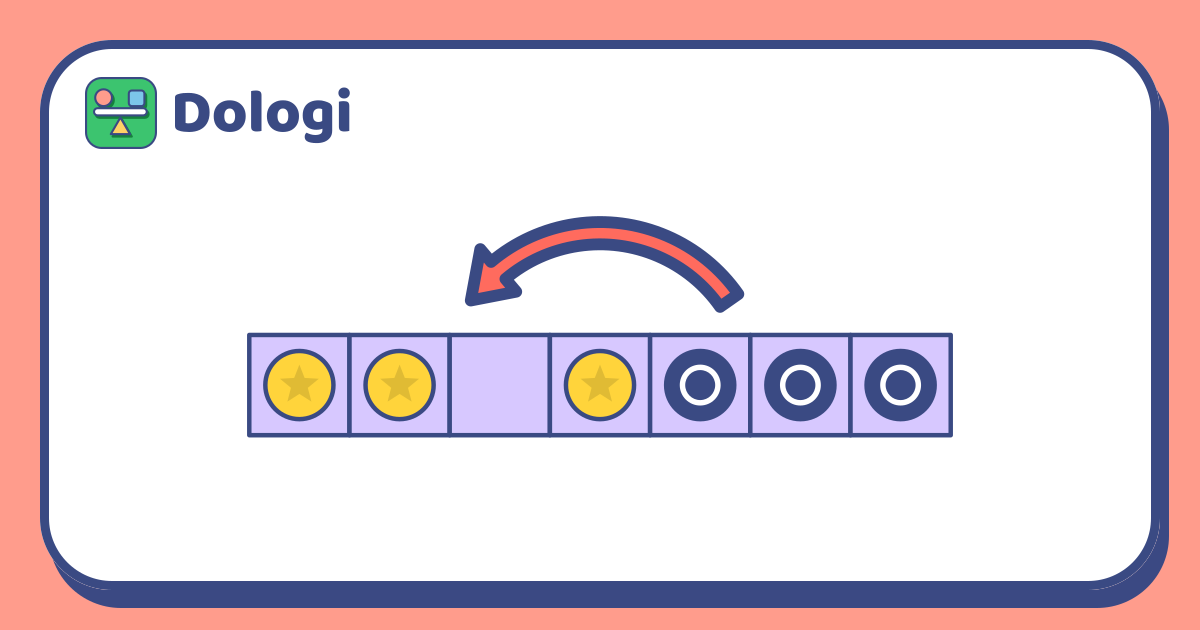
All you need for this puzzle is a strip of paper and a few coins. One team of coins starts on the left, the other on the right, with a single empty square between them. The goal is to make the two teams swap sides. The rules are simple, but the first attempts usually end in a traffic jam, which is exactly what makes it fun.
The puzzle suits children aged about 8 to 12. It starts easy with one coin on each side, gets harder with two and three, and then hides a surprise: the number of moves follows a pattern your child can discover and use to predict bigger puzzles without solving them.
Setting up the strip
Draw a row of squares on a strip of paper, each big enough for a coin. For three coins per side you need seven squares: three for each team and one empty square in the middle.
- Team ○: coins placed heads up on the left. They may only move to the right.
- Team ●: coins placed tails up on the right. They may only move to the left.
- A move is either a slide into the empty square next to the coin, or a jump over one coin into the empty square just beyond it.
- No moving backwards, and only one coin moves at a time.
The goal: all ● coins on the left, all ○ coins on the right, with the empty square back in the middle. Ask your child to count moves as they go.
In this article, ○ is a heads-up coin, ● is a tails-up coin and □ is the empty square. With one coin per side, the strip starts as ○□● and must end as ●□○.
Three puzzles to try
- One coin each side: ○□● becomes ●□○. Fewest moves?
- Two coins each side: ○○□●● becomes ●●□○○. Fewest moves?
- Three coins each side: ○○○□●●● becomes ●●●□○○○. Fewest moves?
Let your child try each one several times before looking at the answers. Writing the strip down after every move, one line per move, makes it easy to go back and spot where things went wrong.
When your child gets stuck
Sooner or later most children reach a position like this one, after two moves of the two-coin puzzle:
□○○●●
Both ○ coins have moved forward, and now nothing can move at all: the gap is behind the ○ coins, and the ● coins can neither slide nor jump into it. Since coins can't go backwards, the only choice is to start again. That isn't a failure. It is a clue.
Ask your child: "What went wrong just before you got stuck?" Two coins of the same team ended up side by side in front of the other team, with the gap behind them. Two useful hints come out of this:
- After a slide, see whether the other team can jump. Jumps are what get the teams past each other.
- In the middle of the puzzle, the coins usually alternate: ○●○●. If two of the same team bunch up, a jam is coming.
Answers
One coin each side: 3 moves. ○□● → □○● → ●○□ → ●□○. A slide, a jump, a slide.
Two coins each side: 8 moves.
○○□●● → ○□○●● → ○●○□● → ○●○●□ → ○●□●○ → □●○●○ → ●□○●○ → ●●○□○ → ●●□○○
Three coins each side: 15 moves.
- ○○○□●●● → ○○□○●●●
- → ○○●○□●●
- → ○○●○●□●
- → ○○●□●○●
- → ○□●○●○●
- → □○●○●○●
- → ●○□○●○●
- → ●○●○□○●
- → ●○●○●○□
- → ●○●○●□○
- → ●○●□●○○
- → ●□●○●○○
- → ●●□○●○○
- → ●●●○□○○
- → ●●●□○○○
Look at who moves: one ○, then two ●, three ○, three ●, three ○, two ●, one ○. The teams take turns, and the number of moves in each turn grows, stays the same for a while, then shrinks. Starting with team ● works just as well; the solution is then a mirror image.
The pattern in the number of moves
Put the results in a table and ask your child to guess the next line before solving it.
| Coins per side | Fewest moves | Jumps | Slides |
|---|---|---|---|
| 1 | 3 | 1 | 2 |
| 2 | 8 | 4 | 4 |
| 3 | 15 | 9 | 6 |
| 4 | ? | ? | ? |
Some children notice that the totals go up by 5, then by 7, so the next jump should be 9: 15 + 9 = 24. Others notice that the jumps are 1, 4, 9, which are 1 × 1, 2 × 2, 3 × 3, and that the slides are 2, 4, 6. With four coins per side, that gives 16 jumps and 8 slides: 24 moves again. Two different ways of looking lead to the same answer, which is a good sign.
Older children can find out why it works:
- Jumps: every ○ coin has to get past every ● coin, and the only way for two coins to pass each other is a jump. With three coins per side, that is 3 × 3 = 9 jumps.
- Slides: with three coins per side, each coin must travel four squares, so the six coins travel 24 squares in total. The 9 jumps cover 2 squares each, which is 18. The 6 squares left are covered by slides of one square each.
So for any number of coins per side, the moves are that number times itself (the jumps), plus twice that number (the slides).
Going further
- Uneven teams: two ○ coins and three ● coins on a strip of six squares. Before solving, can your child predict the number of moves? (Answer: 2 × 3 = 6 jumps, plus 2 + 3 = 5 slides, so 11 moves.)
- A puzzle for a grown-up: your child calls out the moves while you play, and stops you if you break a rule.
- Bigger teams on paper only: with ten coins per side, how many moves would it take? Your child doesn't need ten coins to answer.
Finding a rule for the number of moves is also what makes the "Move the tower" puzzles in the Space topic in Dologi satisfying: stacking discs one at a time, never a big one on a smaller one, where each extra disc changes how many moves are needed.
In short
- Two teams of coins swap sides on a paper strip by sliding into the gap or jumping over one coin, never moving backwards.
- A jam is a clue: two coins of the same team side by side usually mean trouble, while alternating ○●○● keeps things moving.
- The fewest moves are 3, 8, 15 and 24 for one to four coins per side.
- The jumps are the number of coins times itself and the slides are twice the number, so children can predict the moves without solving the puzzle.
Read more: Coin puzzles for kids: move the fewest coins to change the shape