"Heads! No, tails again, that's three in a row, so it has to be heads now." Children from around 8 love flipping coins, and they often have strong ideas about what comes next. Some of those ideas are right, and some are among the most common mistakes adults make about chance too.
A coin is the simplest probability lab you can have at home. This article suggests a 20-flip experiment, a way to pool the whole family's results, a look at streaks and the idea that a coin is "due", and a two-coin challenge for older kids. You need a coin, a towel, paper and a pencil.
Set up: a coin, a towel and a guess
Any coin works: a quarter is easy to catch and easy to see. Flip it with your thumb, let it land on a towel spread on the table so it doesn't roll away, and read the side facing up. If it falls on the floor or lands on its edge against something, flip again.
Draw two columns on a sheet of paper, one for heads and one for tails. Before the first flip, ask your child for a prediction: "If we flip 20 times, how many heads do you think we'll get?" Write the guess at the top. Many children say 10; some pick a lucky number. Either way, the guess makes the result worth checking.
Flip 20 times and keep a tally
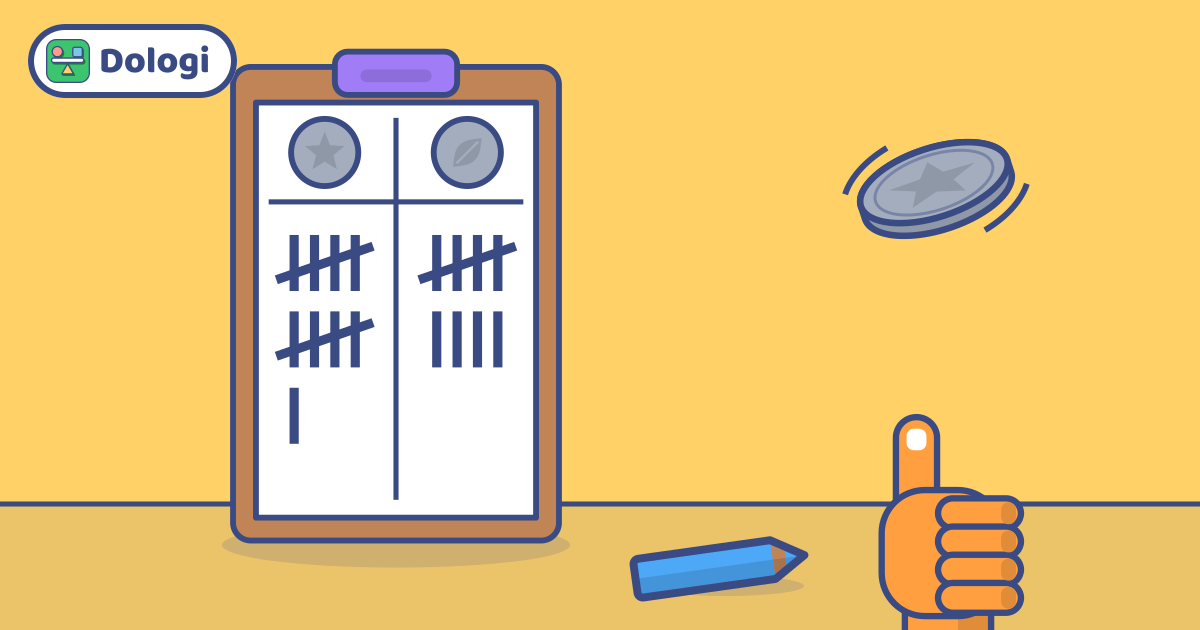
Take turns flipping and let your child mark each result with a tally line, crossing every group of four with a fifth line so the groups are easy to count. After 20 flips, count both columns and compare with the guess.
Results like 11 and 9, or 8 and 12, are completely normal. Here are a few numbers to share, worked out by counting every possible sequence of 20 flips:
- Getting exactly 10 heads and 10 tails happens less than 1 time in 5.
- Getting somewhere between 8 and 12 heads happens about 3 times in 4.
So "half" is what to expect on average, not what you'll get every time. Ask: "Did the coin do something wrong when it came out 12 to 8?" The answer is no. Small numbers of flips wobble.
Pool the whole family's flips
Now ask everyone at home to do their own 20 flips: parents, siblings, a visiting grandparent. Write each person's result in a table, then add them up.
| Person | Heads out of 20 | Share of heads |
|---|---|---|
| Child | 11 | 55% |
| Mom | 8 | 40% |
| Dad | 13 | 65% |
| Sibling | 9 | 45% |
| Grandma | 10 | 50% |
| Everyone | 51 out of 100 | 51% |
On their own, the results spread from 40% to 65%. Together they come to 51 out of 100, very close to half. That's the big idea: the more flips you put together, the closer the share of heads tends to get to one half.
One surprising detail for older kids: the number of extra heads doesn't shrink. In 100 flips, being 3 or 4 away from 50 is ordinary, and exactly 50 heads happens less than 1 time in 12. It's the share, heads divided by total flips, that settles down.
"It's due for heads": a coin has no memory
After a run of tails, many people feel heads is "due". But the coin doesn't know what happened before. Each flip is a fresh start with the same two sides, so the chance of heads is still one half, even after five tails in a row.
Streaks are also more common than most people expect. In 20 flips, a run of at least 4 of the same side in a row happens about 3 times in 4. A run of 5 or more happens in almost half of all 20-flip games.
Two ways to explore this:
- Check the tally. Look through your family's results in the order they were recorded. Every time three of the same side came up in a row, write down what came next. With enough flips, it splits roughly evenly.
- Real or made up? One person secretly flips a coin 20 times and writes down the sequence. Another person invents a sequence of 20 without a coin. Then compare. A made-up list often switches sides too often and avoids long runs; a real one usually has at least one run of 4.
Two coins: three results, not equally likely
Ask: "If we flip two coins at once, what can happen?" Most children list three results: two heads, two tails, or one of each. Then ask: "Are those three equally likely?" Write down the prediction and flip both coins 40 times, tallying the three results.
Usually "one of each" comes up about twice as often as either of the others. To see why, use two different coins, say a quarter and a penny, and list every way they can land:
| Quarter | Penny | Result |
|---|---|---|
| Heads | Heads | Two heads |
| Heads | Tails | One of each |
| Tails | Heads | One of each |
| Tails | Tails | Two tails |
There are four ways, all equally likely, and "one of each" takes two of them. So out of 40 flips you'd expect about 10 double heads, 20 mixed and 10 double tails, give or take.
A challenge for 10- to 12-year-olds: flip three coins. What's the chance all three match? A tempting argument says: "Two of them always match, and the third has a 1 in 2 chance of matching them, so it's 1 in 2." List all 8 ways three coins can land and count: only 2 have all three the same, so the chance is 2 in 8, or 1 in 4. The argument went wrong because you can't know in advance which two coins will match.
The habit of listing every case also helps in puzzles. In Dologi's Math topic, the Equal parts puzzle asks children at some levels to tap every shape that is exactly half colored, and the hint reminds them that 1 of 2 parts is the same as 2 of 4. That's the same idea as 10 out of 20 or 50 out of 100: different numbers, the same half.
In short
- Ask for a guess, flip a coin 20 times on a towel and keep a tally: results like 11 to 9 are normal, and exactly 10 to 10 is less common than most people think.
- Pool everyone's flips in a table: the more flips you add up, the closer the share of heads tends to get to one half.
- A coin has no memory: after a run of tails, heads is still a 1 in 2 chance, and runs of 4 in 20 flips are common.
- With two coins, list the four ways they can land: "one of each" is twice as likely as two heads.
Read more: Is this game fair? Rock, paper, scissors, drawing straws and two dice for ages 8 to 12, Probability for young children: certain, possible or impossible?