"Dad, do you have the crab from the sea animals?" Dad looks at his cards, sighs, and hands it over. Your child lays down four cards, fish, crab, starfish and octopus: a full set! Whoever collects the most sets of four wins.
Card games built on collecting sets are played in lots of families (some know a version as Go Fish or Happy Families), but making your own is more fun: your child draws the cards and picks the themes. It suits kids aged 5 to 10, with two to five players. Kids practice sorting (which group does this card belong to?), asking clearly, and remembering what other players just asked for, because their questions give away which groups they're holding.
Making the deck
You need: about 32 pieces of card the same size (8 groups × 4 cards) and colored pens. For a 5-year-old, 5 groups (20 cards) is plenty.
Choose themes where each group has four clear members nobody can argue about:
| Group | Four cards |
|---|---|
| Fruit | apple, banana, orange, pear |
| Sea animals | fish, crab, starfish, octopus |
| Vehicles | car, bike, train, plane |
| Breakfast | cereal, toast, pancakes, eggs |
| Bugs | bee, butterfly, ant, ladybug |
| School things | pencil, ruler, eraser, backpack |
| Weather | sun, rain, wind, cloud |
| Instruments | drum, guitar, flute, trumpet |
A few drawing tips make the game much easier:
- A big main picture in the middle, with the name written underneath (great for kids learning to read).
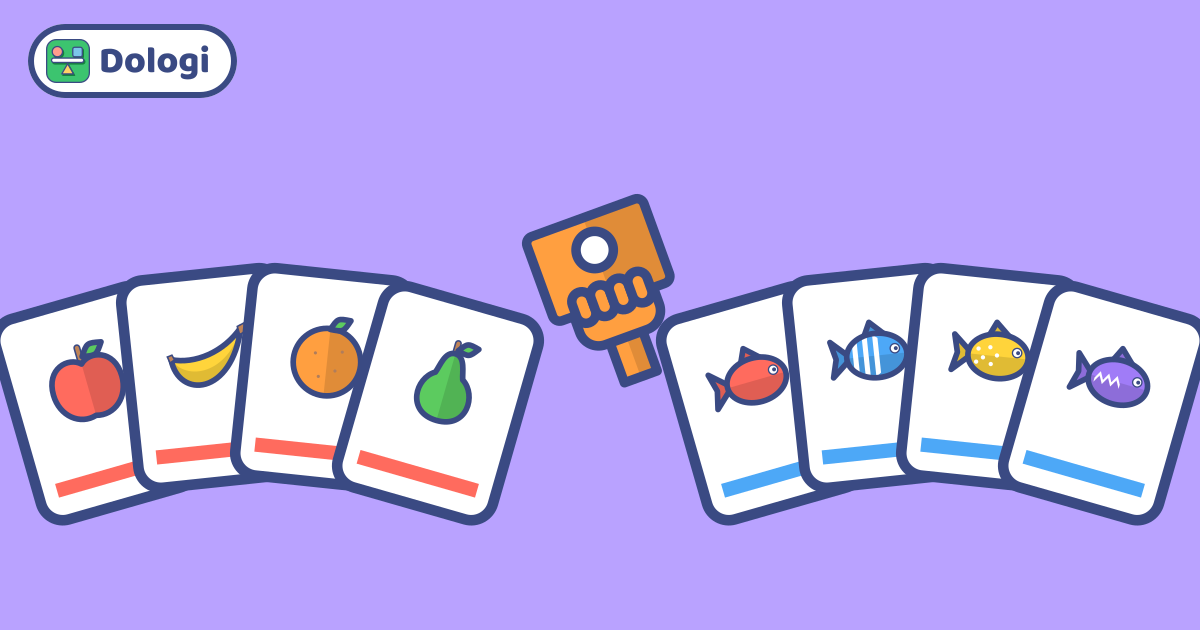
- One border or bottom-stripe color per group: red for fruit, blue for sea animals. One glance at the color tells you the group.
- List all four members in a corner of every card, circling the name of that card. That way your child knows exactly which cards are still missing.
How to play
- Shuffle and deal 6 cards each (two or three players) or 5 each (four or five players). Put the rest face down in a pile in the middle.
- On your turn, choose one player and ask for one specific card: "Mom, do you have the orange?" You may only ask for a card from a group you already hold at least one card of.
- If the player has it, they must hand it over, and you ask again, anyone you like.
- If they don't, they say "Nope," you draw a card from the pile, and play passes to your left.
- When you collect all four cards of a group, lay them face up in front of you.
- If your hand runs out while the pile still has cards, draw one and keep playing. Once every group has been laid down, whoever has the most sets wins.
Bonus rule for fun: if you draw the exact card you just asked for, show everyone and take another turn.
Asking clearly
The game is a chance to practice asking a complete, polite question:
- Say the player's name and look at them.
- Name the card and its group: "the crab from the sea animals," not just "have you got that one?"
- Answer honestly: hand it over if you have it, say "nope" if you don't. Grown-ups set the example, even when giving up a card they badly need.
If a question is vague, give a gentle nudge: "Which card do you want? From which group?" After a few games, kids say the whole sentence on their own.
Remembering who holds which group
This is where memory comes in. Every question gives something away:
- If Mom asks for "the orange," she definitely holds at least one fruit card. Next time you need fruit, asking Mom is smart.
- If you just gave your brother the "butterfly," you know for sure he has it.
- If someone asks for a card and hears "nope," the person asked doesn't have that card.
A tip for younger kids: after every question someone else asks, whisper one short reminder: "Mom has fruit." Older kids can try to keep two or three facts in mind at once. Helping kids remember has more ways to make things stick.
An easy version for 5-year-olds
- Open hands: everyone lays their cards face up on the table. Your child doesn't have to remember anything, just practice sorting and asking: "I can see you have the banana, Dad. Can I have it?"
- Fewer groups: 4 or 5 familiar groups on themes your child loves.
- Play on the same team: the whole family works together to complete every set within 15 turns, then tries to do it faster next time.
Variations
- Sets of three: groups of only three cards make quicker games, good for little ones.
- Tricky groups: four kinds of birds, four kinds of leaves, four countries' flags... Older kids have to look closely to tell them apart.
- Your child invents a group: every time you add cards, let your child create a new group and explain "why these four belong together."
- No color clues: leave off the colored stripes so kids have to work out each card's group themselves.
If your family already enjoys card games, Crazy Eights for kids is another easy one to try.
The Memory topic in Dologi has a puzzle called What's in the sack?: "Watch the sack closely. At the end, tap every fruit that is in it." Its hint is to say each fruit's name out loud as it flies in, a lot like the whispered "Mom has fruit" reminder above.
In short
- Draw 5 to 8 groups of four cards, give each group its own color, and list all four members in a corner of each card.
- Take turns asking one player for one specific card from a group you already hold; hand it over if you have it, draw if you don't.
- Practice full, polite questions and honest answers; remember who asked for what to work out who holds which group.
- Five-year-olds play with open hands and fewer groups; older kids try tricky groups and invent new ones.
Read more: Memory and focus games, Crazy Eights for kids