Your child gets the sum right when it's written across, but gets it wrong as soon as it's set out in columns. Look closely at the workbook and the mistake usually isn't in the adding at all, but in where the digits are written: the shorter number drifts to the left, or the carry gets forgotten. These are position mistakes, so the most effective fix is a position tool too: grid paper. This article is for children aged 7 to 10.
Two common mistakes
Misaligned columns. Your child sets out 246 + 37 but writes 37 under the 24, starting from the left the way we write words:
- Misaligned, it becomes 246 + 370, giving 616.
- Lined up properly (7 under 6, 3 under 4), it gives 283.
Forgotten carry. Your child works out 58 + 27: 8 plus 7 is 15, write 5. In the tens column, 5 plus 2 is 7, forgetting to add the carried 1, giving 75 instead of 85.
The two mistakes look different but share a root: your child doesn't yet see clearly which column each digit belongs to, or that the carry is a ten moving into the tens column, not just a number to keep in mind.
Why children misalign digits
- Habits from writing words: words start on the left, so children line up the shorter number on the left.
- Lined paper has no columns: digits come out big and small with uneven gaps, and after a few rows the columns lean.
- Shaky place value: your child can say "two hundred forty-six" but hasn't yet seen that the 6 in the ones column and the 7 in 37 must share a column.
Fixing it with grid paper: five steps
- One digit per square. Use squared paper (about 1 cm squares for younger children). Each square holds one digit, never spilling into the next.
- Color the columns. Lightly shade three columns: hundreds yellow, tens blue, ones green. Write H, T, O at the top at first.
- Write numbers from the ones column first. For 37, put the 7 in the green square first, then the 3 in the blue square to its left. The shorter number lines up on the right automatically.
- Keep a row of squares for carries. Use the top row, above the first number, for small carried digits. Some schools write carries below the answer line instead; follow whatever your child's school does. Later your child can carry in their head, but writing it down at first stops it being forgotten.
- Say it out loud. "6 plus 7 is 13, write 3, carry 1 into the tens. 4 plus 3 is 7, plus the 1 makes 8, write 8. Then 2." The answer is 283.
Removing the supports gradually
The goal is for your child to line up columns on ordinary paper. Take away one thing at a time:
| Stage | Paper | Color | Carries |
|---|---|---|---|
| First week | 1 cm grid | All three columns shaded, labels on top | Written in their own row |
| Second week | 1 cm grid | Only a color band at the top | Written small |
| Third week | Smaller grid | No color | Written small or carried mentally |
| After that | Ordinary paper | No color | Carried mentally, whispering "carry 1" |
If the columns drift again when a step is removed, go back to the previous stage for a few days. That's perfectly fine.
Checking with an estimate
Before calculating, ask: "Roughly what will the answer be?" 246 + 37 is about 250 + 40, so around 290. An answer of 616 means something's wrong, usually misalignment. An answer of 273 or 293 is close but worth checking the carry.
Try this one: 305 + 48. Estimate about 350. In columns: 5 plus 8 is 13, write 3, carry 1; 0 plus 4 is 4, plus 1 makes 5; then 3. The answer is 353, matching the estimate.
When to check understanding
If your child still mixes up columns after a few weeks with grid paper, place value may not be secure yet. Go back to sticks or ten-blocks: bundle ten sticks into a ten, make 246 with sticks, add 37 more, and watch ten loose sticks become a new bundle. That's exactly what carrying is.
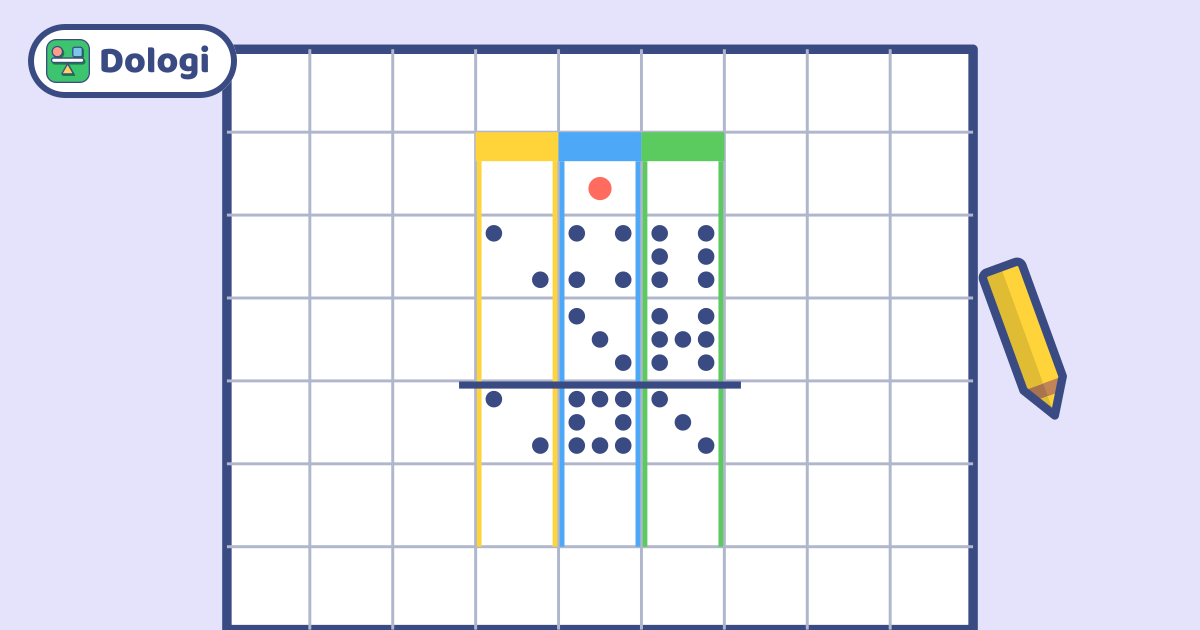
The Focus topic in Dologi has a puzzle called Secret picture: "Paint each square with the color under its number in the code key." Your child has to find the right row and column on a grid, the same skill that keeps digits lined up in column addition.
In short
- The two common mistakes are misalignment (246 + 37 becomes 616) and a forgotten carry (58 + 27 becomes 75); both are position mistakes.
- Grid paper: one digit per square, three colored columns, write from the ones column first, a row for carries, say each step aloud.
- Remove the color and the squares over a few weeks, stepping back if the columns drift.
- Estimate before calculating so your child can spot an answer that makes no sense.
Read more: Tens and ones: teaching place value with bundles of sticks, Rushed math mistakes: building the habit of checking