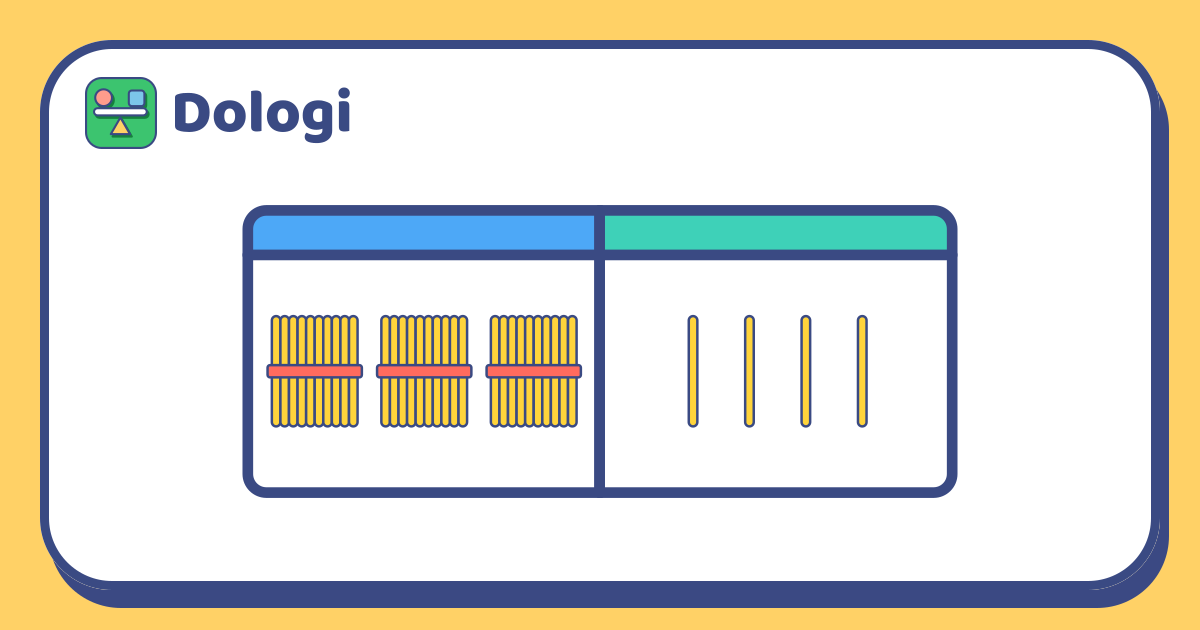
Your child can count to fifty, yet writes "thirty-four" as 304. Or reads 31 and 13 as if they were the same number. These mix-ups are very common around the ages of 6 to 8, and they share one cause: the child does not yet see that a digit's value depends on where it sits.
This idea is called place value. In 34, the 3 is not three, it is three tens: thirty. The good news is that place value is easy to make real, with nothing more than a pile of sticks and a few rubber bands.
Why the same digit can mean different things
Before place value clicks, a two-digit number is just two symbols next to each other. Your child hears "thirty-four", writes down "30" for the first part and "4" for the second, and ends up with 304. From their point of view, they wrote exactly what they heard.
What they need is a picture behind the digits:
- The right-hand digit says how many single things (ones).
- The left-hand digit says how many groups of ten (tens).
So 34 means three groups of ten and four more. And 43 has the same digits but means four tens and three ones, which is a different amount. Children understand this best when they can see and hold those groups of ten.
Making bundles of ten
Craft sticks, ice-lolly sticks or drinking straws cut in half all work well. You also need a few rubber bands or hair ties.
- Give your child a pile of loose sticks (say, between 20 and 40). Ask them to guess how many there are.
- Count them together, but every time you reach ten, stop and fasten those ten with a band.
- At the end, look at what you have: "Three bundles and four loose sticks."
- Now count the bundles in tens: "ten, twenty, thirty", then the loose ones: "thirty-one, thirty-two, thirty-three, thirty-four."
Let your child check that a bundle really has ten inside by opening one and counting. That trust matters: later they will count a bundle as "ten" without opening it, just like counting on in addition.
A place value mat on paper
Draw a line down the middle of a sheet of paper. The left side is for bundles (tens), the right side for loose sticks (ones). This simple mat turns the sticks into a written number.
- Build my number. You say or write a number, for example 52. Your child puts five bundles on the left and two sticks on the right.
- What did I build? You place bundles and sticks, your child writes the number under each side.
- Same digits, different numbers. Build 25 and then 52 next to each other. Which one has more sticks? Why, when they use the same two digits?
- Empty side. Build 40: four bundles and no loose sticks. Ask your child how to write "nothing on this side". This is where the zero in 40 comes from.
Keep the mat for several weeks. Children return to it more easily when it stays on the table or in a drawer they can reach.
Trading ten loose sticks for a bundle
Place value only works because you can always swap ten ones for one ten. A dice game makes this swap feel natural.
- Each player has a mat. Take turns rolling a die and taking that many loose sticks.
- As soon as you have ten or more loose sticks on the right, bundle ten of them and move the bundle to the left.
- The first player to reach five bundles wins.
During the game, ask: "How many do you have now?" Your child reads their mat: "Two bundles and seven sticks, so twenty-seven." After a few rounds, you can play backwards: start with five bundles and give sticks back each turn, opening a bundle when there are not enough loose ones. This is the same idea that later helps with subtraction where a ten has to be broken up.
Common mix-ups and how to help
| What your child does | What helps |
|---|---|
| Writes 34 as 304 | Build 34 on the mat, then write one digit under each side. Only two places, so only two digits |
| Mixes up 13 and 31 | Build both side by side and compare: one bundle and three sticks, or three bundles and one stick |
| Thinks 40 and 4 are nearly the same | Build both. Four bundles against four sticks shows how big the difference is |
| Counts every stick one by one, even in bundles | Let them check a bundle again, then encourage counting bundles in tens: "ten, twenty, thirty" |
When two-digit numbers feel easy, ten bundles can be held together with a bigger band to make one hundred. Your child will see the same pattern again: ten ones make a ten, ten tens make a hundred.
Every child gets there at their own pace, and the ages here are only a rough guide.
In short
- Place value means a digit's value depends on its place: in 34, the 3 stands for three tens.
- Bundles of ten sticks make tens something your child can see, hold and count in tens.
- A two-sided paper mat links the sticks to written digits, including zero when one side is empty.
- Trading ten loose sticks for a bundle in a dice game builds the swap that later helps with adding and subtracting.
Read more: What does a thousand look like? Helping children picture big numbers