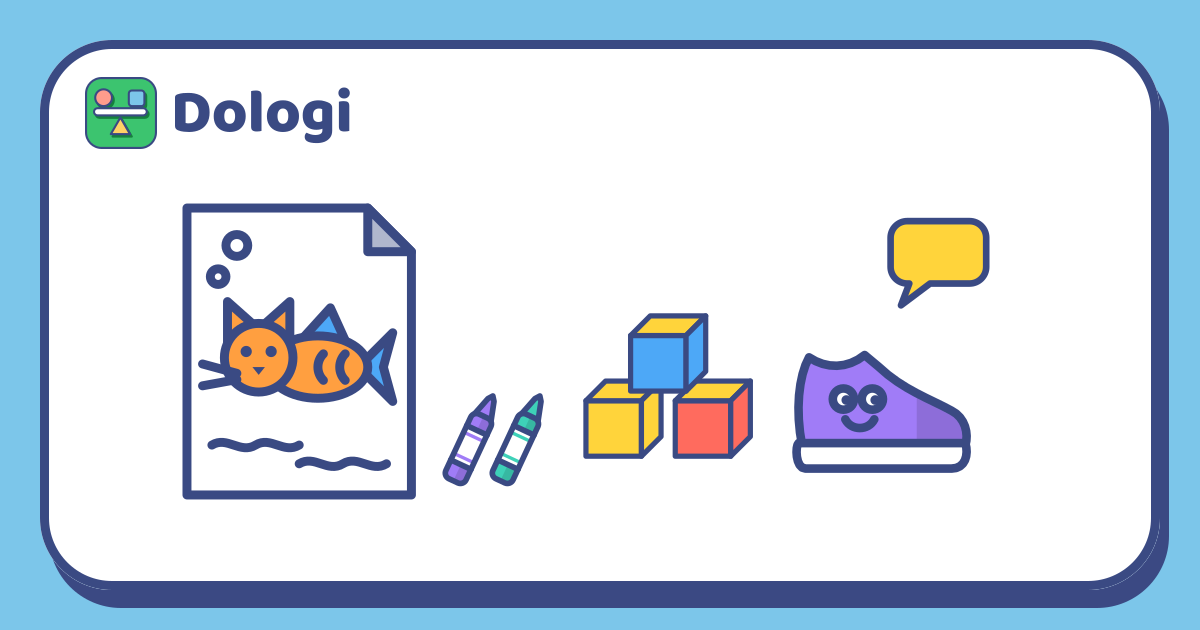
"Go and draw something." A minute later: "What should I draw?" Then the pencil goes down, or your child draws the same house they always draw. This isn't laziness, and it doesn't mean your child lacks imagination. "Anything you like" is one of the hardest briefs there is, for adults too.
This article explains why a short prompt helps your child get started, what makes a good prompt, a set of one-sentence prompts in three groups (draw, build, tell) and a simple way to keep them going all week.
Why "anything you like" is so hard
A blank page has no starting point. Your child has to choose a subject, a size, a place to begin and a story all at once, and when there are too many choices, the easiest one is often to choose nothing.
A one-sentence prompt removes a few of those choices so your child can start straight away. "Draw an animal that is half cat, half fish" already decides the subject but leaves plenty open: which half goes where, whether it lives in water or on land, what it eats, what it is called. Two children given the same prompt still make two completely different pictures.
Small limits help too. "Build a house using only five things" makes your child think harder about each object than "build whatever you want".
What makes a good prompt
| A good prompt is | What that means | Example |
|---|---|---|
| Short | One sentence, easy to remember | "Draw a machine that tidies your toys." |
| A little odd | Something that doesn't exist yet | A pair of shoes that can talk |
| Limited | One small rule that sparks ideas | Only five things, only three colors |
| Open | No single right answer | "Where would an umbrella fly to?" |
Prompts that are too vague ("draw something nice") give your child nothing to hold on to. Prompts that are too narrow ("draw a red cat sitting on a chair") turn into copying instructions.
Drawing prompts
The ages are rough guides. Younger children answer with a scribble and a story; older ones add detail, labels or a comic strip.
| Prompt | Age | Make it harder |
|---|---|---|
| Draw an animal made from two animals: half cat, half fish | 4–12 | Give it a name and a home |
| Draw a picture using only circles | 4–8 | Only circles and three colors |
| Draw a machine that does a job you dislike | 5–12 | Show how it works, step by step |
| Draw the weather on a strange planet | 6–12 | Draw what people there wear |
Building prompts
Building uses whatever is at hand: blocks, cushions, cardboard boxes, cups, pegs. Put away anything sharp or fragile first, and agree on where building is allowed.
| Prompt | Age | Make it harder |
|---|---|---|
| Build a house for an ant using five things from this room | 4–10 | It needs a door and a bed |
| Build the tallest tower you can without blocks | 5–12 | Only ten objects, no tape |
| Build a bridge a toy car can drive across | 5–12 | It must hold a full cup of water |
| Build a home for the cat-fish you drew | 6–12 | It needs both water and a dry spot |
Storytelling prompts
Stories can be told out loud, acted out, drawn as a comic or, for older children, written down. Your child can tell the story to you, to a toy or to a grandparent on the phone.
| Prompt | Age | Make it harder |
|---|---|---|
| Tell a day in the life of a pair of talking shoes | 4–12 | Tell it from the left shoe's point of view |
| The sock that got lost: where did it go? | 4–10 | Add a friend it meets on the way |
| What would happen if the umbrella could fly? | 5–12 | It can only fly when it rains |
| Start with: "This morning, the door wouldn't open…" | 8–12 | The ending must surprise us |
A prompt of the week on the fridge
A routine that works for many families:
- Monday: write or draw one prompt on a card and stick it on the fridge. For children who can't read yet, a quick sketch is enough: a cat and a fish with a plus sign between them.
- During the week: anyone can answer the prompt, whenever they have time. Five minutes is fine. Adults take part too.
- Weekend: everyone shows what they made and tells one thing about it.
- Your child's turn: every few weeks, your child writes the prompt for the whole family. Making up a prompt is creative work in itself: your child has to think about what is fun, what is too easy and what is too hard.
Keep a jar or an envelope of prompts that worked, so on a bored afternoon your child can draw one out.
No marks for pretty or ugly
The prompt is about ideas, not skill. If your child expects a verdict ("pretty", "ugly", "wrong"), they will stick to safe pictures they already know how to make.
- Describe what you see: "Your cat-fish has really long whiskers."
- Ask about their choices: "Why did you put the fins on its back?"
- Let the work be unfinished: a story without an ending or a wobbly bridge is still an answer.
- Never compare: not with a sibling, not with a classmate, not with yesterday's drawing.
In Dologi, the Creative corner has a Drawing board where your child can draw freely, with no scores and no stars. When they don't know what to draw, the Drawing ideas list offers a few ideas to start from. It's one more place to practice starting from a small prompt, not a replacement for paper, crayons and stories told together.
In short
- "Draw anything" is hard because a blank page has no starting point; a one-sentence prompt gives your child somewhere to begin.
- A good prompt is short, a little odd, has one small limit and no single right answer.
- Rotate drawing, building and storytelling prompts, and adjust the difficulty to your child's age.
- Put a prompt of the week on the fridge, let your child write some of the prompts, and describe their work instead of judging it.
Read more: Creative thinking: helping children find more than one way, Storytelling with homemade picture dice: roll three, tell one story