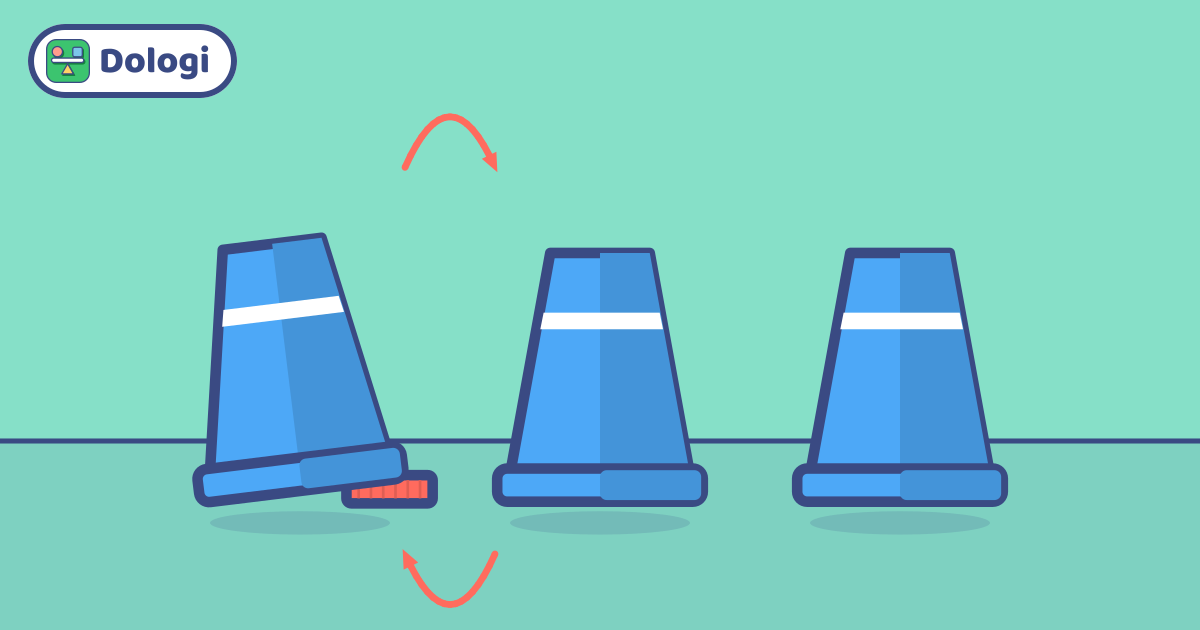
Three upside-down cups, a bottle cap hidden under one of them. You swap the cups around, your child follows along and points: "It's under this one!" It's simple enough to set up while dinner is cooking, yet it holds a 4 to 7 year old's gaze better than many other games.
What it trains is visual tracking: keeping your eyes on one moving object among identical ones without getting distracted. Kids use the same skill to follow a ball, a line of text when reading, or a teacher moving around the classroom.
What you need
- Three identical cups you can't see through: colored plastic or paper cups. Skip glass.
- One small object: a bottle cap, a large wooden bead, a scrunched-up ball of paper. If there's a baby under 3 in the house, pick something too big to swallow and put it away afterward.
- A flat table, with your child sitting opposite you, eyes level with the cups.
How to play
- Line up three upside-down cups. Show your child the object, then cover it with one cup.
- Swap two cups by sliding them along the table, not lifting them.
- Stop and ask: "Where's the bottle cap?" Your child points to a cup.
- Lift the cup they chose. Right? Make the next round a little harder. Wrong? Lift the cup with the object and play again at the same level.
A quick note: this is a watching game, not a magic trick. Never palm the object or sneak it out. Your child needs to trust that it's always under one of the cups, and that looking carefully is enough.
Levels
| Level | How to play | Good for |
|---|---|---|
| 1 | Two cups, one swap, very slow | 4 year olds just starting |
| 2 | Three cups, two or three swaps, slow | 4–5 |
| 3 | Three cups, four or five swaps, getting faster | 5–6 |
| 4 | Four cups, sometimes swapping two that aren't side by side | 6–7 |
| 5 | Two objects in different colors, asked after the swaps: "Where's the red cap? Where's the blue one?" | 6–7 |
Increase one thing at a time: more swaps, or more speed, or more cups, never all at once. Aim for your child getting about seven or eight out of ten right; if they get them all, step it up, and if they miss a lot, step back.
Tracking tips
- Watch the cups, not the hands: your hands move a lot and easily pull eyes away.
- Pick one cup and stick with it: only the cup with the object matters; the other two don't.
- Use a finger for little ones: a 4 year old can follow the cup with a pointing finger during the swaps; once they're used to it, drop the finger and use only their eyes.
- Whisper the position: "left... middle... middle..." helps hold the cup's place in mind as the speed goes up.
- Sit up and face the cups: leaning or glancing away for a second is enough to lose track.
After a wrong guess
- Replay the swaps slowly: "Watch: this cup went here, then here." Your child sees where they lost it.
- Drop down a level and play a few easy rounds to rebuild confidence.
- Praise the attention, not just the result: "You followed it right to the last swap, you were only one off."
- Stop when eyes get tired: five to ten minutes is plenty for young kids. My child can't sit still for five minutes has more on how long is reasonable.
Swap roles: your child does the shuffling
After a few rounds, hand the cups over. Kids love fooling their parents, and shuffling trains fine motor control, planning and sticking to the rules (slide only, no lifting, no hiding things in your hand). Guess out loud as you go: "I saw the left cup go to the middle, then to the end... I'll pick this one." Your child hears how a grown-up keeps track, then uses the same trick on their next turn.
With older kids, it's also a chance to talk about the street version where people bet money on finding the ball: the person shuffling usually hides it in their hand, so players can't win. At home we play to train our eyes, and nobody bets anything.
Variations
- Rattling cups: instead of a bottle cap, hide a small box with a few grains of rice in it; after the swaps, your child gently shakes each cup and listens. The game switches from looking to listening.
- The long way round: instead of swapping, slide the cup with the object on a loop around the table before stopping.
- Two guessers: both point at a cup at the same time on "one, two, three," so nobody copies.
- More cups, fewer objects: five cups, two objects, fewer swaps, but two things to follow at once.
The Focus topic in Dologi has a puzzle called Follow the cup: "Watch the cups swap places. Which cup is the star under now?" Its hint is the same as the tip above: the star goes with its cup, so follow just that one cup.
In short
- Three identical cups and one small object; slide the cups to swap them while your child follows and points.
- Never hide the object in your hand; your child needs to trust it's always under a cup.
- Raise one thing at a time: number of swaps, speed, number of cups, then two objects; aim for seven or eight right out of ten.
- Teach your child to watch the cups, not the hands, and to stick with one cup; then let them do the shuffling.
Read more: Find and cross out sheets, My child can't sit still for five minutes