Your child hunts for the missing sock in the laundry basket, looks for their name on the class list, or picks out a favorite book from a full shelf. Each of these needs the same skill: noticing the thing you are looking for and ignoring everything else. This is often called selective attention.
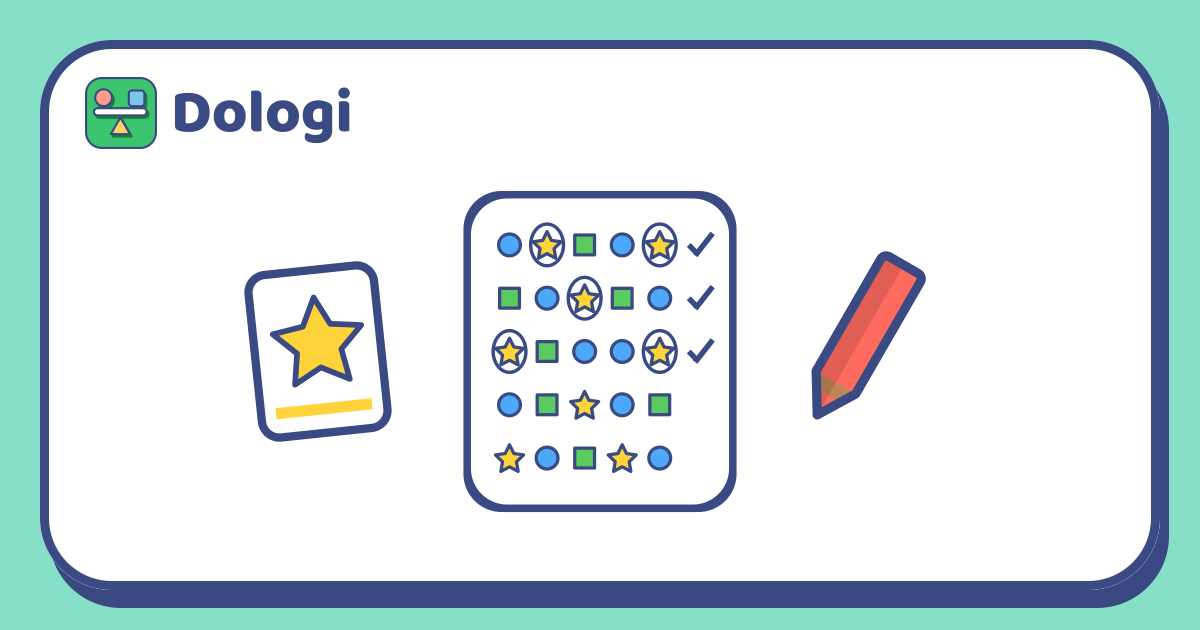
There is a very simple way to practice it at home: a find-and-cross-out sheet. You draw a page full of small mixed pictures, and your child finds and circles every one of a kind, for example every star. This article shows how to make a sheet in a few minutes, how to play so your child gets used to scanning row by row and checking their own work, and how to make it gradually harder for children aged roughly 5 to 10.
What is selective attention?
Selective attention is the ability to keep your eyes and mind on what you need while everything else is still around. When reading, your child has to look at the word they are on. In math, they need to notice that a plus sign is not a minus sign. When searching for something, they need to sweep through a whole pile without missing anything.
A find-and-cross-out sheet practices exactly this. The target is clear, the other pictures are what to ignore, and at the end your child can count to find out whether they found them all. You need no toys and no screens, just paper and a pencil.
Draw a sheet in five minutes
You need a sheet of paper, a pencil for your child and a colored pen for you.
- Pick two or three easy shapes: circles, squares, stars, triangles, smiley faces. One of them is the target.
- Draw them in rows from left to right, evenly spaced. For younger children use big shapes and few rows; for older children use smaller shapes and more rows.
- Scatter the target shape across the rows, with no fixed rhythm, roughly one in five of all the shapes.
- Note how many targets there are on the back of the sheet, using dots or tally marks, so your child can check later.
- Draw a small sample card showing only the target shape and put it next to the sheet.
| Age (rough guide) | Rows | Kinds of shape | Example target |
|---|---|---|---|
| 5–6 | 3–4 | 2 | Every star |
| 7–8 | 5–6 | 3 | Every smiley face |
| 9–10 | 7–8 | 3–4, including look-alikes | Only the blue triangles |
Draw two or three sheets at once, ready for next time.
How to play: scan row by row, then count to check
Show your child the sample card and ask, "What are you looking for?" Once they can say it, off they go.
- Scan each row from left to right, as when reading a book. Your child can rest a finger or a strip of paper under the row they are on, so their eyes do not jump around.
- Circle each target with the pencil.
- Put a check mark in the right margin at the end of each row before moving down. The check marks show how far they have got.
- When the page is finished, count the circles and turn the sheet over to compare with your number.
If the numbers do not match, avoid "that's wrong". Try "one star is still hiding", so your child goes back and checks row by row again. This self-checking step is what helps children get used to working carefully instead of rushing to finish. If your child cannot yet count reliably, count together, touching each circle.
You can time it if your child enjoys that, but the goal is to find them all, not to be fast.
Making it harder
When a sheet starts to feel easy, change one thing at a time:
- Look-alike shapes: five-pointed stars mixed with six-pointed ones, smiling faces with plain faces, circles with ovals. Your child has to look closely at the details.
- Two conditions at once: circle only the blue triangles, and skip red triangles and blue circles. This is a big step up, so it suits older children.
- Two jobs on one page: circle every star and put a cross through every square.
- A busier page: smaller shapes, closer together, more rows.
- Swap roles: your child draws a sheet for you and writes the answer on the back. To make a sheet for someone else, they have to think about which shapes are easy to mix up.
For children who can read and recognize numbers, the sheet can be a page of letters where they find every "a", or a page of digits where they find every 7.
Keep it light
A find-and-cross-out sheet is a game, not a test. A few tips so your child wants to play again:
- One or two sheets at a time, and stop before your child gets tired.
- Praise the method, such as "you checked every row so carefully", rather than speed or cleverness.
- Do not compare your child with siblings or friends. Comparing with their own sheet from last week is enough.
- How long children can focus varies from child to child, and changes with age and time of day. If you are worried about your child's attention, talk to their teacher or doctor.
In Dologi, the Focus topic has "Tap them all" puzzles: your child searches a group of objects and taps every one that matches the request, and at higher levels the request adds a second condition. It is the same job as the sheet on the table, in a different form for a change of pace.
In short
- A find-and-cross-out sheet is a page of small mixed pictures where your child finds and circles every one of a kind; it practices selective attention.
- Making one takes only paper, a pencil and a few minutes; write the answer on the back.
- Scan each row from left to right, check each finished row, and count at the end to check.
- Make it harder with look-alike shapes, two conditions and busier pages, then let your child draw a sheet for you.
Read more: Spot the difference: games that train children's observation skills, My child just guesses: teaching children to stop and check