"Where does the sun go at night?" Most children ask this at some point, and the honest answer sounds strange: the sun doesn't go anywhere. We are the ones who move. The ground under our feet is slowly turning, carrying us into the light and out of it again.
The ground feels perfectly still, so this is hard to believe from words alone. It is much easier with an orange in your hand. Here is a small model of the Earth, the sun and the moon made from kitchen things, for children aged about 4 to 10. As in any good experiment, ask for a prediction before each turn, then look together.
What you need
- An orange, or any round fruit or ball. This is the Earth.
- A wooden skewer or a pencil pushed straight through the middle. An adult does the pushing; the skewer is the line the Earth turns around.
- A small sticker or a dot of pen on the orange: this is your home.
- A flashlight or a lamp without a shade. This is the sun.
- A small ball on a stick, or a ball of foil: the moon, for later.
- A dark room.
One rule for the whole session: the flashlight shines at the orange, never into anyone's eyes.
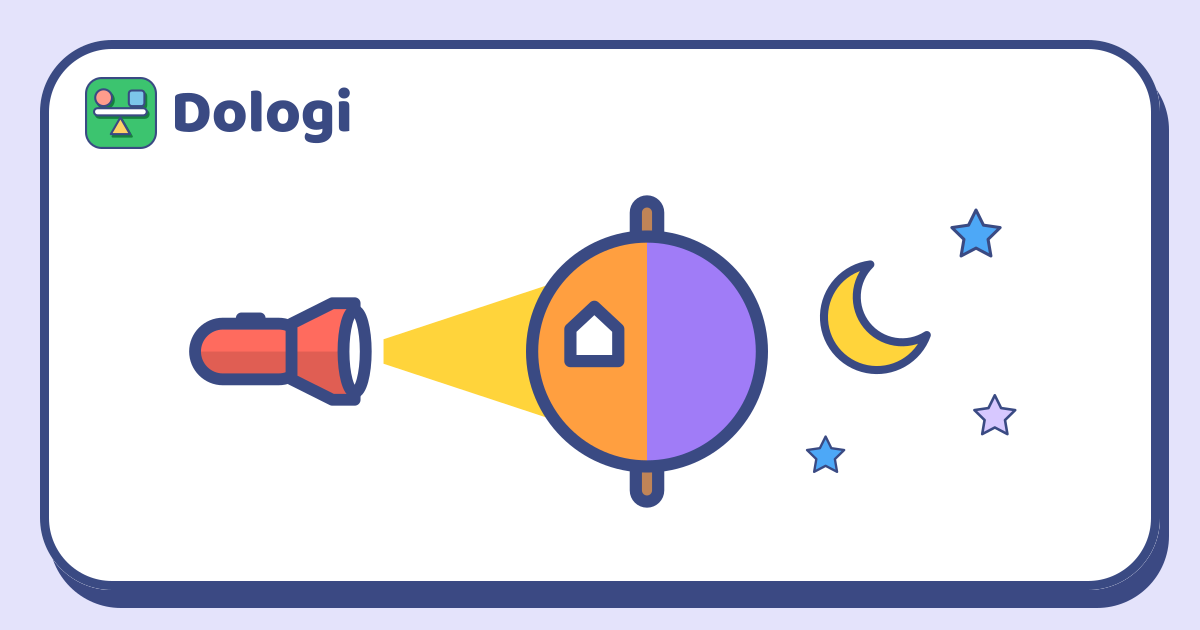
The orange Earth: day on one side, night on the other
Put the flashlight on a pile of books and point it at the orange, held upright by the skewer about an arm's length away. One half is bright, the other is dark. Ask: "If you lived on this side, would it be day or night?"
Now turn the sticker so it faces the flashlight. That is midday at your home. Before turning further, ask your child to predict what will happen to the sticker.
Turn the skewer slowly. Seen from the top of the skewer, turn it the opposite way to a clock's hands, like the real Earth.
| Where the sticker is | What it is like at home |
|---|---|
| Just coming out of the dark into the light | Sunrise, morning |
| Facing the flashlight | Middle of the day |
| Just leaving the light | Sunset, evening |
| On the far side, in the dark | Night |
The real Earth takes about a day to make one full turn, so day and night keep taking turns. Put a second sticker on the other side and ask: "When it is night at our home, what is it like here?" Day. It is never night everywhere at once, which is why a relative far away may be having breakfast while your child goes to bed.
Why the sun seems to move across the sky
If the sun stays still, why do we see it rise, climb and set? A small game shows it.
Put a lamp on one side of the room. Your child stands in the middle, facing away from it, and turns slowly on the spot, looking straight ahead. The lamp comes into view at one side, passes in front of them and disappears at the other. "Did the lamp move?" No, they did. As the Earth turns, the sun seems to travel across the sky, coming up in the east and going down in the west.
Keep the turning slow and stop before anyone gets dizzy. Outside, remember the most important rule: never look straight at the sun.
The moon: a ball that borrows light
The moon doesn't make its own light. It shines because the sun lights it up, just as the flashlight lights up the orange. And because the moon travels around the Earth, about once a month, we see different amounts of its bright side.
Try it like this:
- Leave one lamp on at the side of a dark room and switch everything else off.
- Your child holds the small ball on its stick at arm's length, a little above their head. Their head is the Earth, their eyes are us looking up.
- They turn slowly on the spot, keeping their eyes on the ball, and say what they see.
Facing the lamp, the ball looks dark: the bright side faces away from them. A quarter turn later they see half of it lit. With their back to the lamp, the whole ball shines: a full moon. In between, thin crescents and fat, almost-round shapes appear. If their head blocks the light, the ball goes dark for a moment. That is a small eclipse, and children love it.
Then watch the real moon for a few evenings, and in the daytime too. Draw its shape each time and see if your child can predict the next one.
Questions children ask
| Question | A short answer to try at home |
|---|---|
| Where do the stars go in the daytime? | Nowhere. The sun makes the sky so bright that we can't see them. Poke holes in a piece of card and shine the flashlight through it in a dark room: bright dots on the wall. Switch on the big light and they almost vanish. |
| Is the sun a star? | Yes, the closest one. The other stars are so far away that they look like tiny dots. |
| Why does the moon follow our car? | It is so far away that it seems to stay in the same place while the trees and houses nearby rush past. |
Being able to picture something from another place, like seeing the orange from the flashlight's side, is a real thinking skill. In Dologi's Space topic, the Seen from each side puzzles ask children to work out what a stack of cubes looks like from the front, from the right or from above, the same habit of imagining another viewpoint, in small steps.
In short
- Day and night happen because the Earth turns: the half facing the sun has day, the other half has night, and one turn takes about a day.
- An orange on a skewer and a flashlight in a dark room are enough to show it. Ask for a prediction before every turn.
- Turning slowly on the spot in front of a lamp shows why the sun seems to rise and set even though it stays still.
- A ball held up in a lamp-lit room shows why the moon changes shape. Never look straight at the sun.
Read more: Light and shadow experiments for kids: a flashlight, a few objects and a homemade sundial