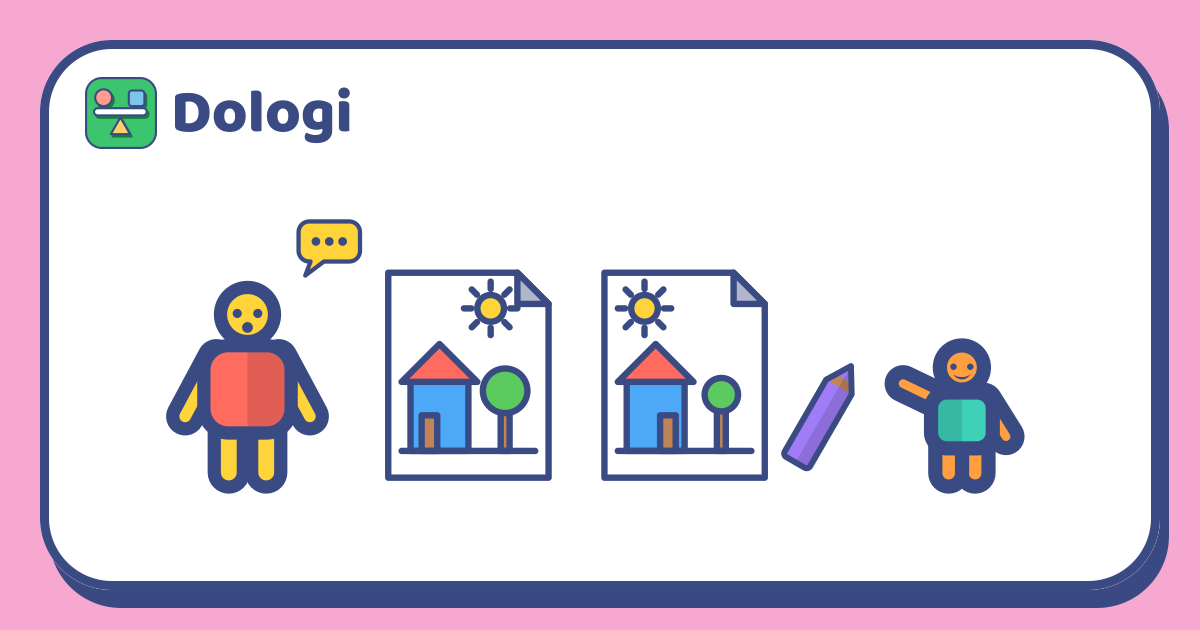
You say "draw a house" and your child draws a house. But what if you couldn't show them which house, and they had to draw it from your words alone? Where is the door? How big is the window? Is the sun on the left or the right?
That is the whole idea of describe and draw: one person looks at a picture and describes it, the other listens and draws without seeing it. At the end you put the two pictures side by side. It needs only paper and pencils, it is often very funny, and it practices two skills at once: listening carefully and explaining clearly. This article explains how to play, which pictures to start with and how to adjust the game for children aged roughly 4 to 12.
How to play
You need two sheets of paper, two pencils and a simple picture for the describer. The picture can be one you draw yourself before the game, or a small object such as a mug or a toy car.
- Sit so the drawer can't see the picture. Back to back works well, or face to face with a large book standing between you.
- The describer describes, the drawer draws. The describer says what is in the picture and where: "In the middle there is a big square. On top of the square there is a triangle, like a roof."
- No peeking and no pointing. Everything has to travel through words.
- Compare when you are done. Put the original and the new drawing next to each other and look at what matches and what doesn't.
A round takes five to ten minutes. Then swap roles, because each role trains something different.
Pictures to start with
The first pictures should be simple enough that a good description really is possible. Three to five shapes is plenty at first.
- Shapes in a row: a circle, then a square, then a triangle.
- A simple scene: a house with a door, a tree next to it and a sun in the sky.
- A face: round head, two eyes, a nose, a smile, maybe a hat.
- A pattern on a grid: draw a three-by-three grid on both sheets and color a few squares.
Leave out tiny details, writing and complicated shapes. A picture that is too hard turns a game into a frustrating test.
Levels by age
Ages here are only rough guides. Every child is different, so watch what works and move up or down a level.
| Age (approx.) | Picture | Rules |
|---|---|---|
| 4 to 5 | Two or three large shapes, colors named | A parent describes, the child draws. Questions allowed at any time. Use simple words: "on top", "under", "next to" |
| 6 to 8 | A simple scene with four to six parts | Take turns describing. The drawer can ask questions, but only after each part is finished |
| 9 to 12 | A detailed scene, a grid pattern or a picture with exact sizes | The drawer may not ask questions in the first round. In the second round, allow three questions and see how much better the drawing gets |
Younger children often describe their own picture in a way only they understand: "and then the thing over there." That is normal. You can help gently: "Over where? Near the top or near the bottom?"
What each role practices
The describer
Describing is harder than it sounds, and children quickly notice this when their drawing comes back looking nothing like the original. A few tips you can try together:
- Start with the big picture. "There is a house, a tree and a sun" gives the drawer a plan before the details arrive.
- Say where things are. Words like "top left", "in the middle" and "next to the door" do most of the work.
- Mention size and number. "A small window" or "three windows" says much more than just "windows".
- Avoid "here" and "this". The drawer can't see where you are looking.
- Go one step at a time. Give one part, wait until it is drawn, then give the next.
The drawer
The drawer practices listening to the end before starting to draw, keeping a few details in mind and turning words into a picture. Asking a good question is a skill too. "How big is the circle?" helps more than "What?" Encourage your child to ask about exactly the part they are unsure of.
Comparing without blame
Looking at the two drawings is the funniest part, and also the most useful one, as long as nobody feels at fault.
- Look for matches first. "The house is in the middle, just like the original!"
- Then find where the words got lost. Instead of "you drew it wrong" or "you explained it badly", ask: "Which word would have helped here?" Often it was a missing "small" or "left".
- Play another round with the same picture. The second drawing is usually much closer, and children can see how much better descriptions make a difference.
If you have more than two players, one person can describe for everyone. At the end you get several very different drawings of the same picture, which shows nicely that the same words can produce different images in different heads.
In Dologi, the Listening topic has a puzzle called "Listen and play back": your child hears a few notes and then plays the same white keys in the same order. Like the drawing game, it is about listening all the way to the end and then reproducing exactly what was heard.
In short
- One person describes a hidden picture, the other draws by listening alone, then you compare.
- Start with three to five simple shapes and make the pictures harder as your child grows.
- Describers learn to start with the big picture and say where, how big and how many. Drawers learn to listen to the end and ask good questions.
- Compare the drawings by looking for which word was missing, not who was at fault, then play the same picture again.
Read more: Listening skills for children: sound games to play at home, Drawing on backs: guessing a shape by feel, Teaching left and right, up and down, in front and behind: direction games for children