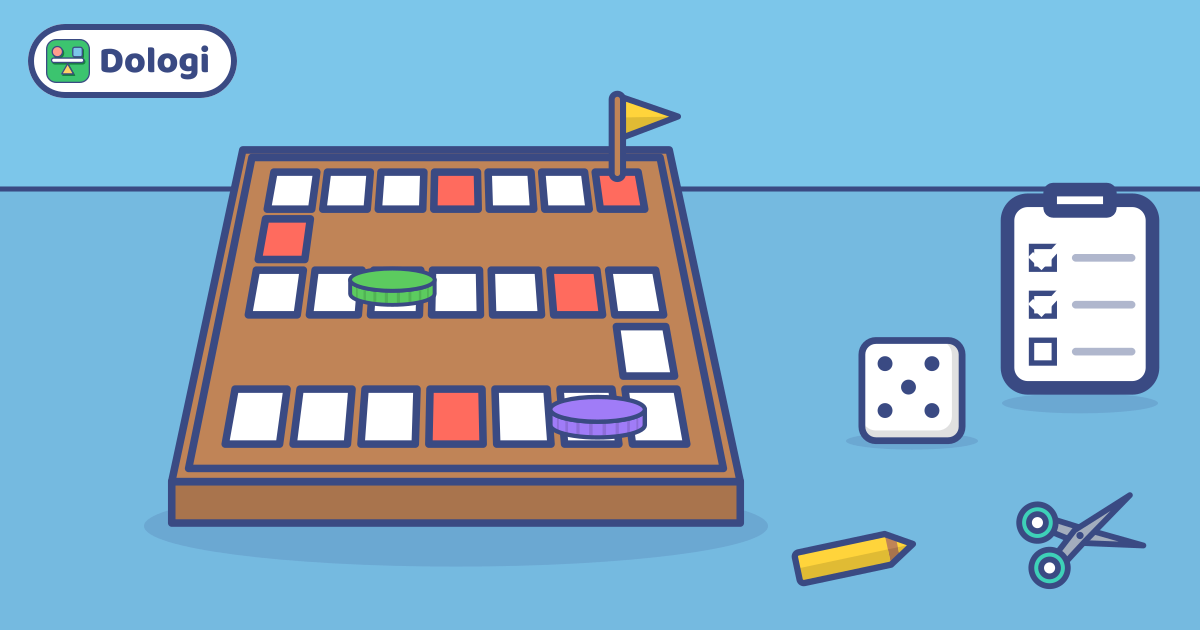
Sooner or later, most children try to change the rules in the middle of a game: "Now I get two turns!" Instead of arguing about it, you can turn that urge into a project. Designing a board game asks for exactly the thinking we want children to practice: imagining how a rule will play out, testing it for real, and changing it when it doesn't work.
This guide works for children from about 7 to 12; younger brothers and sisters can draw squares and be the first players. All you need is a cardboard box lid, a pen, bottle caps and a die. Plan on one afternoon to make the game and a few evenings to test and improve it.
Step 1: a theme and a goal
Start with something your child loves: a turtle trying to reach the sea, a rocket flying to the moon, a cat collecting fish on the way home. Then write the goal in one sentence, for example "The first turtle to reach the sea wins" or "Collect three shells, then get to the beach."
Next, choose the shape of the board:
- A path from start to finish is the easiest place to begin, and the best choice for a first game.
- A loop that players go around more than once works well when they collect things along the way.
- A grid where players choose their direction comes later, because it needs more rules.
Step 2: draw the board and make the pieces
Draw a winding path of squares on the inside of a box lid. For a first game, 20 to 30 squares is plenty; a longer path mostly makes the game slower.
Add a few special squares, but keep them rare, about one in every five. Draw a picture on each one instead of writing words, so even non-readers can play: an arrow pointing back, a star for "roll again," a bridge that jumps you ahead.
For pieces, use bottle caps in different colors. A regular die works fine. If your child wants to make one, draw a net of six squares on thin card, add dots from one to six so that opposite faces add up to seven, like a real die, then cut, fold and tape it.
Step 3: three short rules, in pictures
Every game needs the same few parts. Go through them together:
| Part | Question to answer | Example |
|---|---|---|
| Goal | How do you win? | First to reach the sea |
| Turn | What happens on your turn? | Roll the die, move that many squares |
| Special squares | What does each picture do? | Star: roll again |
| End | Do you need the exact number to finish? | No, any number that reaches the sea |
Then write the rules on a card: three rules, each with a small picture, no more for now. New ideas can go on a "maybe later" list. A short rule card is easier to test, and children see more clearly which rule caused which problem.
Step 4: test it like a real game designer
Play three games in a row, following the rule card exactly as written. Playing strictly by the card shows where a rule is missing: "What happens if two caps land on the same square?" That question goes on the card, it doesn't need a fight.
While you play, quietly notice four things:
- How long each game takes.
- Who won, and whether it was the same player every time.
- When someone got bored and started looking around the room.
- Where you argued about what a rule meant.
Don't fix things in the middle of a game. Write the problem down, finish the game, then talk.
Step 5: fix the rules with three questions
After the test games, ask your child three questions: Which rule makes the game too long? Too easy? Unfair?
| Problem | What you might notice | Something to try |
|---|---|---|
| Too long | Lots of "go back" squares, players sighing | Fewer back arrows, a shorter path, move with two dice |
| Too easy | Nobody decides anything, you just roll and move | A choice each turn: two pieces each, or move the full roll or just one square |
| Unfair | The player who starts wins most games, or one square decides everything | The second player starts one square ahead, or make that square weaker |
Change one rule at a time, then play again. If you change three things at once, you won't know which change helped. Write the date on the back of the lid next to "version 2," then "version 3." Seeing the versions pile up shows your child that improving something is normal, not a sign the first try failed.
Step 6: let your child stay the designer
It's tempting to take over and "fix" the game for them. Try to be the tester instead, and ask rather than tell: "What did you want players to feel when they land on this square?" "Is there a way to catch up if you're far behind?"
A good final test: someone who hasn't played yet, such as a grandparent or a friend, plays using only the rule card. Every question they ask shows a rule that needs a clearer picture. When the game works, your child gives it a name and decorates the box, and it joins the family game shelf.
In Dologi, the "Guess the rule" puzzles in the Logic topic practice the testing part of this habit: children look at things marked with a check and things marked with an X, and the hint asks them to test their idea on the X things and drop it if any of them fits.
In short
- Start with a theme your child loves and a goal that fits in one sentence; a path from start to finish is the easiest board.
- Write three short rules with pictures, and keep new ideas on a "maybe later" list.
- Play three test games exactly by the card, and notice length, winners, boredom and arguments.
- Ask "Too long? Too easy? Unfair?", change one rule at a time and test again.
Read more: Is this game fair? Rock, paper, scissors, drawing straws and two dice for ages 8 to 12, Making up chess rules with your child: five fun chess variants for the whole family