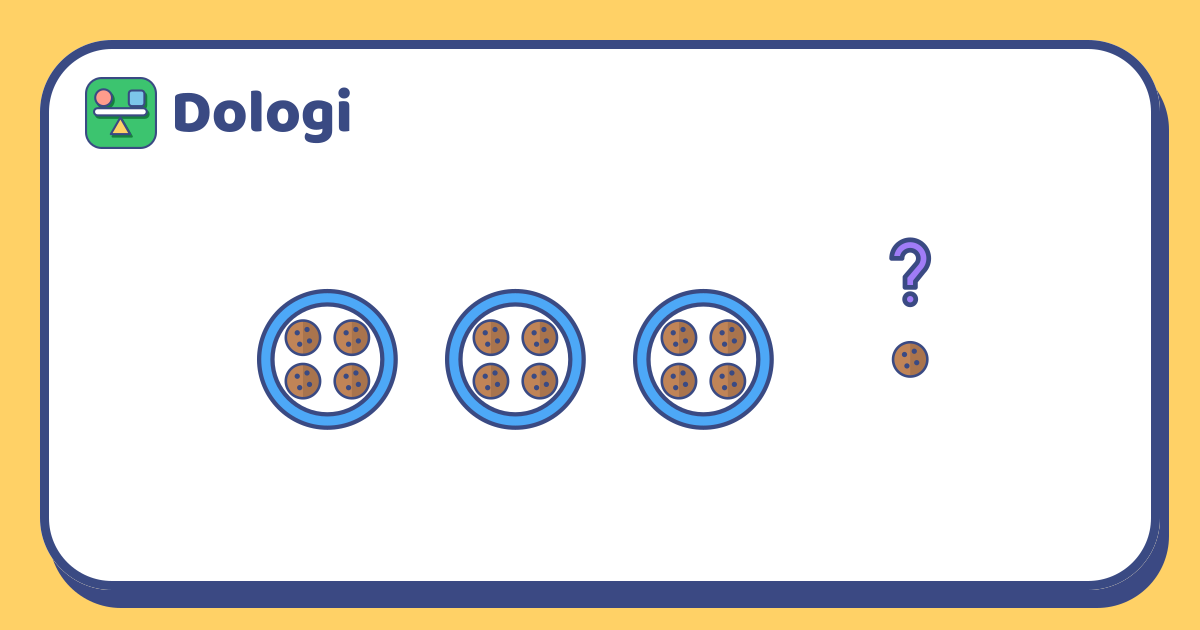
Put twelve cookies on the table and ask two questions. "If three friends share these fairly, how many does each one get?" And: "If we put three cookies in each bag, how many bags do we need?" Both answers are four, and both are written 12 ÷ 3 = 4. Yet for a child, these are two quite different jobs.
Children usually meet division around the age of 7 or 8, often soon after multiplication. This article shows how to explore both kinds of division with everyday things, what to do when there are some left over, and how to help your child see that division is multiplication working backwards.
Two kinds of division
Every division starts with a total. What changes is what you already know.
| Kind | What you know | What you find | Example with 12 cookies |
|---|---|---|---|
| Sharing equally | How many groups (people, plates) | How many in each group | Share between 3 friends: 4 each |
| Making groups | How many go in each group | How many groups | Bags of 3: 4 bags |
Adults rarely notice the difference, because the calculation is the same. Children notice it in their hands: sharing means dealing things out one by one, while grouping means scooping up a fixed number at a time. Try both kinds with the same objects, so your child sees that two different actions lead to the same number sentence.
Sharing equally: one for you, one for you
Sharing is usually the easier way in, because children already know the word "fair".
- Deal it out. Set out three plates and give your child twelve cookies (or grapes, pasta shapes, building blocks). They put one on each plate, then go round again, until the cookies run out. Dealing one at a time is a reliable method, even if it is slow.
- Check it is fair. When the dealing is done, ask: "Does every plate have the same?" Counting each plate to check is part of the job, not an extra.
- Tea party for toys. Seat three or four soft toys around a box and ask your child to share a pile of buttons "so nobody complains". Change the number of toys and the number of buttons and ask them to guess before dealing.
Once dealing feels easy, ask a quicker question: "Could we put two on each plate at once?" This is a small step towards using known facts instead of dealing one by one.
Making groups: how many bags can we fill?
Grouping turns up all over the house, which makes it easy to practice.
- Pair up socks from the washing basket: how many pairs from fourteen socks?
- Put pencils into bundles of five with a rubber band.
- Pack eggs or small toys into boxes that hold six.
- At snack time: "Each bowl gets four strawberries. How many bowls can we fill?"
Here your child counts out a fixed number, sets that group aside, and counts how many groups they have made. A useful habit is to say each group out loud: "That's one bag, that's two bags..." Children sometimes count the cookies instead of the bags, so ask clearly at the end: "How many bags?"
When some are left over
Real life does not always share out neatly. Thirteen cookies on three plates gives four each, with one cookie left over. This left-over part is called the remainder.
Ask your child what makes sense to do with it. The answer depends on the situation:
- Cut the last cookie into three equal pieces, so everyone gets a little more.
- Keep it in the tin for later.
- If the question is about bags, a part-filled bag might still count, or might not.
Two checks help children work with remainders:
- The remainder is smaller than one group. If there are four left over on three plates, you can deal one more round. Ask: "Could each plate still get one more?"
- Put it back together. Four cookies on each of three plates, plus one left over, should make thirteen again. Counting everything back up shows nothing went missing.
Linking division to multiplication
When your child is comfortable with plates and bags, show how division connects to multiplication. Three plates with four cookies on each is 3 × 4 = 12. Start from the twelve cookies and share them back onto three plates, and you have 12 ÷ 3 = 4. Same plates, same cookies, read in the other direction.
A small "number family" makes this easy to see: 3 × 4 = 12, 4 × 3 = 12, 12 ÷ 3 = 4, 12 ÷ 4 = 3. Let your child build each one with objects. Over time, they can use what they know about multiplication to answer a division without dealing at all: "Three times what makes twelve?"
A few common mix-ups:
- Unequal shares. Your child has divided, but one plate has five and another three. Go back to dealing one at a time.
- Muddling the numbers. In 12 ÷ 3, which is the total and which is the number of groups? Ask your child to tell the story first: "Twelve cookies, three friends."
- Counting the remainder as a group. One cookie left over is not another plate. Lay it to one side, away from the plates.
Children learn this at different speeds, and the ages here are only a rough guide.
In Dologi's Math topic, the "Equal parts" puzzles ask your child to spot which shapes are split fairly in half. It is a short way to practice the same question that sits behind sharing: are these parts really equal?
In short
- Division answers two questions: how many in each group (sharing), and how many groups (grouping).
- Start with real objects: deal them out one at a time, or scoop up a set number, then check every group is equal.
- When some are left over, talk about what makes sense in that situation, and check the remainder is smaller than one group.
- Show division as multiplication backwards, using the same plates and cookies.
Read more: What is multiplication? Explaining equal groups to a 7-year-old