Around the age of seven, many children see a new sign in their maths book: ×. Some guess it means "add", others simply learn to say "times" without knowing what it does. Then 3 × 4 turns into a number to remember rather than something to picture, and the first wobble with maths can begin here.
The idea behind the sign is simple enough to show at the kitchen table: multiplication is a quick way to count equal groups. This article shows how to build that idea with things you already have at home, from plates and strawberries to rows and columns, before your child ever needs a times table.
Multiplication means equal groups
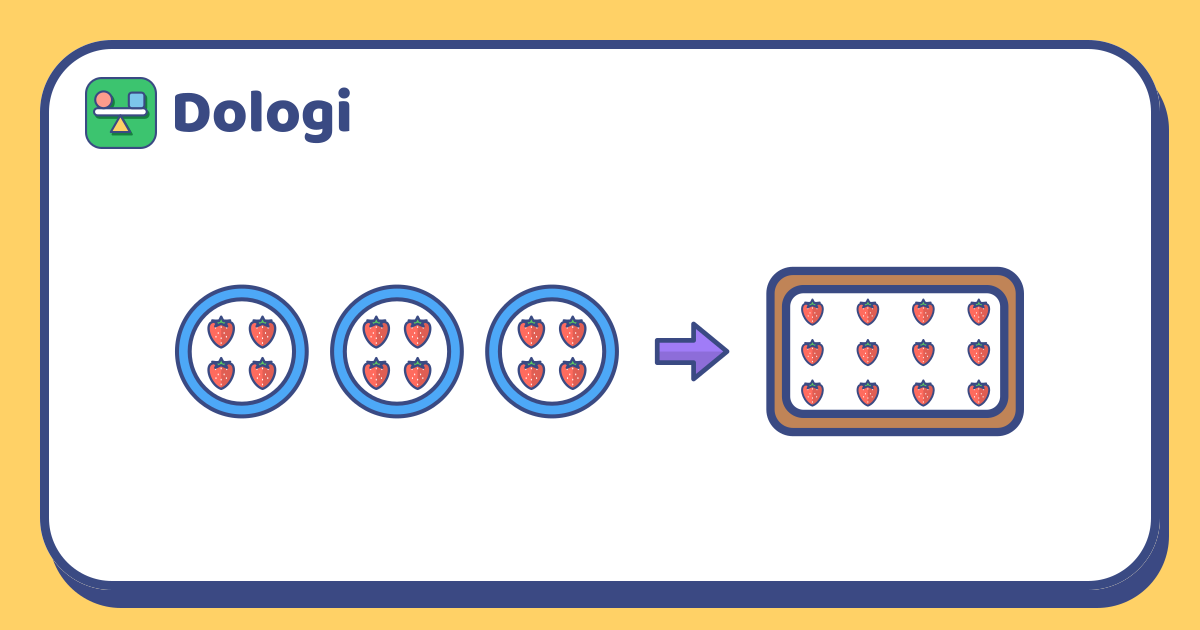
Put three plates on the table and four strawberries on each. Ask two questions:
- "How many plates?" (three groups)
- "How many strawberries on each plate?" (four in each group)
Then: "How many strawberries altogether?" Your child can count one by one, or add 4 + 4 + 4. Both work. Multiplication is simply a shorter way to say it: three groups of four make twelve, written 3 × 4 = 12.
The word that matters most is equal. If one plate has four strawberries, the next three and the last five, you can still add them up, but it is not a multiplication. Turn this into a quick game called "Equal or not?": set out a few groups, some equal and some not, and let your child check. If the groups are not equal, ask them to move things around until they are. This small check is the heart of multiplication, and children enjoy catching you out.
Things first, then drawings, words and symbols
Children understand a new idea best when they meet it in a few forms, one after another. There is no need to rush to the symbols.
| Stage | What you do together | What your child can say |
|---|---|---|
| Things | Make groups with spoons, pasta, buttons or toy cars | "Three plates, four on each" |
| Drawings | Draw circles and put dots inside | "I drew three circles with four dots" |
| Words | Say the groups as a sentence | "Three groups of four is twelve" |
| Symbols | Write it down | "3 × 4 = 12" |
Move back and forth between the stages. When your child writes 3 × 4, ask them to draw it. When they draw groups, ask them to write the number sentence. If a written problem feels confusing, go back to things on the table.
Schools do not all read 3 × 4 the same way: some say "three groups of four", others "four, three times". The answer is the same, so follow the way your child's class says it.
Rows and columns: a faster way to count
Groups on plates are easy to see, but there is an even tidier way to arrange them. Take the twelve strawberries and lay them on a tray in rows: three rows, four strawberries in each row. Now your child does not need to count one by one. They can count by rows: "4, 8, 12."
A neat arrangement of rows and columns like this is called an array. Arrays are everywhere once you start looking:
- windows on a building, in rows and columns,
- a sheet of stickers, a muffin tin, a box of chocolates,
- floor tiles, garden beds, seats in a hall.
Ask: "How many rows? How many in each row? How many altogether?" Then turn the tray a quarter turn. Now there are four rows of three, and still twelve strawberries. Children are often surprised by this, and it is worth letting them discover it for themselves. If you want to go further, the times tables article below builds on arrays.
Counting by groups around the house
Short activities in daily life do more than a long worksheet. A few ideas:
- Group hunt. Look for equal groups at home: pairs of socks (groups of two), legs on chairs (groups of four), fingers on hands (groups of five), wheels on bikes. Your child says the sentence: "Three chairs, four legs each: twelve legs."
- Setting the table. "Four people, each needs a fork and a spoon. How many pieces do we need?"
- Make up a story. Give your child a multiplication, such as 2 × 5, and ask them to invent a story and draw it: "Two ponds with five ducks in each." Then swap: you tell a story, and they write the multiplication.
- How many ways? Give your child twelve buttons: "Can you put them into equal groups?" Groups of two, three, four or six all work. Groups of five leave some over, which is a nice surprise to talk about. This is also the first step towards division.
Common mix-ups and how to help
Most mistakes at this stage show that the picture behind the sign is not clear yet. Go back to objects rather than repeating the rule.
- Adding the two numbers. Your child writes 3 × 4 = 7. Say: "Show me three groups of four," and let them build it.
- Mixing up the two numbers. Which is the number of groups, and which is the number in each group? Use names for them: plates are the groups, strawberries are what goes on each plate.
- Always counting from one. Counting all twelve one by one is fine at first. Later, invite your child to count in groups: "4, 8, 12." Counting in twos, fives and tens gets them used to this.
- Groups of one and groups of nothing. Put one strawberry on each of three plates: three groups of one make three. Then three empty plates: three groups of nothing make nothing. Children find this funny, and it helps them later with × 1 and × 0.
In Dologi, the "Number line hops" puzzles in the Math topic show a rabbit making hops of the same size along a number line. Ask your child: "How many hops? How long is each hop?" It is the same idea of equal groups, laid out along a line.
In short
- Multiplication is a quick way to count equal groups: "how many groups, how many in each".
- Start with objects, then drawings, words and finally the × sign, and move back to objects whenever your child is stuck.
- Rows and columns let children count faster, and turning them shows that 3 × 4 and 4 × 3 give the same answer.
- Short games at home, like group hunts and multiplication stories, build the idea better than early drilling.
Read more: Times tables: should children memorise them or understand them first? and Bean maths: sorting, counting in groups and sharing equally.