Plenty of parents sign their kids up for an after-school chess club because they have heard that "chess is good for the brain," and memory usually comes up first. But better memory for what, exactly? Spelling words, the list of things to pack for school, or just chess?
This post gives an honest answer: which kinds of memory a child uses during a game, what might carry over to other things, and what nobody can promise. At the end there is a position-memory game that needs nothing more than a board and ten seconds.
The short answer
Chess definitely makes children use their memory, and kids who play regularly get faster at remembering chess things: how the pieces move, positions they have seen before, games they have played. Whether that helps them memorize a poem or remember what you asked them to do is far less certain, and it varies a lot from child to child. Think of chess as a great game for exercising memory at the board, not as a way to upgrade memory in general.
Four kinds of memory in one game
| Kind of memory | What it looks like at the board | In a beginner |
|---|---|---|
| Remembering the rules | The knight moves in an L, pawns capture diagonally, the king can't step into check | Forgets the odd rule, needs reminders |
| Recognizing familiar positions | Seeing the board and thinking "this again": one piece attacking two, a king stuck in the corner | Barely there yet, grows over many games |
| Holding moves in your head | "I move my knight, you take my pawn, I take back" without touching anything | One or two moves, then it gets muddled |
| Remembering past games | Telling you about the game they lost: "I lost my queen right here" | Remembers the fun or sad moments, rarely the order |
The third kind is working memory: holding a few pieces of information in mind for a moment so you can use them. Young children can hold only a little, so don't be surprised when your child "forgets" the rook you left waiting. That is a normal limit for their age, not a lack of effort.
Memorizing versus seeing patterns
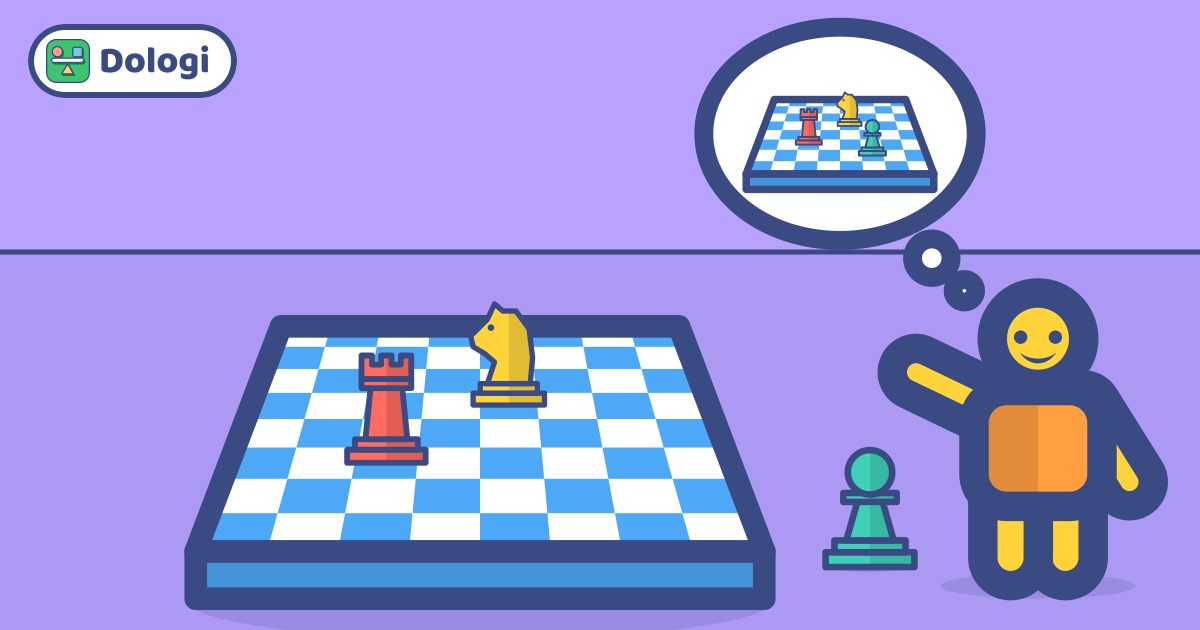
Try this at home. Set up a position from a real game (the king castled, a few pawns in front of it), let your child look for ten seconds, then have them rebuild it. Next, set up the same number of pieces in a random, impossible way (pawns on the back row, two kings side by side) and do it again. For a child who has played for a while, the real position is often much easier.
That's because children don't remember one piece at a time the way they would memorize a phone number. They remember patterns: "king in the corner with three pawns in front" is one chunk, not four separate pieces. The more they play, the more patterns they collect. A random position doesn't match any pattern, so every piece has to be remembered on its own, which is hard for everyone.
This tells you what chess really trains: not a "bigger memory" but a growing library of chess patterns. That library is very useful on the board. Off the board, your child still has to build the patterns of other subjects, like math facts or spelling rules.
A position-memory game for home
All you need is a board and a few pieces. Play when your child is fresh, five to ten minutes at a time.
- Look and rebuild. Put three pieces on the board, let your child look for about ten seconds, then take them off. Your child sets them back up on the empty board. If they get it all right, add a piece next time and work up to five or six.
- Which piece vanished? Set up five pieces. Your child closes their eyes while you remove one. They open their eyes and say which piece is gone and where it was.
- Switch roles. Your child sets up a position to test you. Kids love seeing a grown-up get it wrong.
- Talk about how. After each round ask, "How did you remember it?" One child says "rook in the corner, knight next to it," another counts squares. Saying it out loud helps them notice their own tricks.
- Use real positions. Once your child can play, take positions from the game you just played instead of random ones. They practice remembering and replay the game at the same time.
How many pieces is right varies a lot: younger kids are often comfortable with two or three, while older kids who have played for a while can remember many more. If your child gets frustrated, go back to a number they can do and end on a success.
What chess may not do
- It may not help with memorizing schoolwork. Remembering a position and remembering a poem are different jobs. Some kids find school memorizing easier, some notice no change.
- It is not a fix for forgetfulness. If you are worried about your child's memory or attention, talk to their teacher or pediatrician rather than counting on one activity.
- Pushing takes the fun out. Children remember best what they enjoy. A short, happy game is worth more than a long lesson they just want to be over.
What you can count on: chess gives your child lots of chances to hold information in mind, spot patterns and recall what they just did, inside a game with clear rules the whole family can play.
If you don't have a chess set at home, the Chess room in Dologi's Creative corner has Set up a board: tap Empty board and place pieces wherever you like, so you can play look-and-rebuild right on the tablet. Every game your child plays is saved, and Watch the game again lets you replay it and pause on any move to ask, "What were you planning here?"
In short
- In a game of chess, children use four kinds of memory: rules, familiar positions, moves held in their head, and past games.
- Kids remember positions as patterns, not piece by piece, and that pattern library grows with play.
- Chess memory may not carry over to schoolwork, so don't promise that to your child or yourself.
- Ten seconds of looking, then rebuilding the position, is a fun way to practice. Start with three pieces.
Read more: Chess for children: what age to start, and what they really learn, What is working memory?