Children enjoy practicing more when their effort turns into something they can see. In Dologi, that something is a character they build themselves, the stars they earn after each puzzle, and a chain of beads that grows by one every day they practice.
This article introduces those three parts: the avatar, the stars and the day chain. It also explains why we deliberately kept all three gentle, so that they stay a joy and never become a pressure.
The avatar: a character of your child's own
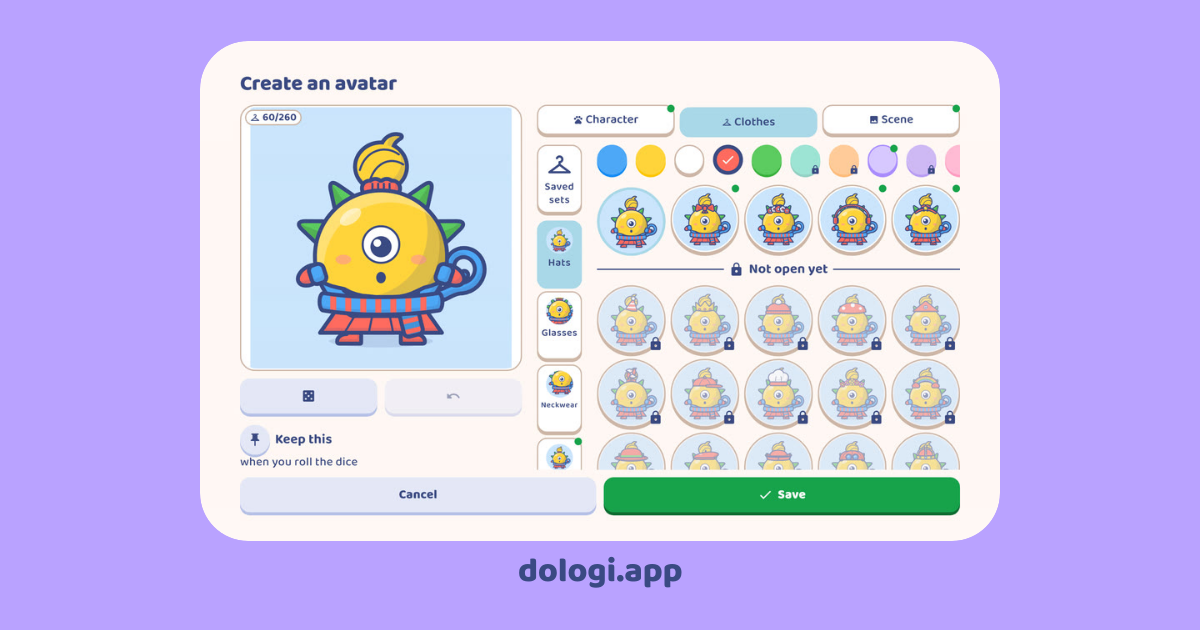
A Dologi avatar is a creature drawn by code, not a photo, and there is no box for typing a real name. Your child builds the character from more than 250 items in three groups:
- Character: body, pattern, eyes, mouth, ears or hair, wings, arms, legs, tail.
- Clothes: hat, glasses, scarf, top, bottoms or skirt, back items, gloves, shoes, items to hold.
- Scene: background and frame.
Every part can be colored with one of 12 colors. The dice button puts together a random new character, and the pin button keeps the parts your child already likes. Your child can also use a picture they drew in the Drawing board as the background, or attach a song they composed in the Music workshop so the character "sings" when tapped.
The avatar appears on the home screen below the player's name, now and then bouncing or waving. It does not appear on the puzzle screen, so your child can concentrate on the puzzle.
Stars: a reward for every puzzle
Each puzzle is worth up to 3 stars:
| What your child does | Stars |
|---|---|
| Right on the first try, no hint | 3 stars |
| A wrong choice, or a hint used | 1 star less for each |
| Solved it alone, even after a few mistakes | At least 1 star |
| Looked at the answer | 0 stars |
At the end of each session, the All done! screen shows the stars just earned and the total.
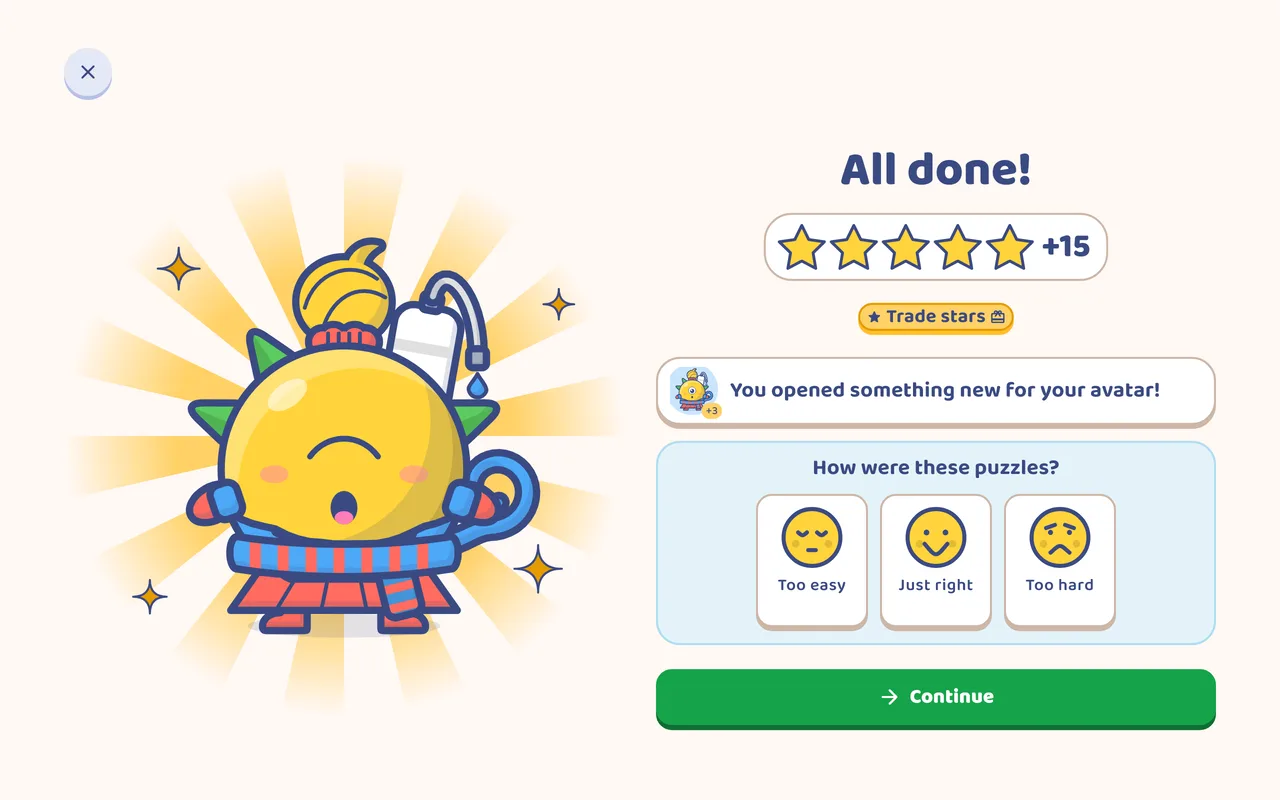
This scoring rewards thinking a puzzle through, not punishing mistakes. A puzzle your child fixed alone after two tries is still worth more than one where they tapped Show answer.
The Star shop: trade stars for items, no real money
Stars are meant to be spent. In the Star shop, your child trades stars for decorations for the character (a chef's hat, a flower crown, a bubble wand, a rainbow background…), new paper for the Drawing board, or star beads that protect the day chain.
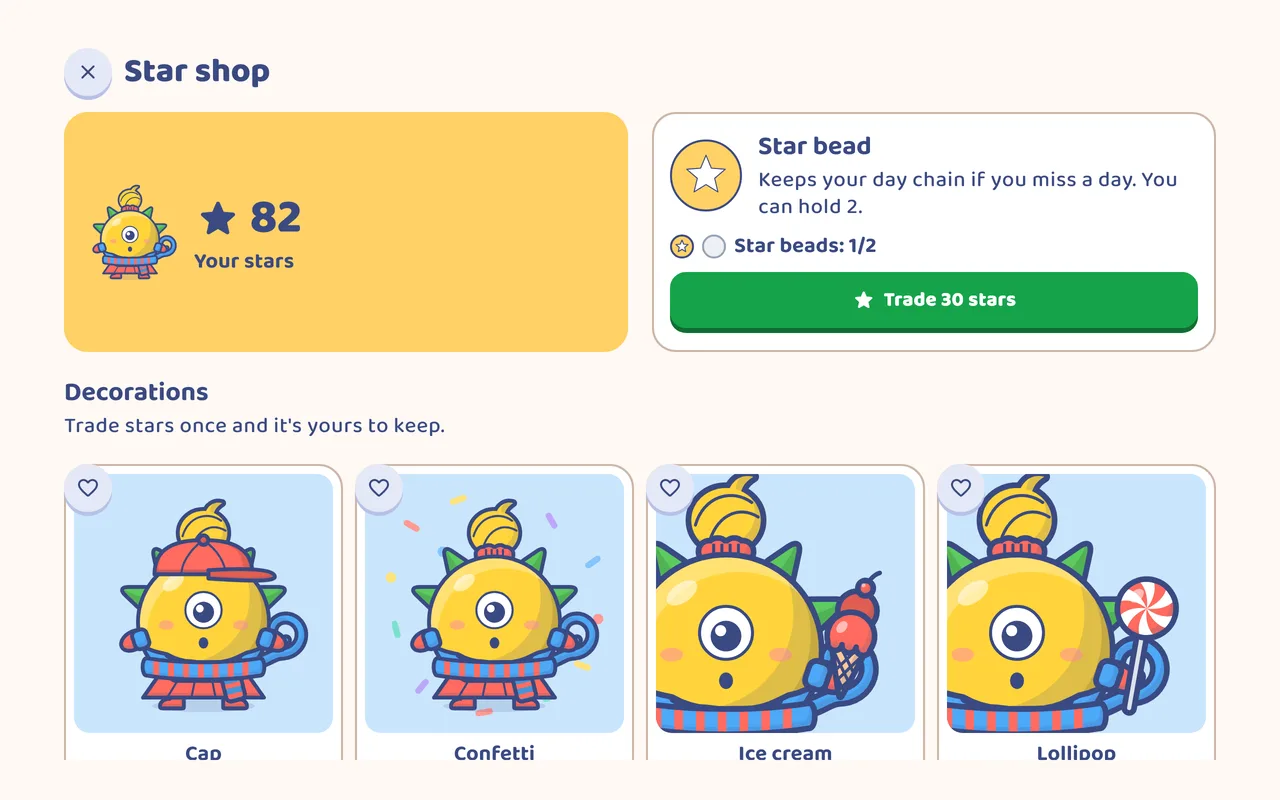
We kept the shop very simple:
- No real money, no discounts, no random gift boxes, no "almost sold out" timers.
- Every trade asks again, "Trade … stars for this?", and your child picks Trade or Not now.
- A trade is forever. If your child doesn't have enough stars yet, the shop shows how many are missing.
- Your child can tap the heart to save up for an item, and the home screen shows the item being saved for. It is a small lesson in saving and waiting.
Most items aren't bought with stars at all but unlocked through practice: solve a few puzzles featuring that animal or object, solve a few more in one topic, or practice for a number of days. At the end of a session, if your child has just unlocked something new, the app says so right away so they can try it on.
The day chain: a chain of beads that grows each day
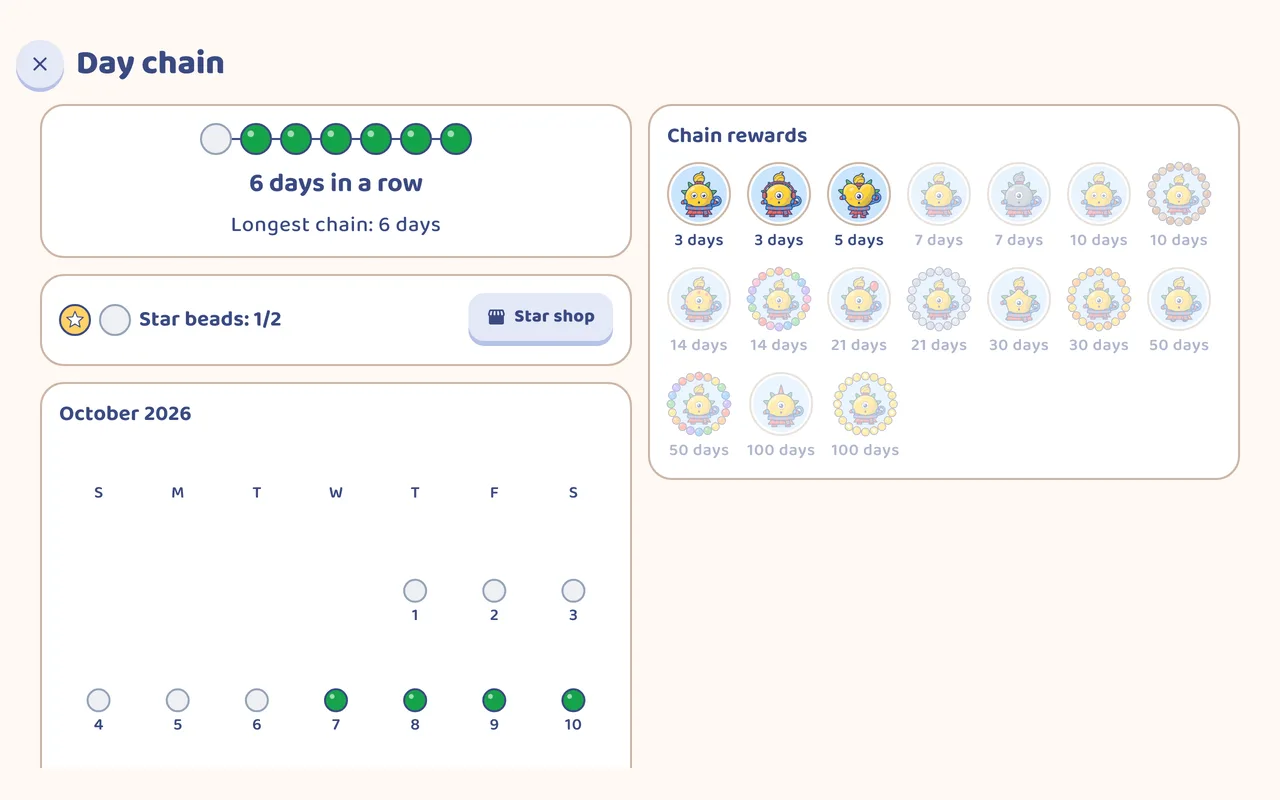
On every day your child finishes a whole session of puzzles, the day chain gets one more bead. The Day chain screen shows the last seven days, the calendar for the month, and the gifts that unlock at chain milestones.
Missing a day is fine:
- A star bead that keeps the chain covers a missed day automatically. Your child can hold up to 2, traded in the Star shop or given as a gift the first time the chain reaches 3 days.
- Parents can set up to 2 rest days a week (for example the weekend): rest days don't break the chain.
- When the chain breaks, the app says nothing. There is no warning color and no sentence that blames your child. The longest chain is still recorded.
Dologi sends no notifications to call your child back into the app and shows no "you're about to lose your chain" countdown. We want children to return because they like it, not because they're afraid of losing something.
Parents still decide
In the parent area, every player has a Day chain switch. Turn it off and your child no longer sees the chain button, the chain screen or star beads, while everything already unlocked stays. The gifts tied to the chain are then counted by the total number of days practiced, so your child loses nothing.
The day chain is also different from the family goals that parents set: family goals count practice days, which don't have to be in a row, and the reward is something in real life, like an outing to the park. You can read more in Parent area in Dologi: play time, reports and family goals.
A few tips to make in-app rewards really help:
- Praise how your child thought ("you kept trying until it worked") more than the number of stars.
- Ask about the character: "Why did you pick this hat?" Children love to tell the story.
- Don't turn the day chain into a condition ("if you don't keep the chain, no…"). Let it stay your child's joy.
In short
- The avatar is a character your child builds from more than 250 items, with no real photo and no real name.
- Stars reward thinking things through; the Star shop has no real money and no random gifts.
- The day chain has no notifications and no countdown, and it comes with star beads and rest days; parents can turn it off for each player.
- The best reward is still a parent's well-timed praise.
Read more: Building a daily learning habit: 15 minutes a day, with less reminding · When your child gives up on hard problems: helping children keep trying and not fear mistakes