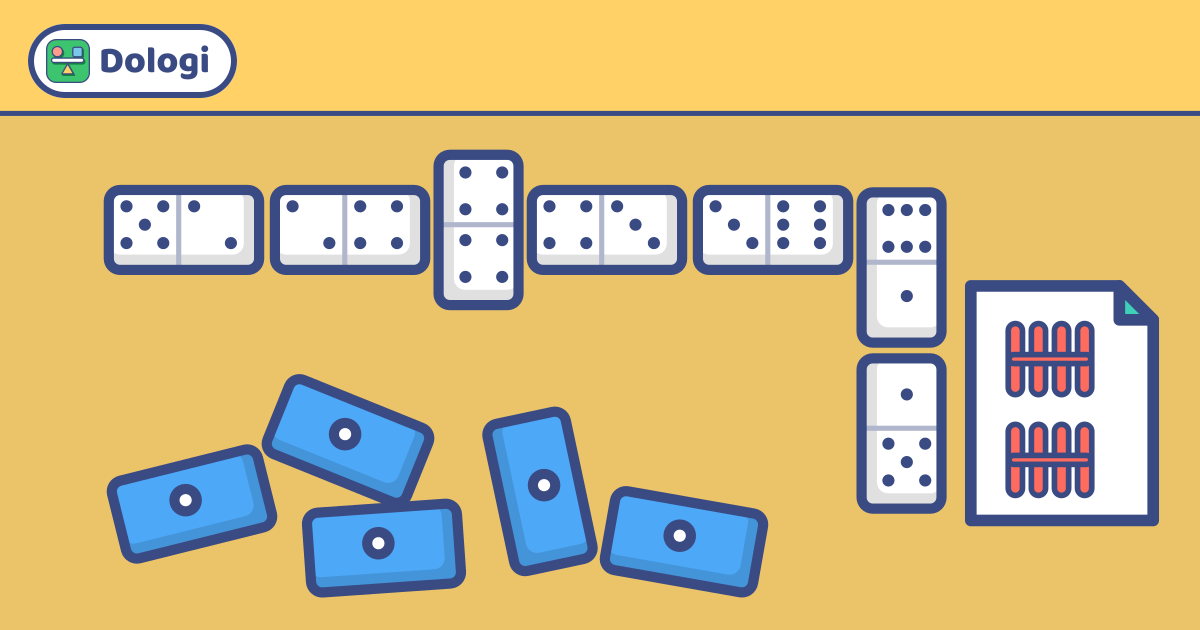
Say "dominoes" to many children and they picture a long line of tiles tipping over one after another. But dominoes started out as a table game: each player holds a few tiles and takes turns adding one to a line, so that touching ends show the same number of dots. The rule is simple enough for a five-year-old, and there is still plenty to think about for a ten-year-old.
This post covers the basic matching game, an easier version for young children, a scoring rule for older kids, and how to make a set from cardboard if you don't have one.
What's in a set of dominoes
The most common set, called double-six, has 28 tiles. Each tile has two halves, and each half shows from 0 to 6 dots, arranged like the faces of a die. Every pair of numbers appears exactly once: there is a 2–5 tile, but no separate 5–2. Tiles with the same number on both halves (1–1, 4–4, 6–6) are called doubles.
Before your first game, turn all the tiles face up and explore them together:
- How many tiles have a blank half?
- Which tile has the most dots? Which has the fewest?
- Find every tile with a 6 on it. (There are seven, counting the 6–6.)
No set at home? Make one. Cut cardboard or an old cereal box into rectangles about two fingers wide, draw a line across the middle, and add dots with a marker. A full 0–6 set needs 28 tiles, but a small 0–3 set has only 10 and takes about ten minutes. Letting your child draw the dots is counting practice in itself.
The basic matching game
- Turn all the tiles face down and shuffle them. With two players, each draws 7 tiles; with three or four players, each draws 5. The rest stay face down to one side as the draw pile, sometimes called the boneyard.
- Everyone stands their tiles on edge so the others can't see the dots.
- The player holding the highest double sets it in the middle of the table.
- Taking turns, each player adds one tile to either end of the line. The half that touches the line must match that end: if the end shows 4, you can play 4–1, 4–6 or 4–4.
- If you can't play, draw from the pile until you can. When the pile is empty, pass.
- The first player to place all their tiles wins. If nobody can play, everyone adds up the dots left in their hand, and the lowest total wins.
Doubles are usually laid crosswise so they stand out. When the line reaches the edge of the table, turn a corner; the ends just have to keep matching.
Ages 5–6: tiles face up, smaller set
For beginners, the full rules can be a lot to keep in mind. Start gently:
- Use a smaller set. Keep only the tiles from 0 to 3 (10 tiles). With fewer dots, children can see the number right away.
- Play with tiles face up. Everyone lays their tiles face up in front of them. Think out loud: "The end shows 3. I have a 3–2, so I'll put it here."
- Play as a team. The whole family builds one long line together until no more tiles fit. Nobody wins or loses.
- Counting or seeing, both are fine. At first your child may touch and count each dot. After a few games, many children see three dots in a diagonal and just know it's three. There's no need to rush that.
Once your child is matching without asking for help, add the 4s, 5s and 6s, and try playing with hidden tiles.
Ages 7–10: add up the ends to score
Older children often want points. This version keeps the same matching rule and adds one bit of math:
- After placing a tile, add the dots on both open ends of the line.
- If the total is 5, 10, 15 or 20, the player who just moved scores that many points.
- A double at the end of the line counts both halves. If one end is the 5–5 double and the other end shows 5, the total is 5 + 5 + 5 = 15.
- Keep score on paper with tally marks, crossing each group of five. The first to reach a target you agree on, like 50 or 100, wins.
This version has children doing mental addition all game long: add two numbers, then check whether the total is a multiple of five. Before long they start planning: "If I play my 6–4 on this end, the ends will be 4 and 6. That's 10 points."
For kids who like a challenge, try this one: how many dots are there in the whole set of 28 tiles? A hint: how many times does each number from 0 to 6 appear? (Each appears 8 times, so the total is 8 × 21 = 168 dots.)
What children practice along the way
Dominoes aren't magic, but one short game packs in a lot of what children are learning at this age:
| In the game | What your child practices |
|---|---|
| Finding a tile with the same number | Comparing amounts, recognizing dot patterns |
| Seeing the number in a dot pattern | Recognizing small amounts without counting one by one |
| Adding up the two ends | Mental addition up to 20 |
| Choosing which tile to play | Thinking a move or two ahead, saving a useful tile for later |
| Counting leftover dots when the game is blocked | Adding several numbers in a row |
What matters most is that the game stays fun. If someone adds wrong, count again together, and nobody loses points for being slow.
In Dologi's Math topic, the "Add and answer" puzzles include one that asks, "How many dots are there on the dominoes altogether?" Your child adds up the dots on a few tiles, much like adding the two ends at the table, on days when nobody is free to play.
In short
- The classic domino game is about matching dots, not toppling tiles, and works from around age 5.
- Young children play with a 0–3 set, tiles face up, all on one team.
- Older children add the two ends of the line and score when the total is a multiple of five, keeping score with tally marks.
- No set? Cut tiles from cardboard and draw the dots; a small set needs just 10 tiles.
Read more: Building a long domino run: one push and the whole line falls · Dice games for children: counting and mental math with a pair of dice