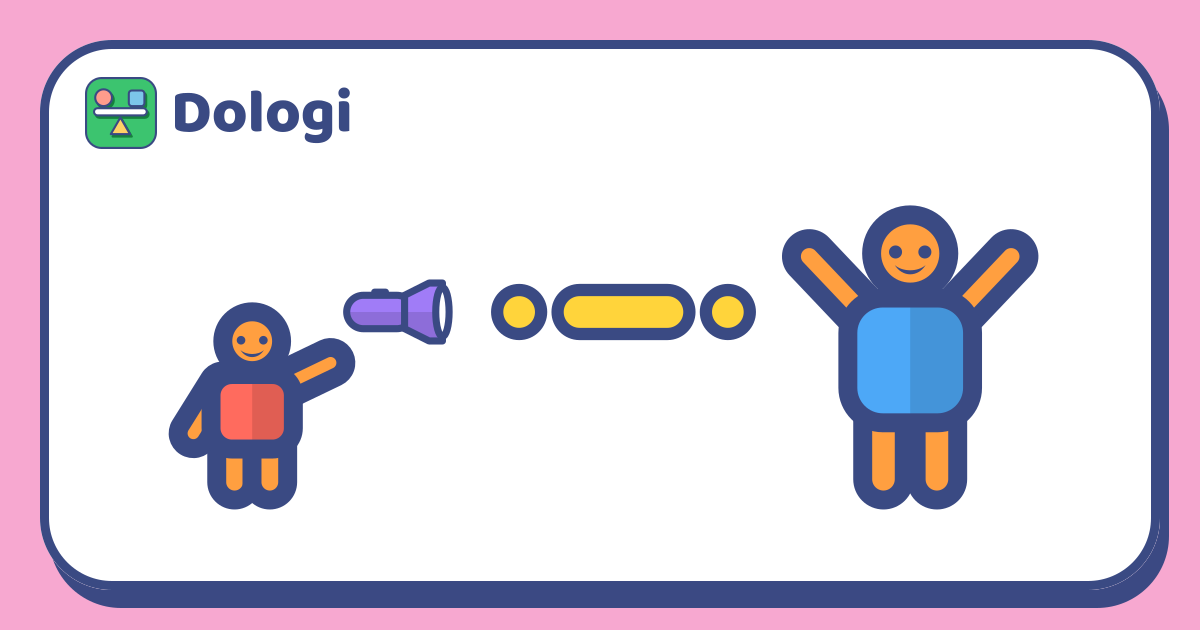
Two signals are enough to say almost anything. A short one and a long one, arranged in different orders, can stand for "yes", "dinner is ready" or "good night". The best-known code of this kind, Morse code, was sent along telegraph wires and flashed between ships with lamps long before phones existed.
Children love secret messages, and a dot-and-dash code turns that love into real practice: listening closely, remembering a rule, and translating a message from one form into another. That last part is exactly what computers do all day. This article shows how to build a family code together, send it by tapping and with a flashlight, and adjust the game for children from around 4 to 12.
How a dot-and-dash code works
A dot is a short signal: a quick tap, a quick flash, a short "dit". A dash is a long one: a longer flash, a drawn-out "daaah". A message is a row of dots and dashes, and a code table says what each row means.
The pause matters just as much as the signals. Without a pause, "dot, dash" and "dot … dash" sound the same, and the receiver cannot tell where one word ends and the next begins. Agreeing on how long to wait between words is part of the code. Computers work the same way: every message is a row of two kinds of signal, and both sides must agree on the rules before they can understand each other.
Make your family's code table
Instead of learning a whole alphabet, start with a handful of words your family really uses. Sit down together and make a table on a sheet of paper.
| Message | Code |
|---|---|
| Yes | • |
| No | — |
| Dinner is ready | • • — |
| Come and play | — — • |
| Good night | • — • — |
| Well done | — • — |
A few tips for building it:
- Let your child choose the words. A code for "snack time" or "the cat is here" gets used far more than one chosen by an adult.
- Give the shortest codes to the words you use most. "Yes" and "no" get a single signal each. Real codes follow the same idea: in the famous telegraph code, the letter used most often in English, E, is just one dot.
- Check that no two words share a code. Read the table aloud together and look for duplicates. Finding a clash and fixing it is a small taste of debugging.
- Stick the table where everyone can see it, on the fridge or by the bedroom door.
Sending by tapping
The easiest way to start is at the kitchen table. A dot is one quick tap with a fingertip. A dash is a slow rub of the palm across the table, or a knock followed by a slide. Agree on one signal that means "message starting" (for example, three fast taps) so the receiver knows to listen.
Then play:
- The sender picks a word from the table without saying it.
- They tap it slowly, leaving a clear pause at the end.
- The receiver writes the dots and dashes on paper as they hear them, then looks up the table.
- Swap roles.
Once that works, try it with the receiver's eyes closed, then from behind a door or through a wall between two rooms. Hearing without seeing makes your child focus on the sounds alone.
Sending with a flashlight
At dusk or in a darkened room, a flashlight makes the code feel like a real spy mission. A dot is a quick flash; a dash is a flash while you count "one, two, three" in your head.
- Shine the light at a wall or the ceiling, never into someone's eyes.
- Start from opposite ends of a room, then try from one room to the next, from a bedroom doorway, or across a garden.
- Make up a "message received" reply, such as two quick flashes, so the sender knows the code got through.
A bedtime "good night" flashed from the doorway can become a family ritual. On another evening, your child can use the flashlight to answer your questions with yes and no.
Adjusting it by age
Every child is different, so treat these ages as a rough guide and watch what your child enjoys.
- Around 4 to 6: use only two signals. One tap means "yes", one long rub means "no". Ask simple questions ("Do you want an apple?", "Is it raining?") and let your child answer in code. Then swap, and let them ask the questions.
- Around 7 to 9: use a table of six to eight words and send two-word messages, such as "come and play" plus "yes". Your child writes down what they hear before decoding.
- Around 10 to 12: design a code for some letters, giving the shortest codes to the letters that appear most often in your language. Count letters in a page of a book to find out which ones those are. Then add rules for mistakes: what signal means "please repeat"? Should every message end with a "done" signal?
What your child is practicing
A five-minute round of taps and flashes exercises several skills at once:
- Careful listening and watching: telling short from long, and noticing where the pauses are.
- Working memory: holding a row of signals in mind until it can be written down or matched.
- Encoding and decoding: the same message can be words, dots and dashes, or flashes of light. This is the idea behind every digital message.
- Agreeing on rules: a code only works when sender and receiver share the same table, the same pause and the same start signal.
In Dologi, the "Listen to the message" puzzles play a row of short and long sounds; your child finds the strip of dots and dashes that sounds the same and types its number. It is the receiver's job from this article, in a short puzzle.
In short
- A dot-and-dash code uses only a short signal, a long signal and pauses, which is enough to send many messages.
- Build the code table together around words your family uses every day, with the shortest codes for the most common ones.
- Tap on the table or flash a flashlight at the wall, and swap sender and receiver often.
- Younger children start with yes and no; older ones can design a code for letters and add rules for mistakes.
Read more: Picture codes for children: a code-breaking game for home · Binary numbers with dot cards: counting like a computer for 8-to-12-year-olds