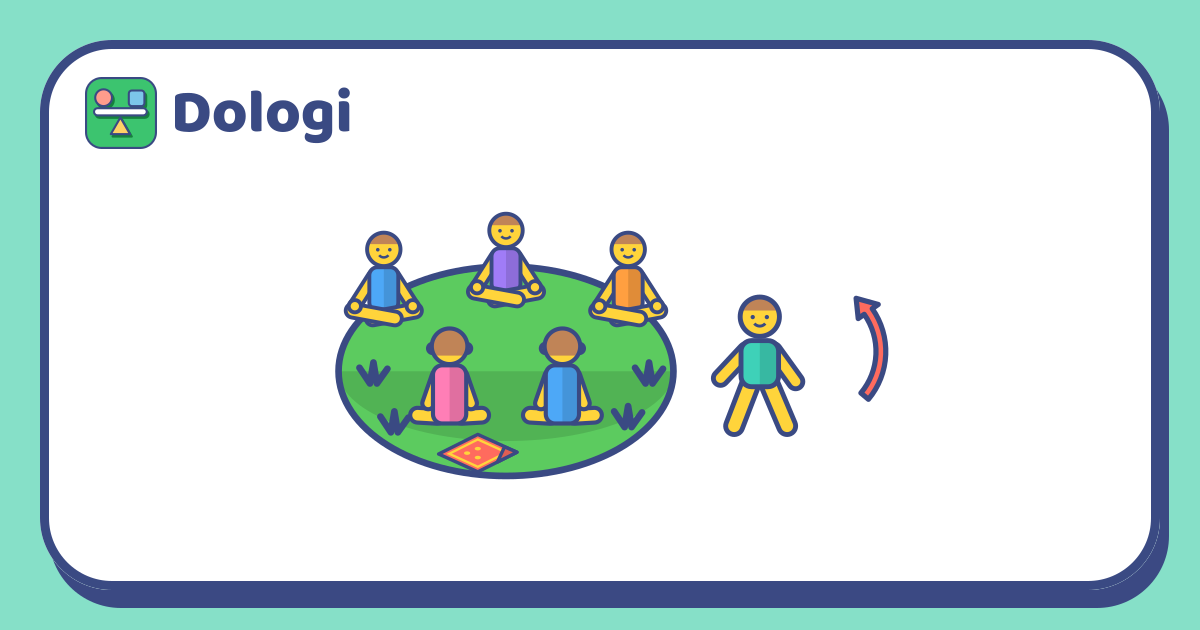
Children sit in a circle and one child walks around the outside holding a handkerchief. Somewhere along the way, they drop it quietly behind someone's back and keep walking. The child with the handkerchief behind them has to notice, grab it and give chase. That is the whole game, and versions of it have been played in schoolyards and parks in many countries for generations.
It needs nothing but a piece of cloth and a few children, so it suits a birthday, a family gathering or an afternoon in the park. It is also a lovely way to practice attention: you cannot see what happens behind you, so you have to listen and stay alert. This guide covers the basic rules, versions for different ages and changes that keep every child in the game.
How to play
- Players: about 5 to 12 children, roughly 4 to 9 years old. Adults can join the circle too.
- You need: a handkerchief, a scarf or any soft cloth. A knotted dish towel works fine.
- Space: a lawn, a park or a large room, with enough room to run around the circle.
- Everyone sits in a circle facing the middle, about an arm's length from their neighbors.
- One child is the walker. They go round the outside of the circle holding the handkerchief.
- Seated children may not turn round to look. They can only listen, or feel behind them with their hands.
- The walker drops the handkerchief behind one child and carries on as if nothing happened.
- When that child notices, they pick it up and chase the walker around the circle.
- The walker tries to get all the way around and sit down in the empty spot. The child holding the handkerchief becomes the next walker.
If the walker completes a full lap and comes back to the handkerchief before anyone notices, they tap that child gently on the shoulder. The two simply swap roles, with no penalty.
Why it is good attention practice
Most attention games ask children to look carefully. This one asks them to notice something they cannot see.
- Listening for footsteps. Footsteps that slow down, pause or come closer are clues. Children learn to pick out one small sound from the noise of the group.
- Feeling behind. With their hands resting on the ground behind them, children can check quickly without turning round.
- Staying alert while waiting. Most of the time, nothing happens to you. Keeping your attention switched on while you wait is hard, especially for younger children.
- Keeping a secret. The walker practices a different skill: acting naturally, walking at an even pace and not giving the game away with a look or a giggle.
You can point these moments out in a few words: "Did you hear the footsteps slow down behind Dad?" Children soon start listening on purpose.
One game, many names
Circle games with a dropped cloth are known in many places, often with a song or a rhyme. In Japan it is called hankachi otoshi, "handkerchief drop". Children in Korea play sugeon dolligi, in Thailand mon son pha, in Vietnam bỏ khăn, in Germany Plumpsack and in Brazil corre cutia. In many English-speaking schools a close cousin is duck, duck, goose, where the walker taps heads instead of dropping a cloth.
If you grew up with a version of your own, teach that one. Children enjoy knowing that their grandparents played the same game, and any song you remember can become part of it.
Changes so nobody is out
In some old versions, a child who is caught has to sit in the middle of the circle. For young children it works better to keep everyone in and simply swap roles.
| Age (approximate) | Change | Why it helps |
|---|---|---|
| 4–5 | Walk fast instead of running; the walker whispers "now" after dropping | Easier to follow, less rushing |
| 5–7 | Every child is walker once before anyone has a second turn | Nobody waits forever |
| 6–9 | Two walkers with two handkerchiefs of different colors | More to listen for, less waiting |
| 7–9 | Seated children sing while the walker goes round | Footsteps are harder to hear |
For a quiet version indoors, skip the chase: the seated child only has to notice and hold the handkerchief up before the walker completes a lap. It is the same attention practice without the running.
Tips for the adult in charge
- Start with a demonstration round. Walk round yourself so children see what a quiet drop looks like.
- Make sure every child gets chosen. Gently suggest that the walker drops it behind someone who has not had a turn yet.
- Notice listening, not speed. "You heard it straight away!" means more than who won the chase.
- Stop while it is still fun. Ten to fifteen minutes is often enough for younger children.
If your child enjoys games like this, the Focus topic in Dologi has puzzles such as "Follow the cup", where cups move around and your child keeps watching the one that hides an object. It is a quiet way to practice the same steady attention on a day without a group.
In short
- Children sit in a circle facing inward; the walker drops a handkerchief behind someone, who has to notice and give chase.
- Seated players may not look round, so they practice listening for footsteps and feeling behind them.
- Keep everyone in the game: swap roles instead of sending children out, and use two handkerchiefs for big groups.
- Adjust to age: fast walking for little ones, singing or a second walker for older children.
Read more: Traditional playground games: jump rope, stick-and-ball jacks and tug of war · Birthday party games for children: everyone plays, nobody is out