This week your child wants to be a veterinarian. Last week it was a firefighter, and next month it might be a baker or a bulldozer driver. The answer to "What do you want to be when you grow up?" changes all the time, and that's exactly how it should be. In elementary school, the point isn't to pick a career early. It's to discover that there are a huge number of jobs, what people in them actually do, what tools they use, and who they help.
This article suggests games and conversations that help kids explore jobs at home: matching tools to jobs, hearing about a real workday, talking with people they see every day, and talking about jobs so that every child feels every job is open to them.
Why talk about jobs with young kids
- They see what grown-ups do. Kids know you "go to work," but often have no idea what that means. Knowing helps them understand you better.
- They learn who makes the world around them. The bread at breakfast, the streetlight outside, the freshly paved road: someone made each of them.
- School starts to make sense. "Carpenters measure everything twice" shows that measuring and math aren't just worksheet stuff.
- It's real reasoning. Working out which tools a job needs, or what has to happen first, is a genuine logic puzzle.
The tool-matching game
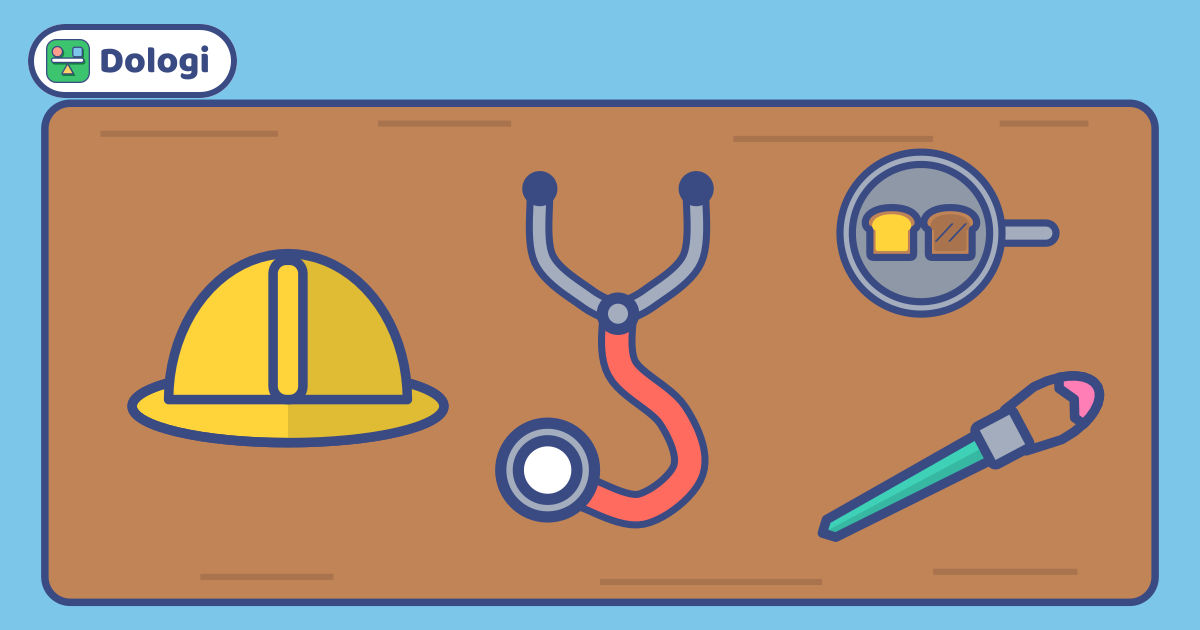
Make about ten cards with a tool drawn on each and ten cards showing a worker (or just the job name if your child reads). Simple drawings are fine: hard hat, stethoscope, frying pan, paintbrush, scissors, comb, wrench, watering can, whistle, mail bag.
- Easy round (ages 4–6): flip a tool card; your child finds the worker who uses it and says what they do with it.
- Harder round (ages 7–9): one tool, many jobs. Scissors are used by hair stylists, tailors, gardeners and surgeons. How many jobs can your child think of? Then flip it: what does one job need?
- Guess the job with yes-or-no questions (ages 8–12): one person thinks of a job, the other asks "Do you work outside?", "Do you use a machine?", "Do you work with kids?" Each answer rules out a group of jobs, just like 20 Questions.
- Put the steps in order: a baker mixes the dough, lets it rise, shapes the loaves, bakes them, then sells them. Write or draw each step on a card, shuffle, and let your child line them up.
A day at work: start with yourself
Kids understand jobs best when they hear from real people, and the closest real people are you, grandparents, aunts and uncles.
- Describe your day in words your child gets: "In the morning I answer customers' emails, at lunch I meet with my team, in the afternoon I fix mistakes in a plan." Include the hard parts and the fun parts.
- Show them your tools if you can: a tape measure, a sewing machine, a laptop full of spreadsheets, a toolbox, a notebook.
- Visit your workplace on a suitable day, if your employer allows it. Many workplaces hold a "bring your kid to work" day.
- Talk to people you meet. The crossing guard, the librarian, the mechanic, the nurse at the pediatrician's office. Help your child ask a short, polite question when the person isn't busy: "How long have you done this job?", "What's the hardest part?" Most people are happy to answer a curious kid.
Every job deserves those questions. The sanitation crew at dawn and the night-shift security guard do work the whole neighborhood depends on, and kids should hear that.
Every job is open to every child
Children pick up messages like "girls are teachers" and "boys fix cars" very quickly, from books, shows and offhand comments. You can help your child see that any job is for anyone who's interested and willing to learn.
- Mix up your examples. When you tell stories or draw cards, include a woman pilot, a man who's a nurse, a woman engineer, a man who's a pastry chef.
- Describe jobs by what they need, not by gender. Swap "that's a job for boys" for "that job needs someone who likes fixing machines and is patient."
- When your child says "girls can't do that," ask "What makes you think so?" and then tell them about a real person you know, or look one up together.
- Don't put jobs down. Avoid lines like "If you don't study, you'll end up flipping burgers." It teaches kids to look down on working people, and on jobs they might love someday.
By age, and when they change their mind
- Ages 4–6: pretend play with things from around the house: a doctor's office with bandages, a bakery with play dough, a construction site with blocks. Kids learn job words, tool names and how to work with others.
- Ages 7–9: draw a day in a favorite job as a four-panel comic, or make a "job notebook" with one page per job: tools, workplace, and who it helps.
- Ages 10–12: look into what someone in that job has to learn, what they need to be good at, and what the tough days are like. Talk about jobs that didn't exist when you were a kid, so they see jobs change over time.
Let them change their mind as often as they like. Try not to label them ("our future doctor!") after one comment; what's worth praising is the curiosity and the effort to find out more.
In Dologi, the Logic topic has a puzzle called What happened first?: your child puts pictures in order from first to last, like a flower growing or a candle burning down. It's the same thinking they use to line up the steps in a baker's day: some things have to be finished before the next one can start.
In short
- "What do you want to be?" changing every week is normal; the goal is to learn about lots of jobs, not to choose early.
- Play tool matching, guess-the-job with yes-or-no questions, and put the steps of a workday in order.
- Tell your child about your own job and help them talk to the people around them; every job is worth asking about.
- Show men and women in every kind of job, describe jobs by skills rather than gender, and never put a job down.
Read more: The 20 questions game: guessing an object with yes-or-no questions, Teaching children to ask good questions