"How long will it take?" sounds like a sum: add up the times and you have the answer. Scheduling puzzles prove that the order of the jobs matters as much as their length. Do two things at once, swap something in at the right moment, and the same work finishes sooner.
The three puzzles below suit children aged about 8 to 12. Each one is solved on paper with small cards and a hand-drawn timeline, then checked with the question every planner asks: could anyone do it faster?
Puzzle 1: three slices of toast, one small pan
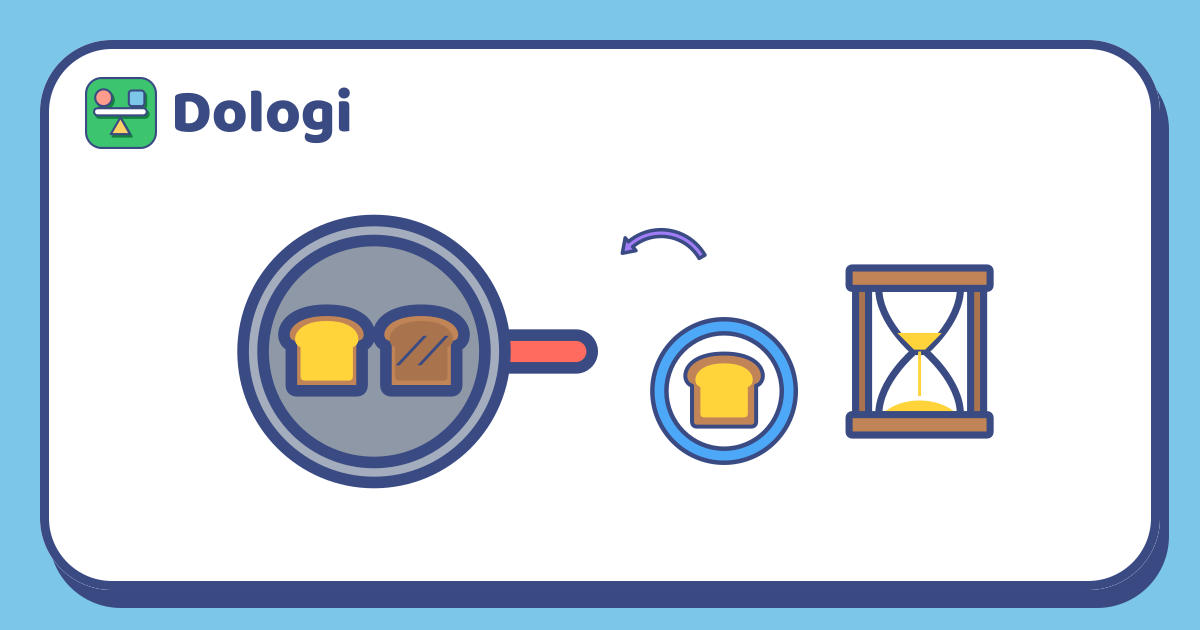
A small pan holds only two slices at a time. Each side of a slice takes one minute to toast, and every slice needs both sides done. You have three slices.
What is the shortest time to toast all three?
Most people answer 4 minutes: two slices on both sides (2 minutes), then the third slice on both sides (2 more). There is a quicker way.
How to solve it on paper. Write six cards: A1, A2, B1, B2, C1, C2 (slice A side 1, slice A side 2, and so on). Draw a grid with two rows, one for each spot in the pan, and one column per minute. Placing a card in a cell means "this side toasts in this spot during this minute". One rule: the two sides of the same slice can't share a column, because a slice can't lie on both sides at once.
The pan stays on paper. Real pans and stoves are a job for an adult.
Puzzle 2: the washing machine works while you do
Saturday morning, four jobs:
- Run the washing machine: 30 minutes (it runs by itself once started)
- Tidy the desk: 10 minutes
- Pack the school bag: 5 minutes
- Hang up the washing: 10 minutes (only once the machine has finished)
Doing the jobs one after another takes 30 + 10 + 5 + 10 = 55 minutes. What is the shortest time to finish everything?
Draw two lines on a strip of paper, "you" and "machine", with one mark every five minutes. Then place each job as a block of the right length. The key question: which jobs need you, and which only need time?
Puzzle 3: four animals, one bridge, one lamp
It is night. A rabbit, a cat, a duck and a turtle want to cross a narrow bridge. The rules:
- At most two on the bridge at a time.
- They have one lamp, and nobody crosses without it. Someone must bring it back each time.
- Alone, the rabbit needs 1 minute, the cat 2, the duck 4 and the turtle 8.
- Two walking together go at the slower one's pace.
Warm-up: only the rabbit, the cat and the turtle. Fewest minutes?
The real puzzle: all four. Can everyone cross in 15 minutes?
Make one card per animal and move them from one side of the table to the other, with a bottle cap as the lamp. Write each trip on the timeline: who crosses, which way, how many minutes.
Answers and timelines
Toast: 3 minutes.
| Minute | Spot 1 | Spot 2 |
|---|---|---|
| 1 | A1 | B1 |
| 2 | A2 | C1 |
| 3 | B2 | C2 |
The trick is in minute 2: slice B leaves the pan with one side done and waits on the plate, so slice C can start.
Washing: 40 minutes. Start the machine first. While it runs, tidy the desk (minutes 0 to 10) and pack the bag (minutes 10 to 15). There are 15 free minutes to read or play. When the machine stops at minute 30, hang the washing: done at minute 40.
Bridge, warm-up: 11 minutes. Rabbit and turtle cross (8), the rabbit brings the lamp back (1), rabbit and cat cross (2).
Bridge, all four: 15 minutes. The natural idea is to let the fast rabbit walk everyone over: turtle (8), back (1), duck (4), back (1), cat (2) = 16 minutes. The better plan:
- Rabbit and cat cross: 2 minutes
- Rabbit brings the lamp back: 1 minute
- Duck and turtle cross together: 8 minutes
- Cat brings the lamp back: 2 minutes
- Rabbit and cat cross: 2 minutes
Total: 2 + 1 + 8 + 2 + 2 = 15. Sending the two slowest together hides the duck's 4 minutes inside the turtle's 8.
Can anyone do it faster?
Finding a good plan is one half of the puzzle. The other half is showing that no plan is better. Older children enjoy this part.
- Toast: there are 6 sides to toast and the pan does 2 per minute, so at least 3 minutes. The grid has no empty cell, which means no wasted space. Nobody can beat 3.
- Washing: the machine alone needs 30 minutes, and hanging can only start after it. 30 + 10 = 40 is the floor.
- Bridge: here the trick doesn't always win. Try other times: 1, 4, 5 and 6 minutes. Walking everyone over with the fastest gives 6 + 1 + 5 + 1 + 4 = 17. The trick gives 4 + 1 + 6 + 4 + 4 = 19, which is slower. A quick test: compare twice the second-fastest time with the fastest plus the second-slowest. With 1, 2, 4, 8: 2 + 2 = 4 is less than 1 + 4 = 5, so the trick wins. With 1, 4, 5, 6: 4 + 4 = 8 is more than 1 + 5 = 6, so it loses.
More to try:
- Five slices in the same pan? (5 minutes: 10 sides, 2 per minute.)
- A bigger pan that holds three slices, with four slices to toast? (3 minutes: 8 sides, 3 per minute, and it can be done.)
- Plan a real morning together: what can happen while the eggs boil or the toast is in the toaster?
Looking for the smallest total is also what the "Fewest steps" puzzles in the Math topic in Dologi ask for: your child draws a route from a house to a tree, where each road has a number of steps, and compares routes to find the one with the fewest.
In short
- In scheduling puzzles, the order of the jobs changes the total time: overlap jobs, and swap things in at the right moment.
- Cards and a timeline drawn on paper make every plan visible, so mistakes and empty spaces are easy to spot.
- Toast: 3 minutes. Washing: 40 minutes. Bridge: 11 minutes with three animals, 15 with four.
- Checking that nothing can be faster (counting sides, finding the job that can't be shortened) is as valuable as the answer itself.
Read more: Tricky math puzzles for 8-to-12-year-olds with answers