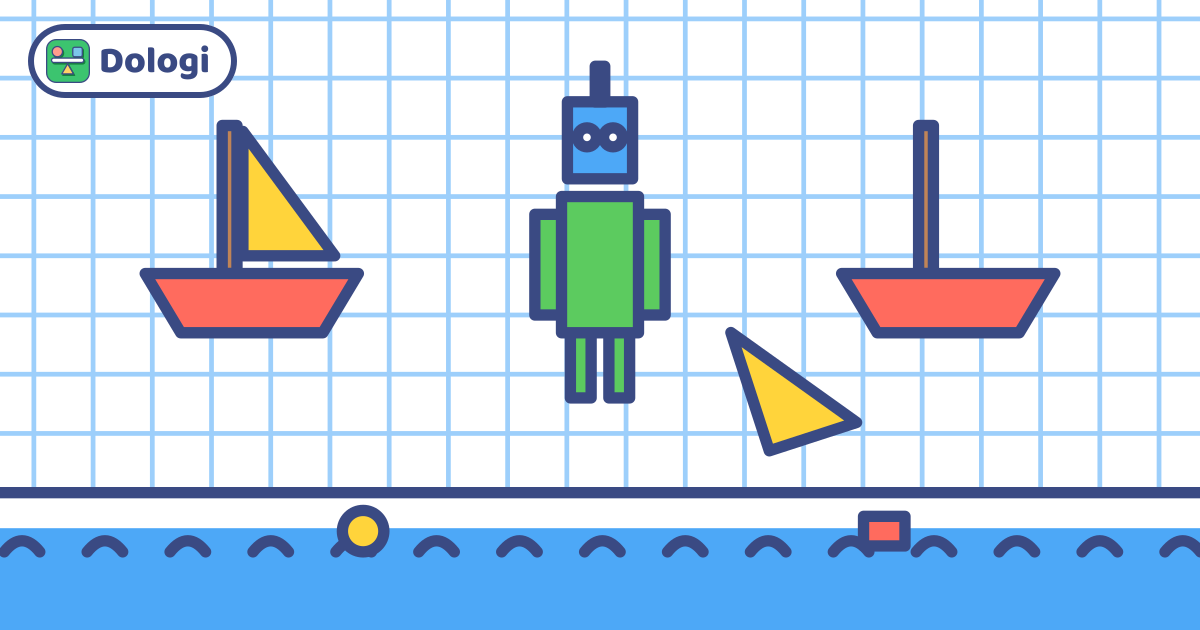
Dip a thin piece of craft foam in water and it sticks to bathroom tiles, no glue needed. Suddenly the bathroom wall is a giant board: you build a boat, and your child builds an identical boat right next to it. And square tiles make a ready-made grid for putting each piece in exactly the right place.
The game suits kids aged 4 to 6 and fits nicely into the last ten minutes of bath time. Your child practices copying a model, noticing which pieces a picture is made of, placing things above, below, left and right, and getting a first feel for symmetry.
What you need
- Thin colored craft foam sheets (about 2 mm, from a craft or stationery store), scissors and a pen.
- Cut basic pieces, each at least as big as one small tile, in several colors:
| Piece | Suggested number |
|---|---|
| Square, one tile in size | 6 |
| Rectangle, two tiles long | 6 |
| Triangle (half a square, cut diagonally) | 6 |
| Big and small circles | 4 |
| Half circle | 2 |
If you cut pieces to the size of your own tiles, every piece fits a square exactly, and copying on the grid becomes much easier.
Bath safety
- A grown-up stays the whole time, never leaving a child alone in the bath, even for a minute.
- Your child sits in the tub and doesn't stand up to reach high tiles; use the rows they can reach sitting down.
- Pieces should be too big to swallow. If there's a baby under 3 at home, put everything away after the game.
- Keep the water comfortably warm, play for about ten minutes, then dry off.
Levels of play
Level 1: copy a row (age 4). You stick three pieces in a row: red circle, blue square, yellow triangle. Your child sticks an identical row right below. Build up to four or five pieces.
Level 2: build from a model (ages 4–5). You build a picture, your child copies it alongside:
- Boat: a trapezoid (or half circle) for the hull, a long rectangle for the mast, a triangle for the sail.
- Robot: square head, rectangle body, small rectangles for arms and legs, two circles for eyes.
- House: a square, a triangle roof, a rectangle door.
- Fish: a round body and a triangle tail.
Ask before they start: "How many pieces does this boat have? Which piece is at the bottom?" Counting and picking out all the pieces first helps your child look closely at the model.
Level 3: copy the exact position on the grid (ages 5–6). Now copy not just the picture but where it sits: "The mast is three tiles tall. The sail is right next to the mast, on the right." The copy has to match the model tile for tile.
Level 4: find the missing half (ages 5–6). Pick a vertical grout line as the "mirror line." You build half a butterfly or half a house on the left of it, and your child builds the right half so the two halves are mirror images. Tip: a piece touching the mirror line on the left also touches it on the right.
The tile grid is a ready-made board
Square tiles help kids talk and think about position more clearly:
- Count squares: "How many tiles long is the hull?" "How many rows tall is the robot?"
- Above, below, left, right: "Stick the circle right above the square." "Left eye, right eye."
- Simple coordinates: with a 6-year-old, try "second row, third tile from the left" to place a piece.
Grid drawing and symmetry for children has more copying games on squared paper, perfect for carrying on outside the bathroom.
Swap roles: your child makes the model
After a few rounds, let your child build a picture of their own while you copy it. Every now and then, make one deliberate mistake (sail facing the wrong way, an eye one tile off) for your child to find: "Does mine look like yours? What's different?" Comparing two pictures piece by piece is great practice for the eyes.
Storing the pieces
- After the bath, peel the pieces off, squeeze them gently and dry them on a towel or in a hanging mesh bag.
- Foam that stays damp can go moldy; if you see black spots, cut new pieces.
- No tiled wall? Use the side of the tub, a glass shower door, or a wet plastic tray.
The Space topic in Dologi has a puzzle called Mirror painting: "Paint so the right half looks like the left half in a mirror." Its hint is the same as the tip in level 4: a square next to the line stays next to the line on the other side.
In short
- Thin wet foam sticks to tiles; cut squares, rectangles, triangles and circles sized to your tiles.
- A grown-up always stays, your child plays sitting down, pieces are too big to swallow, and the game fills the last ten minutes of the bath.
- Move from copying a row and building from a model to copying exact positions and finding the missing half of a symmetrical shape.
- Use the tiles to count squares and describe positions; swap roles so your child makes the model and spots your mistakes.
Read more: Grid drawing and symmetry for children, What is spatial thinking?