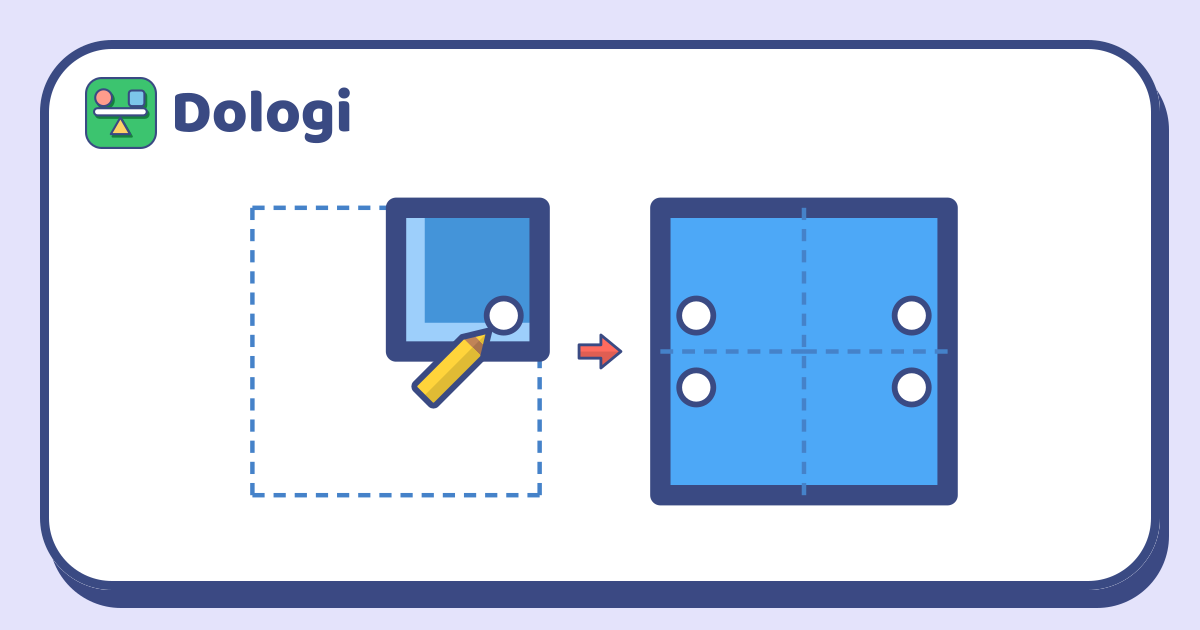
Fold a sheet of paper, poke one hole through it, and ask: "How many holes will there be when we open it, and where?" Most children say "one". When they open the sheet and find two, or four, they want to try again straight away. That surprise is the start of a very useful skill: picturing a change in your head before you see it.
Below are fold-and-punch puzzles for children aged roughly 6 to 12, from one fold to three, a routine for drawing the guess before opening, and the answers at the end.
What you need and how to punch safely
- A few square sheets of thin paper. Printer paper cut into squares works well.
- A sharpened pencil, and something soft to punch into: an eraser, a lump of play dough or a folded towel.
- A second sheet the same size for drawing predictions.
Lay the folded paper on the soft base and push the pencil tip straight down through all the layers. Stay close by with younger children; for thick stacks, an adult can punch while the child guesses.
Start with one fold
Puzzle 1. Fold a square in half from left to right. Punch one hole near the top corner on the right, where the loose edges are, well away from the fold. Ask: "How many holes when we open it, and where?"
Puzzle 2. Fold a new square the same way. This time punch the hole halfway down, just next to the fold.
Before opening, help your child notice two things:
- The pencil went through two layers, so there will be two holes.
- The fold is a mirror line. The second hole is the same distance from the fold, on the other side. A hole far from the fold opens into two holes far apart; a hole close to the fold opens into two holes close together.
A good habit: run a finger along the edges of the folded sheet. The edge that is joined is the fold; the edges that open are the outside of the sheet.
Two folds, four layers
Puzzle 3. Fold a square in half from left to right, then in half again from bottom to top. You now have a small square, a quarter of the size. Punch one hole in the middle of it.
Count the layers first: one fold makes 2, a second fold makes 4. As long as the hole is away from every fold, number of layers = number of holes. So four holes. But where? Open one fold at a time, starting with the last one, and find each mirror hole as you go.
When that is easy, add a third fold. Fold in half three times, and the pencil goes through 8 layers, so there are 8 holes. Use thin paper here, or let an adult punch.
Harder versions: diagonal folds and holes on the fold
- Puzzle 4, a diagonal fold. Fold a square corner to corner to make a triangle. Punch a hole near the middle of the long side, just next to the fold. Ask where the two holes will be.
- Puzzle 5, a hole on the fold. Fold a square in half and push the pencil right through the fold itself, halfway along. How many holes now?
- Puzzle 6, the corner of two folds. Fold into quarters as in puzzle 3, then punch at the corner where both folds meet.
Puzzles 5 and 6 catch many children out, because the "layers = holes" rule no longer works. A hole on a fold is shared by both sides, so it doesn't double.
Draw the guess before you open
Guessing out loud is fine. Drawing the guess is better, because your child can then check it on their own.
- Fold the drawing sheet exactly like the puzzle sheet, then open it flat. The creases show where the mirror lines are.
- Your child draws a dot wherever they think a hole will be.
- Open the punched sheet and lay it on top of the drawing.
- Compare: are the holes and dots in the same places? If not, which fold was forgotten?
Work backwards (ages 10–12)
Older children enjoy the reverse question: here is the opened sheet, how was it folded and where was it punched?
- Puzzle 7. An opened sheet has one hole near each of its four corners. It was folded twice and punched once. How?
- Puzzle 8. An opened sheet has only two holes, near the top-left and bottom-right corners. It was folded once. How?
- Puzzle 9. An opened sheet has a single hole, right in the middle. Find two different ways to make it.
Ask your child to test each idea with a real sheet.
In Dologi, "Fold and punch" puzzles in the Space topic show a sheet being folded and punched, and children choose which sheet shows it opened. The hint is the same as in this post: holes go through every layer, and each hole gets a mirror hole across the fold.
Answers
- Puzzle 1: two holes along the top, one near the left corner and one near the right corner.
- Puzzle 2: two holes in the middle of the sheet, close together, one on each side of the fold.
- Puzzle 3: four holes, one in the middle of each quarter of the sheet. With three folds and the hole in the middle of the small piece: 8 holes in two evenly spaced lines of four.
- Puzzle 4: two holes near the center of the sheet, one on each side of the diagonal fold.
- Puzzle 5: a single hole, sitting on the fold line.
- Puzzle 6: a single hole, in the very middle of the sheet.
- Puzzle 7: fold in half and in half again, then punch near the corner of the small square where all the loose corners of the sheet lie.
- Puzzle 8: fold along the diagonal that joins the top-right and bottom-left corners, so the top-left corner lands on the bottom-right corner, then punch near that corner.
- Puzzle 9: fold in half once and punch on the fold, halfway along; or fold into quarters and punch at the corner where both folds meet.
In short
- Fold, punch one hole, and ask for the number and places of the holes before opening.
- Away from the folds, each fold doubles the layers, and every layer gets a hole.
- The fold is a mirror line: each new hole is the same distance from it, on the other side. A hole on a fold doesn't double.
- Draw the guess on a sheet folded the same way, then lay the opened sheet on top to check.
Read more: One sheet of paper, three challenges for ages 7–12: cut a hole big enough to step through, and how many times can you fold it? · Grid drawing and symmetry for children: copy, mirror and fold to check