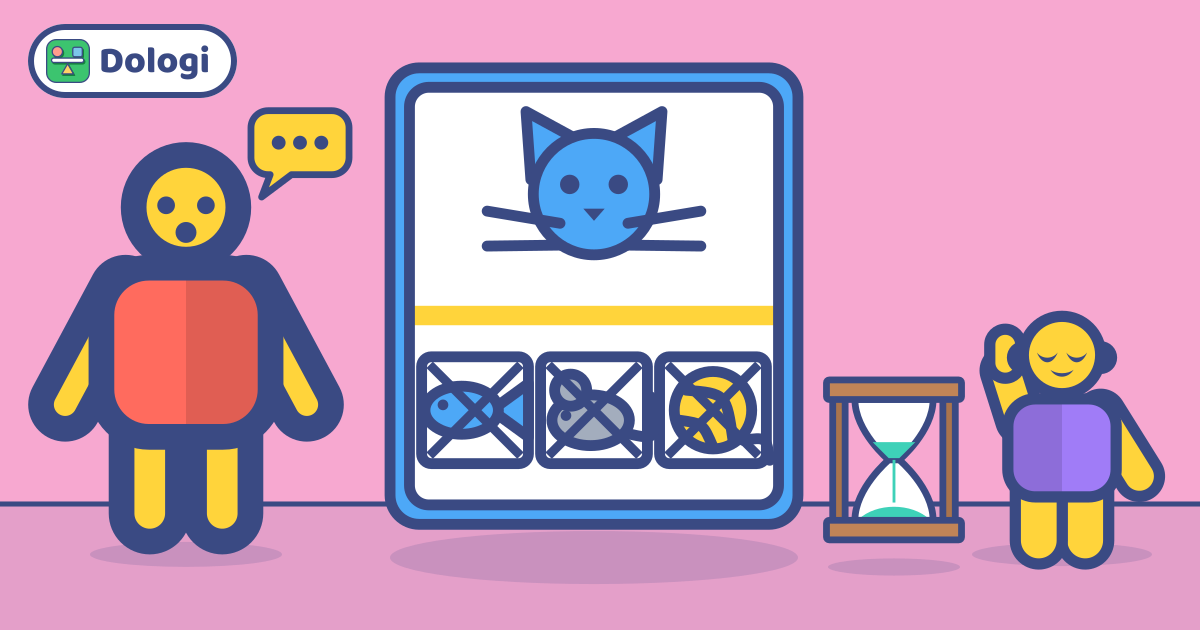
Ask your child, "What does a cat like to eat?" and the answer comes right away: "Fish!" Now turn it around. How do you get your child to say "cat" when you're not allowed to say "fish", "mouse" or "ball of yarn"? You have to find another way: "It's the pet that naps in the sunny window, says meow, and Grandma's has orange stripes."
That's the forbidden words game. All it takes is a few homemade paper cards and an hourglass. It suits children from about 8 to 12, and younger ones can play an easier version. The describer practices explaining clearly in a roundabout way, and the guessers practice listening to every clue and putting them together. This article covers how to play, how to make the cards together, describing tricks and how to adjust the rules by age.
How to play
- Make cards. Each card has the main word at the top and two or three forbidden words below: the words almost everyone would say first.
- Split into two teams. With only a few players, play all together and whoever guesses first gets the point.
- Turn over a one-minute hourglass. The describer draws a card and describes it for their team. Once it's guessed, they draw the next one, as many as they can.
- Pick a watcher. Someone from the other team looks at the card too. If the describer says the main word or a forbidden word, the watcher calls "Buzz!" and that card is out.
- Keep score. One point for each card guessed. When time is up, the other team takes a turn.
Besides the forbidden words on the card, agree on a few more rules:
- No saying part of the main word (for "bicycle", no "bike" or "cycle").
- No gestures or acting it out.
- No "it rhymes with…", "it starts with C" or "it sounds like…".
- No saying it in another language.
Also agree on a pass rule: one free skip per turn, or every skip costs a point.
Making the cards together
Making the cards is half the fun, and it's a small thinking exercise of its own. To pick the forbidden words, your child has to ask: "If I had to describe this, what would everyone say first?" Those are exactly the words to forbid.
Some sample cards:
| Main word | Forbidden words |
|---|---|
| Cat | fish, mouse, ball of yarn |
| Pancakes | syrup, breakfast, flip |
| Backpack | school, books, carry |
| Umbrella | rain, wet, open |
| Snowman | snow, carrot, winter |
| Library | books, quiet, borrow |
For children who don't read well yet, use picture cards: draw a big cat, then draw a fish, a mouse and a ball of yarn small underneath and cross them out. One look tells them what they can't say. Keep the finished cards in an envelope and add a few new ones every time you play.
Tricks for describing in a roundabout way
Children often get stuck on the first sentence, because the easiest word is forbidden. Practice a few other ways in:
- Say what group it belongs to (if that word isn't forbidden): "It's an animal people keep at home."
- Describe how it looks: color, size, shape, how many legs.
- Say where you find it: "It likes sleeping on the windowsill."
- Say what it does or what you do with it: "It's great at climbing trees."
- Say what it's the opposite of: "Unlike a dog, it doesn't need walks."
- Use a family memory: "Grandma has one called Ginger."
- Leave a gap: "It's raining … and dogs."
The guessers have a job too: listen to every clue and combine them, instead of shouting out random words. "A pet, great at climbing, says meow" is three clues, and that's enough to be sure.
Levels by age
These ages are rough guides only. Every child is different.
| Age (approx.) | How to play |
|---|---|
| 5 to 7 | Picture cards, no forbidden words. Just don't say the main word. No timer |
| 8 to 10 | Two forbidden words per card, one minute per turn, everyday words from home and school |
| 11 to 12 | Three or four forbidden words, harder words like jobs, feelings, places and school subjects, less time |
With mixed ages, make teams of one adult and one child. Adults get harder cards or an extra forbidden word so the game stays fair.
After each round
A short chat after the round helps your child remember good tricks for next time:
- Ask about the best clue: "Which clue made you get it right away?" "Who had the cleverest description?"
- Collect describing tricks: stick a sheet on the fridge and write down the ones the family liked.
- Don't laugh at someone who gets stuck. Everyone's mind goes blank sometimes while the sand is running. Offer a nudge: "Try saying where you find it."
- Shy children can describe in a pair with a parent, taking turns giving clues.
In Dologi, the Logic topic has a puzzle called "Who lives here?": your child looks at clue cards and works out which animal lives in the house with the question mark. Just like the guessers in this game, they find the answer from clues about its features, not from its name.
In short
- Each card has a main word and two or three forbidden words. The describer has one minute to get their team to guess as many cards as possible.
- Make the cards together: picking forbidden words means asking "what would everyone say first?" Use picture cards with crossed-out pictures for children who don't read well yet.
- Describe in a roundabout way through group, looks, place, use and family memories. Guessers listen to every clue and put them together.
- After each round, talk about the best descriptions and never laugh at someone who gets stuck.
Read more: A family drawing and guessing game: rules, homemade word cards and helping your child not mind "bad" drawings, Describe and draw: a listening game that helps children listen closely and explain clearly, Guess the animal from its moves: an acting game without words