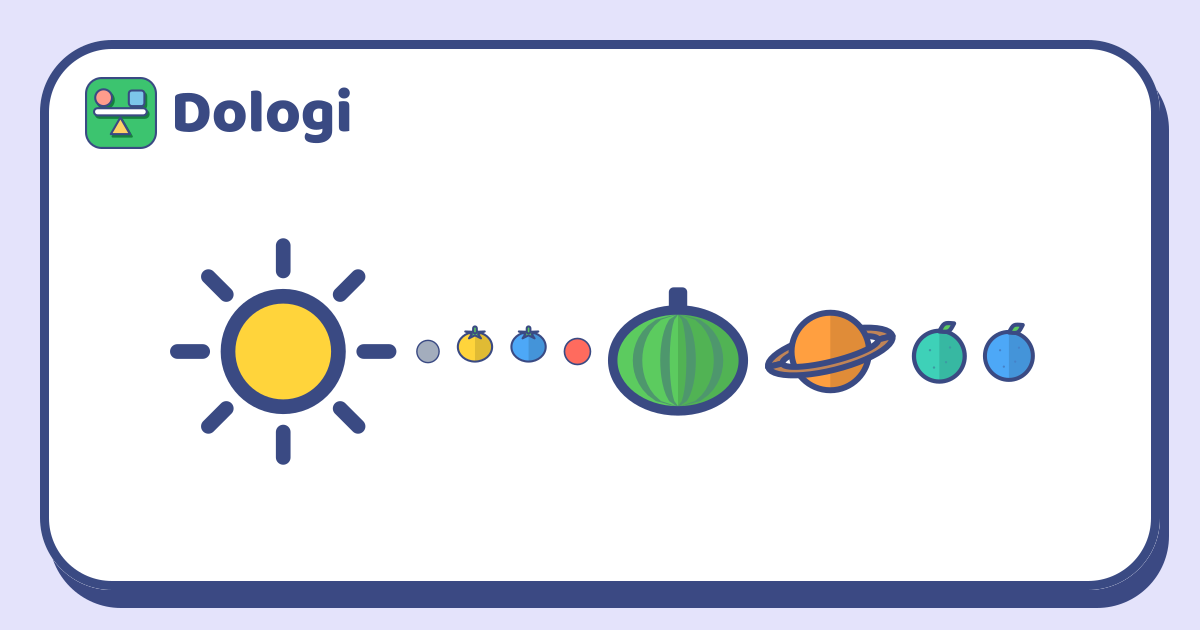
Pictures of the solar system usually show the planets in a neat row, all fairly close to the Sun. It looks tidy, but it hides the most surprising part: how different the planets are in size, and how far apart they really are.
A fruit bowl is enough to show that. In this activity your child picks fruits to stand in for the planets, puts them in order, works out how big the Sun would have to be, and then walks the distances. It suits children from about 4 to 12; younger ones line up and name the fruits, older ones do the measuring and the sums.
What you need
- Eight round fruits or vegetables of different sizes. A pea, a couple of grapes or cherry tomatoes, a blueberry, two oranges or apples, and one or two big fruits such as a melon, a watermelon or a pomelo. Use whatever your kitchen has; the sizes matter more than the names.
- A strip of paper or card to make a ring for Saturn.
- A ruler or tape measure, for children who want to check sizes.
- Paper and a pencil to note guesses and results.
- Some space: a hallway, a garden or a park for the distance walk.
Line up the planets by size
Put all the fruits on the table and ask your child to line them up from biggest to smallest. Then tell them which planet each fruit will be, starting with the biggest:
- Jupiter: the biggest fruit
- Saturn: the second biggest (add the paper ring)
- Uranus and Neptune: two fruits of almost the same size
- Earth and Venus: two small fruits that are nearly twins
- Mars: smaller still
- Mercury: the smallest of all
Now the twist: ask your child to put them in order from the Sun instead. The order is Mercury, Venus, Earth, Mars, Jupiter, Saturn, Uranus, Neptune. The line changes completely: four small planets close to the Sun, then four big ones further out. Two lines made from the same fruits, sorted by different rules, is a nice first step in comparing and ordering.
For children aged about 4 to 6, this part is plenty. Let them hold each fruit, say its planet name and count how many small ones would fit across the big one.
A size model that is closer to the truth
Older children can make the sizes match properly. Pick a grape or cherry tomato about 2 cm wide as Earth, and use the "times as wide as Earth" column to find the size of everything else.
| Planet | About how many times as wide as Earth | Size if Earth is 2 cm | Fruit idea |
|---|---|---|---|
| Mercury | 0.4 | 8 mm | a pea |
| Venus | 1 | 2 cm | a grape or cherry tomato |
| Earth | 1 | 2 cm | a grape or cherry tomato |
| Mars | 0.5 | 1 cm | a blueberry |
| Jupiter | 11 | 22 cm | a small watermelon or a big pomelo |
| Saturn | 9 | 18 cm | a melon, with a paper ring about twice as wide |
| Uranus | 4 | 8 cm | an orange or an apple |
| Neptune | 4 | 8 cm | an orange or an apple |
| Sun | 109 | 2.2 m | no fruit is big enough! |
Before you show the last line, ask your child to guess how big the Sun would be in this model. Guesses are often far too small. At this scale the Sun would be a ball about 2.2 meters wide, taller than a door. Mark that height on a wall or door frame with a piece of tape, and stand the little grape next to it.
Two questions for children aged about 10 to 12 (answers below):
- Jupiter is about 11 times as wide as Earth. If Earth is a 2 cm grape, how wide is Jupiter?
- If the Sun shrank to a 22 cm watermelon, how big would Earth be?
Answers: 11 × 2 cm = 22 cm. For the second, the Sun is 109 times as wide as Earth, so Earth would be 22 cm ÷ 109, about 2 mm: roughly a sesame seed.
Walk the distances
Now for the space between the planets. Here one model can't do both jobs. If Earth is a 2 cm grape, it would sit about 235 meters from the Sun, and Neptune would be about 7 km away. That is why books squeeze everything together.
So make a second, separate model just for distances. Let one step stand for the distance from the Sun to Earth. Start at a "Sun" (a ball or a chair) and have your child walk out, leaving a fruit or a paper marker at each planet:
| Planet | Steps from the Sun |
|---|---|
| Mercury | less than half a step |
| Venus | almost 1 |
| Earth | 1 |
| Mars | 1 and a half |
| Jupiter | 5 |
| Saturn | 9 and a half |
| Uranus | 19 |
| Neptune | 30 |
Indoors, use one floor tile or a 10 cm strip of paper per step; 30 steps then fit in about 3 meters of hallway. Then stand at Neptune and look back: the first four planets are all bunched up next to the Sun, and the rest is mostly empty space. Ask your child what surprised them most and write it down.
You may also be asked about Pluto. Since 2006 it has been called a dwarf planet, which is why the list now has eight planets.
Planet names and the days of the week
Some planet names are hiding in English words your child already knows. Saturday is Saturn's day, and Sunday and Monday come from the Sun and the Moon.
To remember the order from the Sun, make up a silly sentence together where each word starts with the same letter as a planet: M, V, E, M, J, S, U, N. For example: "My Very Excited Mouse Jumps Sideways Under Noodles." A sentence your child invents is usually the one they remember best.
Ordering things by size, from smallest to biggest or the other way round, is also the idea behind the "Put in order" puzzles in the Math topic in Dologi, where children arrange pencils from shortest to longest, weights from heaviest to lightest or glasses from least water to most.
In short
- Line up eight fruits by size, then by distance from the Sun, and compare the two lines.
- With Earth as a 2 cm grape, Jupiter is a 22 cm melon and the Sun would be taller than a door.
- Distances need a separate model: one step from the Sun to Earth puts Neptune 30 steps away.
- Let your child guess before each reveal, and invent their own sentence to remember the planet order.