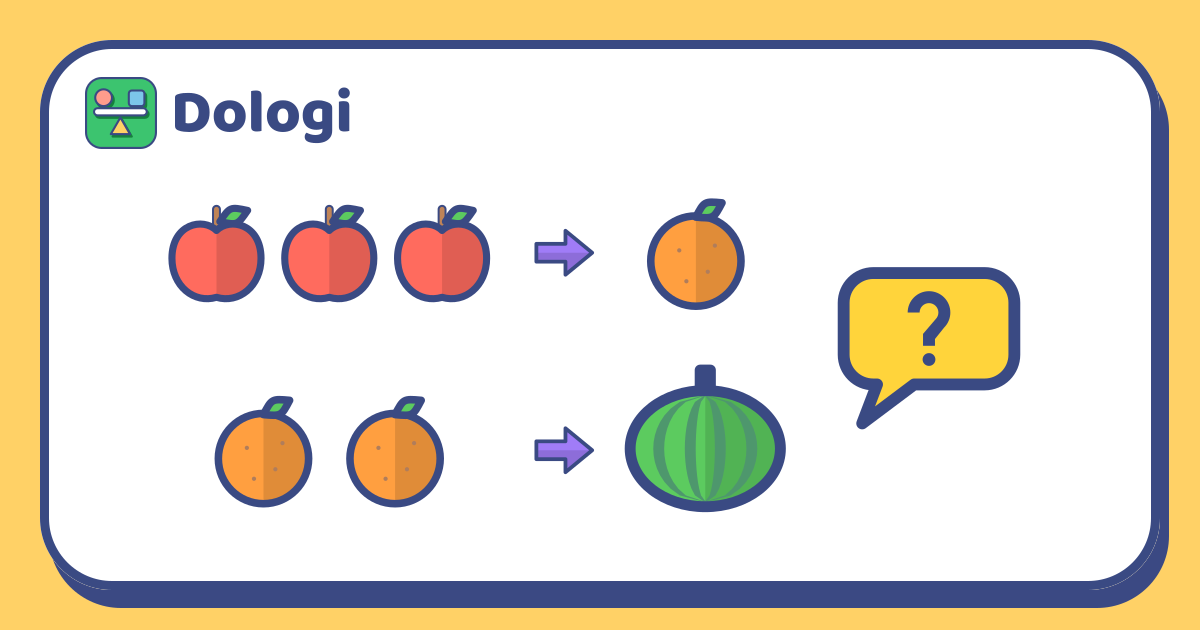
Three apples get you one orange. Two oranges get you one watermelon. So how many apples do you need for a watermelon? Many children answer "five", adding 3 and 2. Others line up apples on the table, group them in threes, and find the real answer: six.
Trading puzzles like this one are a small market where each card says what is worth the same as what. They suit children of about 7 to 11. Younger ones play with real fruit or counters; older ones work on paper and are soon solving chains of three or four trades. Below you'll find how to set up the game, three kinds of puzzles with answers, and questions that help when your child gets stuck.
Set up the market
You need a few pieces of real fruit, or counters in different colors, and some paper cards.
- A trade card shows two sides with a line between them, for example three apples on one side and one orange on the other. Both sides are worth the same.
- A card works both ways. Three apples get you an orange, and an orange gets you three apples.
- You can use a card as many times as you like. With six apples, you can make the "3 apples for 1 orange" trade twice.
Draw the fruit on the cards rather than writing numbers at first. When children can see three little apples, they understand the trade before they need to calculate it.
Puzzle 1: chain two trades
Here the answer comes from using one card after another.
- 3 apples = 1 orange and 2 oranges = 1 watermelon. How many apples for one watermelon?
- 2 bananas = 1 pear and 1 pear = 4 strawberries. How many strawberries for 3 pears? And how many bananas for 8 strawberries?
- 1 watermelon = 4 oranges and 1 orange = 3 apples. You have 15 apples. How many oranges can you get? Is that enough for a watermelon?
If your child says "five" for the first question, don't correct them straight away. Ask them to put out the fruit: "Show me two oranges made of apples." Seeing two groups of three usually settles it.
Puzzle 2: which basket is worth more?
Two baskets hold different fruit, so you can't compare them by counting. The trick is to turn both into the same kind of fruit, usually the smallest one.
Cards: 1 orange = 3 apples, 1 pear = 2 apples, 1 watermelon = 2 oranges.
- Basket A has 2 oranges and 1 apple. Basket B has 3 pears. Which is worth more?
- Basket C has 1 watermelon and 1 apple. Basket D has 3 pears and 1 apple. Which is worth more?
A table helps children keep track:
| Basket | Fruit | In apples |
|---|---|---|
| A | 2 oranges + 1 apple | ? |
| B | 3 pears | ? |
Counting fruit is a trap here: basket B has more pieces of fruit than basket A, but that doesn't make it worth more.
Puzzle 3: the missing number
Now the trades are written with numbers and one number is missing. This is also where children learn a useful trick: a card with more than one fruit on both sides can be split into smaller identical cards. "2 oranges = 6 apples" is the same as two cards that each say "1 orange = 3 apples".
- Cards: 2 oranges = 6 apples, 4 apples = 2 pears, 4 oranges = 1 watermelon. Fill in: 1 watermelon = ? pears.
- Same cards. Fill in: ? apples = 2 pears + 1 orange.
- Challenge: 2 pears = 5 bananas. Can you get exactly 3 pears with bananas, without cutting a banana in half?
Answers
Puzzle 1
- 6 apples. One orange is 3 apples, so two oranges are 3 + 3 = 6 apples.
- 12 strawberries (3 pears × 4). For 8 strawberries you need 2 pears, which is 4 bananas.
- 5 oranges (15 ÷ 3). A watermelon costs 4 oranges, which is 12 apples, so yes: after the trade, 3 apples are left over.
Puzzle 2
- A = 3 + 3 + 1 = 7 apples, B = 2 + 2 + 2 = 6 apples. Basket A is worth more, even though it has fewer pieces of fruit.
- A watermelon is 2 oranges, which is 6 apples, so C = 7 apples. D = 6 + 1 = 7 apples. They are worth exactly the same.
Puzzle 3
- 6 pears. Split the cards: 1 orange = 3 apples, 2 apples = 1 pear. A watermelon is 4 oranges = 12 apples = 6 pears.
- 7 apples. 2 pears are 4 apples, 1 orange is 3 apples.
- No. Every 2 pears cost 5 bananas, so 3 pears would cost 7 and a half bananas. With whole bananas you can get 2 pears (5 bananas) or 4 pears (10 bananas), but not exactly 3.
Why these puzzles are worth playing
- Multiplication with a reason. "Two oranges, each worth three apples" is the equal groups idea behind multiplication.
- The equals sign means "worth the same". Children see that the two sides can be swapped, which helps later with equations.
- Converting units. Changing coins into notes, hours into minutes or meters into centimeters works the same way: one big unit equals a fixed number of small ones.
- Keeping track of several steps. Writing down each trade, or drawing it, is a habit that helps with any word problem.
Remember that the cards are the rules of the game. In a real market, what things are worth is something people agree on, and it can change. That can be a nice conversation in its own right.
When your child gets stuck
- Go back to real objects. Put out the fruit or counters and actually make the trades.
- Ask which fruit to count in. "Let's turn everything into apples" is often the first step.
- Trade back. "If you trade your orange back, how many apples do you get?" checks the answer.
- Swap roles. Your child makes the trade cards and a puzzle for you, and checks your answer.
In Dologi, the "Fruit swap" puzzles in the Math topic work just like these cards: both sides of every card are worth the same, and children find the number that goes on the bottom card, splitting cards into smaller ones when they need to.
In short
- A trade card says that two sides are worth the same; it works both ways and can be used as many times as needed.
- To chain trades, use one card after another: 3 apples for an orange and 2 oranges for a watermelon make 6 apples, not 5.
- To compare two baskets, turn everything into one kind of fruit; counting pieces of fruit can mislead.
- Start with real fruit or counters, then move to drawings and numbers, and let your child make puzzles for you.
Read more: What is multiplication? Explaining equal groups to a 7-year-old