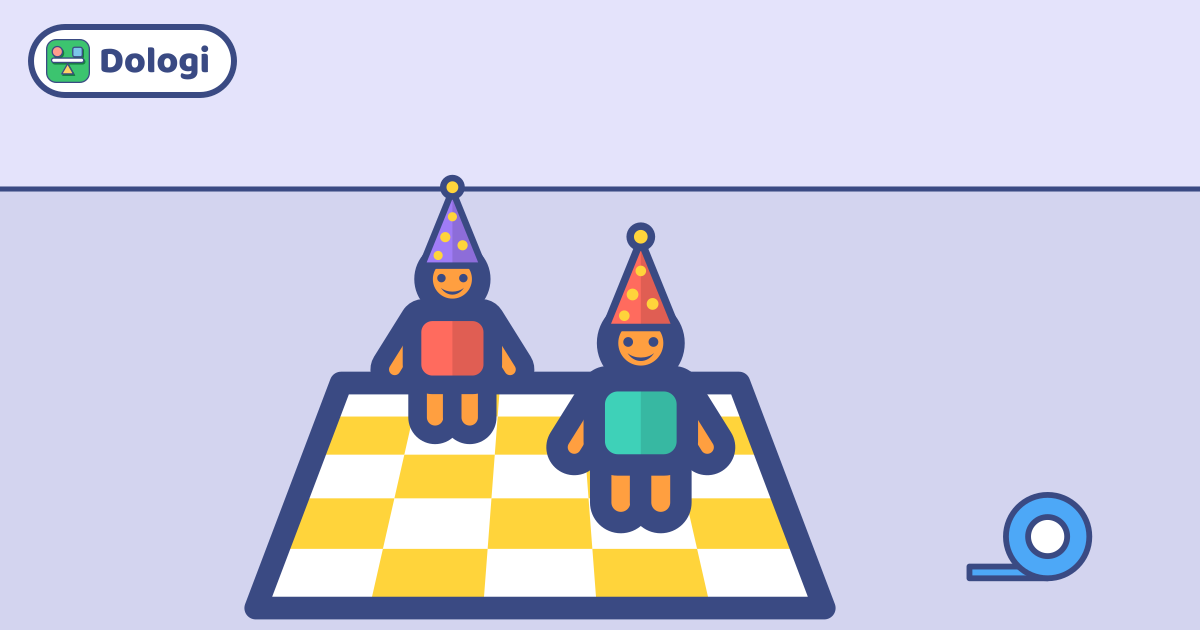
Some kids last three minutes at a chessboard before they start wiggling, standing up and running laps around the table. It's not that they don't like chess; they just learn more with their bodies than with their eyes. For kids like that, instead of asking them to sit still, bring the whole game down to the floor: a huge board, and your child is the piece.
Here's how to make a giant chessboard from things you already have at home, and six games that help your child learn how each piece moves with their own two feet.
Why a giant board works for active kids
- They get to move. Every move is a few real steps, so they're learning and moving at the same time.
- The moves stick. Walking an L shape while counting "one, two, turn" helps the knight's move stay with them longer than seeing it on paper.
- They see the board from inside. Standing in the middle, they look out in every direction and really get rows, columns and diagonals.
- Lots of people can join. Siblings, friends and parents all get a role: piece, commander or referee.
Building the board from things at home
- Masking tape in straight lines on the floor is the easiest option and usually comes up easily when you're done. Outside, use sidewalk chalk.
- Square size: each square should be big enough for your child to stand in with both feet, about one of their steps. A five-by-five board suits younger kids and smaller rooms; older kids with more space can go for the full eight by eight.
- Light and dark squares: lay colored paper or newspaper in every other square, or just stick one diagonal strip of tape across each dark square.
- Pieces: your child wears a folded paper hat with a piece drawn on it (knight, pawn, rook…). Not enough people? Use stuffed animals, cardboard boxes or plastic bottles with a picture of the piece taped on.
- Build it together the first time: count the squares and tape the lines as a team. Just by building it, your child learns how many rows and columns a board has.
Six games for the giant board
| Game | How to play | What your child learns |
|---|---|---|
| Knight to the target | Put a toy on one square. Your child is the knight and walks L shapes, "one, two, turn," to reach it in as few moves as possible | The knight's move, planning a route |
| Pawn race | Three or four people per side are pawns, stepping straight ahead one square and capturing diagonally. First to the far row wins | Pawn rules, taking turns |
| Rook clears the way | Your child is a rook, moving straight as far as they like until something blocks the way. Collect all the toys scattered on the board in as few moves as possible | Straight lines, obstacles |
| One-color bishop | Your child is a bishop and may only move diagonally. Ask, "Can you ever reach a square of the other color?" | Diagonals, square colors |
| King finds a safe square | You're a rook, standing still and pointing along the row and column you guard. Your child is the king, stepping one square at a time to find a square you don't guard | Guarded squares, check |
| Commander | One person stands outside the board and gives orders: "Corner knight, jump!", "Pawn, one step!" Everyone else follows | Listening, remembering the moves |
Start with one piece and one game. Once your child is comfortable, combine two: one side is a rook, the other side is a few pawns, and you play a small game right on the floor.
From the floor back to the small board
After a few rounds on foot, set up the same position on a small chessboard: "Remember, you were standing in this corner and jumped to here, right?" Your child will see that the small board is just the giant board shrunk down. Many active kids can then stay at the small board longer, because the moves already feel familiar. Some still prefer the giant board, and that's fine too.
You can also flip it around: solve a little puzzle on the chessboard, then stand up and "walk" the solution on the floor.
Keeping it fun
- Short games, swap roles often. Today your child is the knight, tomorrow the commander.
- Let your child invent the rules for a new game, then the whole family tries it.
- Say the move out loud while stepping: "The rook goes straight, one, two, three squares." Words that go with steps help the move stick.
- Stop while it's still fun. A taped board can stay down for a few days, and your child will come back to it.
When you want to keep playing without taping a board, the Chess room in Dologi's Creative corner has six Little games with these same familiar rules, like Pawn race, Pawns and rook and Pawns and knights, plus Two players mode so siblings can play together on one device, with the board flipping after each move if they like.
In short
- A giant board helps active kids learn chess with their whole body: every move is a few real steps.
- Build it with masking tape or chalk, squares about one step wide, five by five for younger kids; your child wears a paper hat as the piece.
- Six games to try: knight to the target, pawn race, rook clears the way, one-color bishop, king finds a safe square, commander.
- After playing on the floor, set the same position up on a small board so your child connects walking the moves with playing them.
Read more: My child can't sit still for five minutes: helping active children focus, Knights jump in an L, bishops slide diagonally