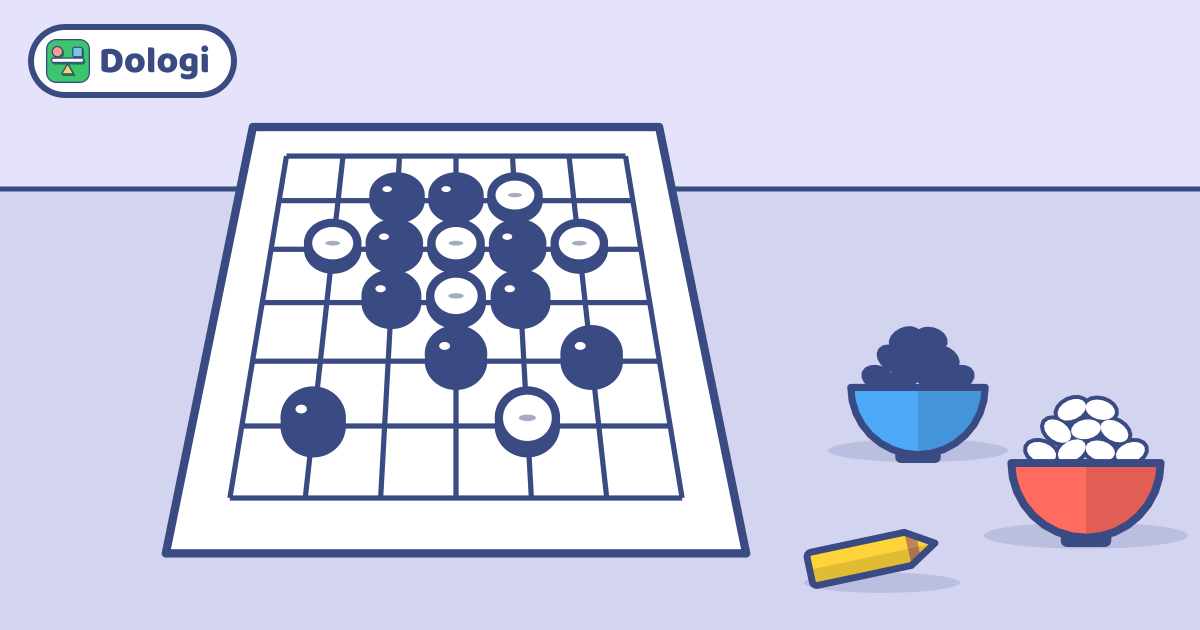
Go is a very old board game from East Asia, and it has fewer rules than checkers or chess: two players take turns placing stones, stones never move, and a stone that gets completely surrounded is captured. That's almost all of it. The depth comes from what children discover while playing, not from a long rulebook.
The full game is played on a big 19 × 19 board, which is far too much for a beginner. This guide starts small: a grid you draw on paper, beans for stones, and a first game where whoever captures a stone first wins. It suits children from about 6, and younger ones who enjoy placing beans can join in with a parent's help.
Making the board and stones
You need:
- A sheet of paper or the inside of a cereal box, a ruler and a dark pen.
- Beans in two colors, such as black beans and white navy beans, about 30 of each. Buttons or small paper circles colored in two colors work too.
- Two small bowls, one for each player.
Draw 7 lines across and 7 lines down, about 3 cm apart. The important part: stones go on the points where the lines cross, not inside the squares. Children who know tic-tac-toe or checkers often put the first bean in a square, so show it once with your finger.
| Board | Good for | A game lasts about |
|---|---|---|
| 7 × 7 lines | first games, around 6–7 | 5–10 minutes |
| 9 × 9 lines | once captures feel easy | 15–25 minutes |
| 13 × 13, then 19 × 19 | children who want more, usually later | much longer |
The one rule to learn first: liberties
Black plays first. Players take turns putting one stone on any empty point. Once a stone is down, it stays where it is.
Each stone needs empty points next to it along the lines. Go players call these liberties; with children you can call them "breathing spaces." Diagonal points don't count, only the points joined to the stone by a line.
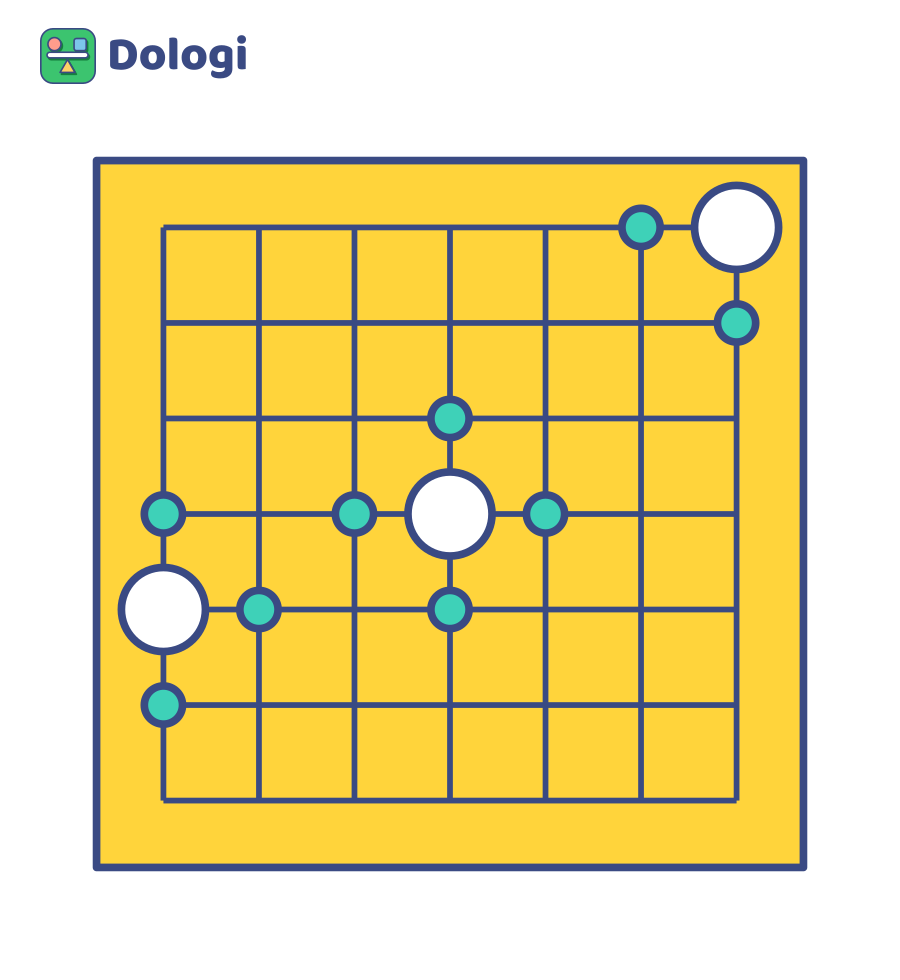
A stone in the middle has four liberties, a stone on the edge has three, and a stone in the corner only two. That alone teaches something useful: the corner is the easiest place to get trapped. Stones of the same color that touch along a line form a group and share all their liberties, so a group is harder to surround than a single stone.
The first game: whoever captures first wins
When the other player fills a stone's last liberty, that stone is captured and comes off the board. The same goes for a whole group: when the group has no liberties left, every stone in it is removed together.
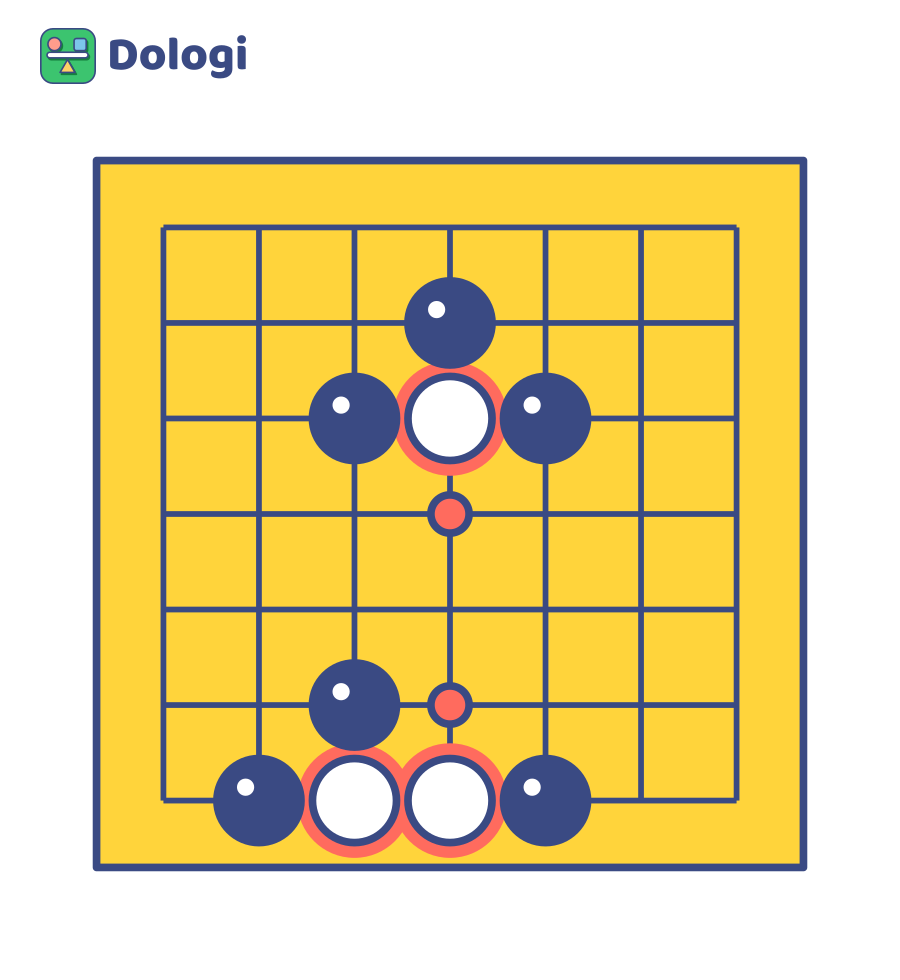
In the first weeks, play this simple version: the first player to capture a stone wins. Games are short, the goal is clear, and every move matters. Two small rules to add:
- Say it out loud when a stone is down to one liberty. It's a friendly warning in practice games, and it trains everyone to count liberties.
- You may not place a stone where it would have no liberties at all, unless that move captures the other player's stones first.
Play several games in a row and swap colors each time. Once your child wins often, change the goal to the first player to capture three stones, then five. Longer goals mean your child has to defend and attack at the same time.
The question before every move
Most beginner games are decided by one missed warning. Teach your child to ask before each move: "Which group has only one liberty left?" Check your own groups first, then the other player's.
- If it's yours, save it: add a stone to give it more liberties, or connect it to a stronger group.
- If it's the other player's, you can capture it right now.
Think out loud on your turns too: "My two stones only have one breathing space left, so I'll add one here." Hearing how you check the board helps your child build the habit faster than any explanation.
Moving on to the full game: surrounding territory
When captures come easily, move to the real goal of Go: surrounding more of the board than the other player. Capturing is still part of it, but now it's a tool, not the finish line.
- The game ends when both players pass in a row because no useful move is left.
- To count, each player gets one point for every stone on the board and one point for every empty point surrounded only by their own stones. More points wins.
- One new rule: if a stone has just captured a single stone, and taking it straight back would put the board exactly as it was a moment ago, that is not allowed right away, or the two players could swap forever. Play somewhere else first, then you may take it back.
Stay on the 9 × 9 board for a long time. It already holds plenty of interesting games, and a game short enough to finish keeps the fun going.
In Dologi, the "Color the map" puzzles in the Logic topic train the same way of looking at a board: what matters is not how big a region is but which regions touch each other, and the hint suggests starting with the region that touches the most others.
In short
- Draw a 7 × 7 grid on paper and use beans in two colors. Stones go on the crossing points, never move, and need empty points next to them along the lines.
- Start with the game where the first capture wins, then aim for three or five captures.
- Before each move, ask "Which group has only one liberty left?"
- Move to 9 × 9 and surrounding territory once captures feel easy.
Read more: Checkers for kids: draw the board on paper, use bottle caps, learn jumping and kings