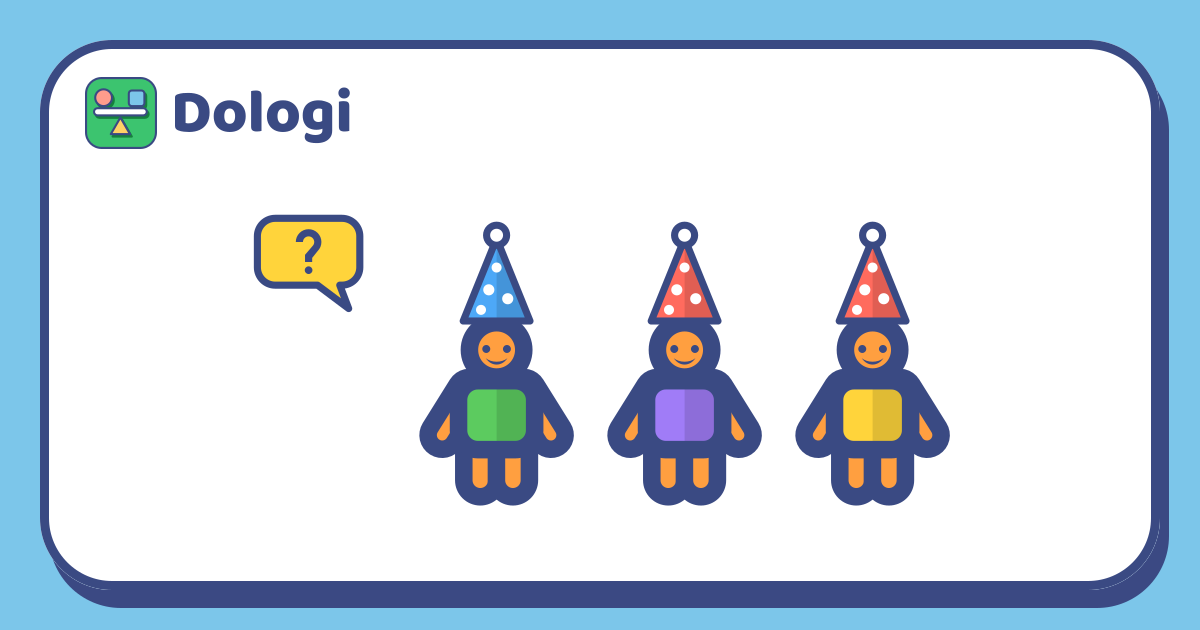
Three children stand in a line, each wearing a paper hat. Each one can see the hats in front of them, but not their own. One by one they say "I don't know"… until the child at the front, who can see no hats at all, suddenly says "I know mine!"
Hat puzzles are a wonderful step up for children around 10 to 12 who already enjoy logic puzzles. The trick is not in what the players see but in what they say: when someone says "I don't know", it tells everyone else something. This article gives the rules, four puzzles with full solutions and tips for acting them out with real paper hats.
The rules every hat puzzle needs
Hat puzzles only work when everyone plays by the same rules. Read them out before each puzzle:
- Everyone sees the hat supply first. For example: "In this bag there are 3 red hats and 2 blue hats." Each player gets one hat; the rest stay hidden.
- No one can see their own hat, and no one turns around, touches their hat or looks for a reflection.
- Players answer only with "I know, it's red", "I know, it's blue" or "I don't know", in the order the puzzle says.
- Everyone is honest and thinks carefully. This rule matters most: a player can trust that the others would have answered if they could.
Puzzle 1: two in a line (warm-up)
The hat bag holds 2 red hats and 1 blue hat. Two players stand in a line facing the same way. The back player can see the front player's hat. The front player can see no hats.
The back player says: "I don't know." The front player says: "Now I know my color!"
What color is the front player's hat, and how do they know?
Puzzle 2: three in a line
The bag holds 3 red hats and 2 blue hats. Three players stand in a line. The back player sees the two hats in front. The middle player sees only the front hat. The front player sees nothing.
The back player says: "I don't know." The middle player says: "I don't know." The front player says: "I know!"
What color is the front player's hat?
Puzzles 3 and 4: quick turn and bonus
Puzzle 3. Same bag (3 red, 2 blue), same line of three. This time the back player answers straight away: "I know, mine is red!" What did the back player see?
Puzzle 4 (bonus). Two players face each other, so each sees only the other's hat. There are plenty of red and blue hats. The adult says: "At least one of you is wearing a blue hat." Both players must answer at the same time. In the first round, both say "I don't know". In the second round, both say "I know!" What colors are their hats?
Answers step by step
Puzzle 1: red. The back player would only know their own hat if they saw the blue hat in front, because there is only one blue hat, so their own would have to be red. Since the back player said "I don't know", the front hat is not blue. So it is red.
Puzzle 2: red. A table of possibilities makes this clear. List every color pair the middle and front players could have, then cross out the ones that don't fit what was said:
| Middle | Front | Still possible? |
|---|---|---|
| Red | Red | Yes |
| Red | Blue | Yes, until the middle player speaks |
| Blue | Red | Yes |
| Blue | Blue | No: the back player would have seen both blue hats and known their own was red |
After the back player's "I don't know", the middle player knows the pair "blue, blue" is gone. The middle player can see the front hat. If it were blue, the only possible row left would be "red, blue", and the middle player would know their own hat was red. But the middle player said "I don't know", so the front hat cannot be blue. The front player follows this reasoning and knows: red.
Puzzle 3: two blue hats. With 3 red and 2 blue hats, the back player can only be sure when both blue hats are in front of them; then theirs must be red. If they saw any red hat in front, a blue or a red hat would still be possible for them.
Puzzle 4: both blue. Each player thinks: "If my hat were red, the other player would see red, know that at least one hat is blue, and say 'I know, mine is blue' in the first round. They didn't. So my hat isn't red: it's blue." Both think the same way, so both answer in the second round.
Playing it for real
Acting the puzzles out makes the reasoning far easier to follow than reading them.
- Make the hats: roll colored paper into cones and tape them, or clip a colored card to the back of a cap. Two clearly different colors work best.
- Place the players in a line facing a blank wall, away from windows, mirrors or a dark TV screen that could show a reflection.
- Start small. Begin with Puzzle 1 and let your child be the back player first, so they experience what "I don't know" means from the inside.
- Use the table. Before each answer, let your child write all possible combinations and cross them out one by one. The crossing out is where the thinking happens.
- Let your child set up the hats. Choosing the hats so that the puzzle still works is a great challenge: "Can you set them so the front player can't know?"
In Dologi, the "Who lives where?" puzzles use the same kind of step-by-step elimination: clue cards cross out houses one by one until each character has only one place left.
In short
- In hat puzzles, each player sees other hats but not their own, and must reason from what others say.
- "I don't know" is a clue: it rules out the situations in which that player would have known.
- A table of possibilities, crossed out row by row, makes the reasoning visible.
- Play it with real paper hats, starting with two players, and let your child design new puzzles.