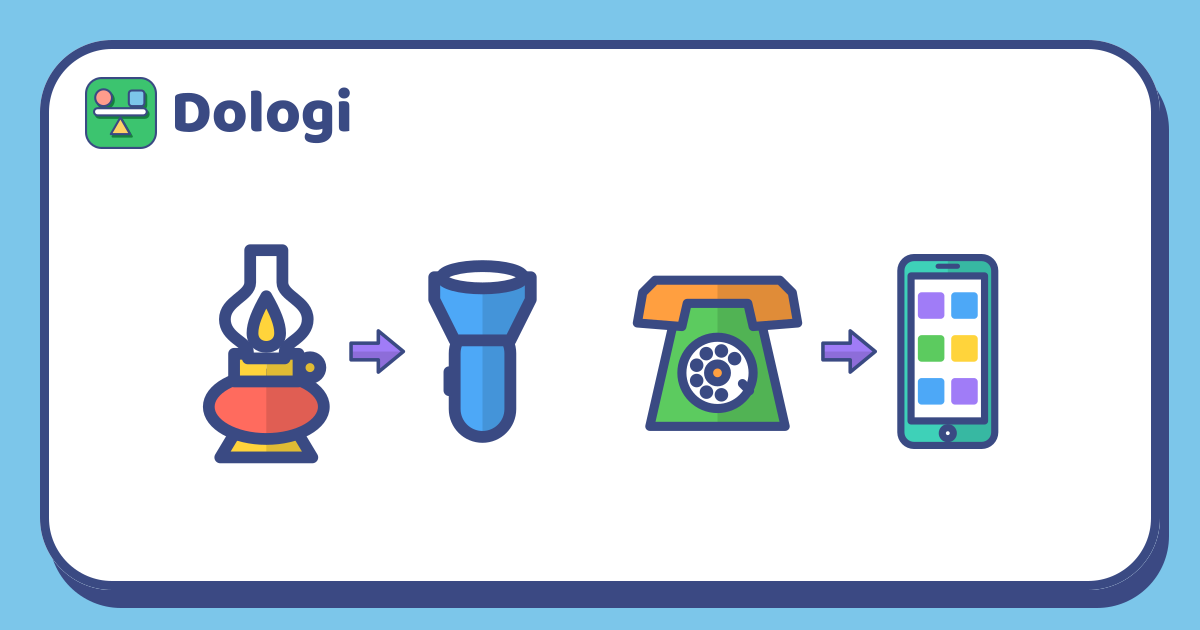
For many children, history sounds like a list of dates and names. But almost every family has clues to the past close at hand: an old lamp in a cupboard, a dial telephone at a grandparent's house, a camera that took film, a photo of the kitchen as it used to be.
This article shows how to turn those objects into a detective game. Your child looks closely, guesses what something was for, checks the guess, and then asks the big history question: why did it change?
Why old objects make history real
- Children can see and hold them. A heavy telephone with a dial says more about the past than a sentence in a book.
- They invite a real question. "What was this for?" has an answer your child can work out from clues, so they are reasoning, not just memorizing.
- They show change, not just facts. Putting an old object next to a new one makes children ask why people stopped using the old one.
- They connect generations. The best expert on a dial telephone is often a grandparent, and the object gives them a reason to tell their story.
How to play "What was this for?"
Choose one object, or a photo of one if the real thing is fragile. Then go through the steps of a detective:
- Look closely. What is it made of? Which parts move? Where would a hand hold it? Is it light enough to carry around?
- Guess out loud, with a reason. Ask your child to say "I think it was for… because…". A guess with a reason is worth more than a correct guess with none.
- Check the guess. Ask an adult who used it, or look it up together. Being wrong is part of the game: a good detective changes their mind when a new clue appears.
- Find today's version. Which object in your home does the same job now?
- Ask why it changed. Is the new one smaller, safer, faster, cheaper? Is there anything the old one did better?
Clues to look for
| Clue | Question to ask | Example |
|---|---|---|
| A place for fuel or water | What made it work? | An oil lamp has a base that holds oil and a wick that soaks it up |
| Holes, buttons or a handle that turns | How did people use it? | On a dial telephone you put a finger in a hole and turn the dial for each number |
| A glass or metal cover | What is it protecting? | The glass chimney on an oil lamp keeps the flame steady and away from fingers |
| Size and weight | Did it stay in one place or travel? | An old telephone sat on a table, joined to the wall by a cord |
| Wear and repairs | Was it used often? Was it fixed instead of replaced? | A worn handle, a mended crack |
Then and now: talking about why things change
Lay out pairs of objects, or pictures of them, and talk about what changed and why.
| Then | Now | A question to talk about |
|---|---|---|
| Oil lamp | Electric light, flashlight | What do you need for each one to work? Which one is safer? |
| Dial telephone at home | Cell phone | Why could the old phone not leave the house? |
| Camera with film | Camera in a phone | When could people first see the photo they took? |
| Letter in an envelope | Message on a screen | How long did news take to arrive? |
| Washboard and tub | Washing machine | Who did the work, and how long did it take? |
Help your child notice that change has reasons: a new kind of energy, smaller parts, safety, cost, or simply saving time. And not everything new is better. Old objects were often built to last for years and to be repaired. Asking "What did we lose?" is as good a history question as "What did we gain?"
Activities by age
| Age (roughly) | Activity |
|---|---|
| 4–6 | Sort a few pictures into "long ago" and "today", then match each old object with the new one that does the same job |
| 7–9 | Fill in a detective card for one object: draw it, write three clues, a guess and the answer after checking. Then ask a grandparent one question about it |
| 10–12 | Make a small "home museum" with a label for each object, or draw a timeline of one job, such as lighting a room: fire, candle, oil lamp, light bulb. Finish with a guess about what might replace today's objects |
A word about safety: old objects can be fragile, have sharp edges, or still hold old fuel or batteries. An adult handles them, nobody lights an old lamp, and a photo works just as well when the real thing is not safe to touch.
Looking at clues, making a guess and checking it is the same thinking children use in the "Guess the rule" puzzles in Dologi's Logic topic: they look at a set of things marked with a check mark, work out what they have in common and pick another one that fits.
In short
- Old objects are history your child can hold: start with one object or one photo.
- Play "What was this for?": look, guess with a reason, check, find today's version, ask why it changed.
- Compare then and now, and talk about both what was gained and what was lost.
- Let grandparents be the experts, and leave fragile or unsafe objects to adults.
Read more: Observation skills: teaching children to look closely before deciding, Teaching children to ask good questions