Your child reads the chapter three times, closes the book, and feels ready. The next day, at the quiz, half of it is gone. Rereading feels like studying because everything looks familiar, but looking familiar isn't the same as being able to say it without the page.
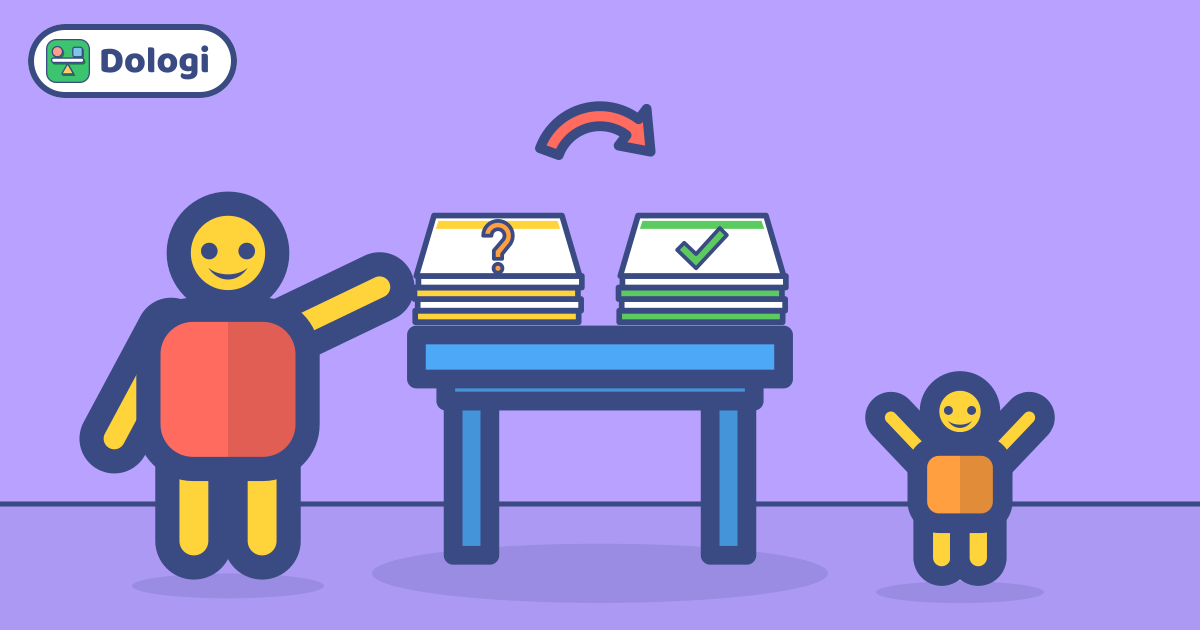
Homemade question cards fix that. A question on one side, the answer on the other: your child has to pull the answer out of their own head before checking. They cost almost nothing, work for nearly any subject, and turn review into something you can do together.
Why questions work better than rereading
When your child tries to answer from memory, two good things happen. Recalling the answer makes it easier to recall next time. And the cards they miss show exactly what needs more work, so practice goes where it's needed instead of where it's comfortable.
Coming back to the same cards after a day, then a few days, then a week also helps much more than doing them all in one long evening. Short and repeated beats long and once.
Making the cards
- Material: index cards, or sheets of paper cut into four. A pencil and a few colored markers.
- One idea per card. If the answer needs a long paragraph, split it into several cards.
- Front: the question. Back: a short answer, plus a little drawing if it helps.
- Let your child write them. Choosing what to ask and finding the answer in the notes or book is already a round of review. You can help phrase the questions.
- Start small: 10 to 15 cards for a topic is plenty. Add more later.
- Color by subject (a stripe or dot on the corner), so mixed piles can be sorted quickly.
For kids who don't read yet, use picture cards: draw on the front, and you read the question aloud.
If your child already takes notes, they make a great source: each heading or underlined idea can become a question. See teaching older kids to take notes.
Writing questions that make your child think
A card is only as good as its question. Some tips:
- One question, one short answer. "The water cycle" isn't a question.
- Avoid yes/no. A coin flip gets half of them right.
- Ask "why" and "how" too, not only names and dates.
- Flip it around. Make a second card that asks the same thing the other way.
- Use pictures. Draw a plant on the front with arrows pointing to parts; the names go on the back.
| Weak card | Better card |
|---|---|
| Math: "Multiplication" | "7 × 8 = ?" and another card: "56 = 7 × ?" |
| Science: "The water cycle" | "Where does the water in a puddle go on a sunny day?" Back: "It evaporates. It turns into water vapor and rises into the air." |
| Science: "Is a whale a fish?" | "Why is a whale a mammal and not a fish?" Back: "It breathes air and feeds its babies milk." |
| Spelling: "Words with silent letters" | "Spell the word for the part of your body between your hand and your arm." Back: "wrist" |
| Vocabulary: "enormous" | "What does enormous mean? Use it in a sentence." Back: "Very, very big. The whale was enormous." |
Front, back and two piles
- Shuffle the cards, so the order doesn't give answers away.
- Read the front and answer out loud (or on scrap paper) before turning the card over. No peeking, even for "I almost know it."
- Turn it and check. Got it? It goes on the "I know it" pile. Not yet? It goes on the "not yet" pile.
- Go through the "not yet" pile again until it's empty, or until the session is over.
- Next day, start with yesterday's "not yet" cards. Bring the "I know it" pile back a few days later, then after a week.
That's enough of a system for most families. For foreign-language words, a three-section box works well; see helping kids remember new words.
Ten minutes is plenty. Stop while your child still wants to keep going.
Quiz each other
Cards are even better as a game for two.
- Swap roles. Your child holds the cards and quizzes you. Get one wrong on purpose and let them correct you: explaining the answer is great practice, as in learning by teaching.
- Beat yesterday. Count the "I know it" pile at the end and compare with yesterday's count, not with a sibling's.
- Draw it. For some cards, the answer has to be a quick drawing instead of words.
- Mystery card. Mix in an old card from last month. Remembering it feels great.
- Card of the day. Stick one hard card on the fridge or bring it in the car for a quick question at a red light.
When your child is stuck, offer a small hint ("It starts with a p…") rather than the answer. And keep the tone light: a missed card is useful information, not a failure.
In Dologi's Memory topic, the What’s in the sack? puzzle uses the same habit: fruits fly into a sack one by one, some fly back out, and at the end your child answers from memory about what's still inside.
In short
- Answering from memory works better than rereading; homemade question cards make it easy.
- One idea per card, a clear question on the front, a short answer or drawing on the back, and let your child write them.
- Answer before flipping, sort into "I know it" and "not yet," and bring the cards back over several days.
- Quiz each other, swap roles and keep sessions short and light.
Read more: Reviewing for end-of-term tests without the stress, How to help children remember for longer, Helping kids remember new words