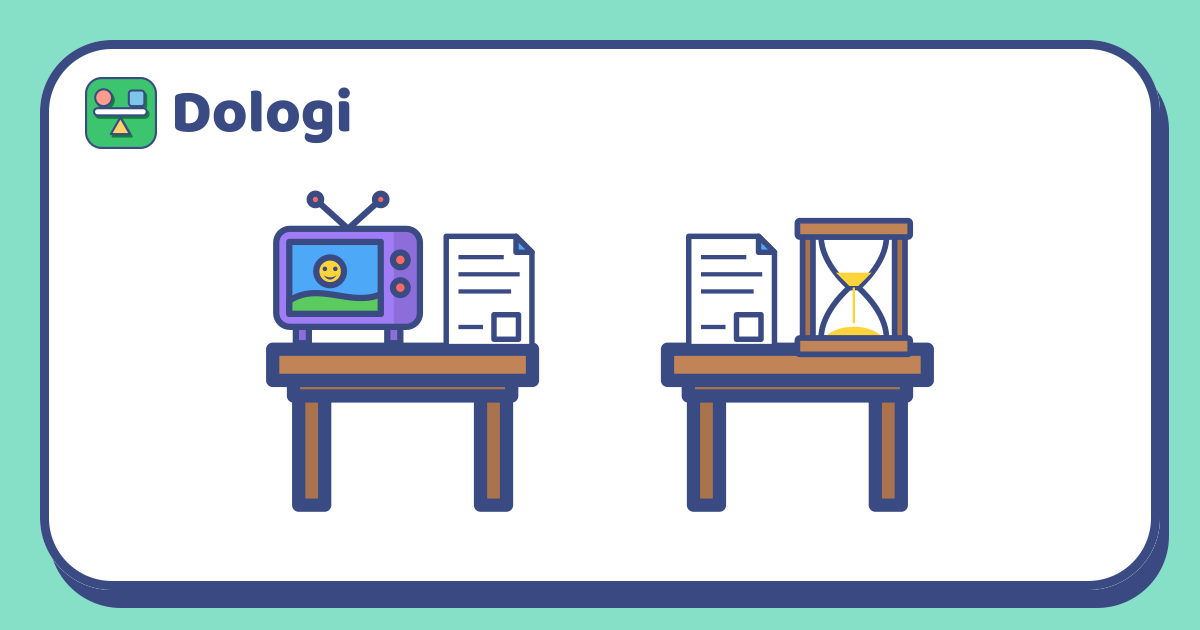
"I can do my homework and watch at the same time, it doesn't bother me!" Many parents have heard this sentence, often from a child sprawled on the sofa with a math book on their knees and a cartoon playing. Arguing rarely helps: you say the TV is a distraction, your child says it isn't, and nobody changes their mind.
There is a better way. Children aged about 7 to 12 love being the scientist, so turn the question into an experiment. Do the same kind of short task twice, once with the TV on and once in a quiet room, write down the time and the mistakes, and let your child look at the results and decide. This article shows you how to set it up, what to record, and how to extend it to music, phone notifications and choosing a place to study.
Why "doing both" feels easy
When we watch something and work at the same time, it often feels smooth. In practice, attention tends to jump back and forth: a glance at the screen, back to the page, find the place again, a laugh at a joke, back to the page. Each jump is small, so it is hard to notice from the inside.
That is why telling your child "you can't concentrate like that" does not convince them. It feels fine to them. An experiment lets them see the effect, or the lack of it, with their own eyes. And if the result surprises you, that is useful too: you learn something real about how your child works.
Setting up a fair experiment
The key idea is the one scientists use: change only one thing. Everything else stays the same, and only the TV is on or off.
- Choose a short task with two equal versions. For example, two sets of 15 sums of the same type, copying two paragraphs of the same length, or two pages of a spot-the-difference book. It should take about 5 to 10 minutes.
- Round A: TV on. Put on a program your child enjoys, at a normal volume, where they can see it from their seat.
- Round B: quiet. Same table, same chair, same pencil, TV off.
- Measure time. Use a kitchen timer or stopwatch. Your child starts it and stops it.
- Check mistakes afterwards. Mark the work together once both rounds are done.
Swap the order on another day (quiet first, then TV) so that being tired or warmed up doesn't decide the result. Do it at the same time of day if you can.
Recording and reading the results
Before starting, ask your child to predict: "Which round do you think will be faster? Which will have fewer mistakes?" Writing a prediction down makes the result more interesting, whichever way it goes.
Draw a small table on paper:
| Day | Round | Time | Mistakes | How it felt (easy / OK / hard) |
|---|---|---|---|---|
| 1 | TV on | |||
| 1 | Quiet | |||
| 2 | Quiet | |||
| 2 | TV on |
After two or three days, look at the table together and ask open questions: "What do you notice? Was there a difference in time? In mistakes? Did it feel different?" Let your child say the conclusion in their own words. If the difference is small, say so honestly. The point is to look at evidence, not to win the argument.
Music, phone notifications and other distractions
Once your child understands the method, they can test other things the same way:
- Music without words versus songs with lyrics. Some children find quiet instrumental music pleasant while working; songs with words may pull attention more, especially during reading or writing. Test it rather than guess.
- A phone nearby. Compare a round with the phone face up on the table and a round with it in another room. Even without a sound, a screen lighting up is something to look at.
- Noise in the house. A sibling playing, a conversation in the next room. You may not be able to remove these, but your child can test headphones without music, or a different spot.
Change one thing at a time, and keep the same task type so the rounds can be compared.
Letting your child choose where to study
The experiment is most useful when it ends with a decision your child makes. Using the results, agree together on a study spot and a few conditions: where to sit, whether music is allowed, where the phone stays. Write it down and try it for a week, then check how it is going.
Younger children (around 7 to 8) will need you to run the timer and the table; children of 10 to 12 can often plan and run the whole experiment themselves. Either way, a rule your child helped to discover is much easier to follow than one handed down.
The same goes for learning on a screen. Dologi has no ads, so nothing pops up in the middle of a puzzle, and a short session of the Focus topic works best at the quiet spot your child chose, with the TV off.
In short
- Arguing about TV and homework rarely changes minds; a small experiment lets your child see for themselves.
- Use the same type of short task twice, TV on and TV off, and change nothing else.
- Record time and mistakes over a few days, swap the order, and let your child state the conclusion.
- Use the same method for music, phones and noise, then agree on a study spot together.
Read more: How long can children focus at each age? · Fair test experiments for ages 7–11: change only one thing at a time