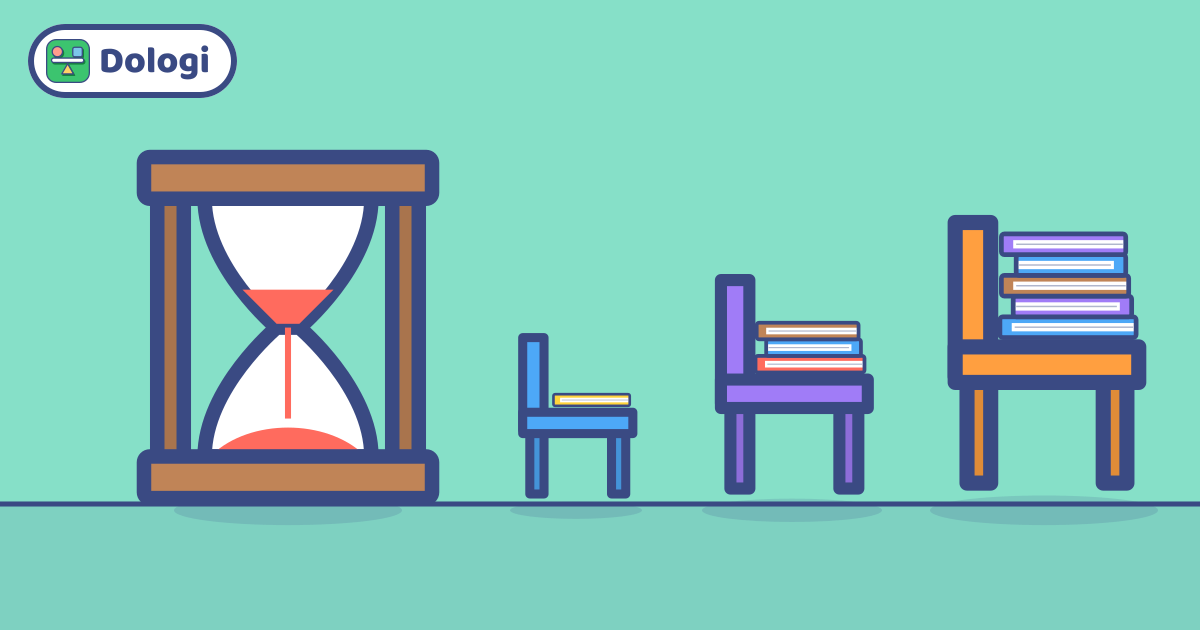
Some parents ask, "Is 20 minutes of homework really enough?" Others have the opposite problem: their child sits at the desk until 9 p.m. and everyone ends the night in tears. Both worries come from the same question: how much time at home is the right amount?
There is no single correct number. What matters is that the time is focused, that the school's work gets done, and that there is still room to play, move around, eat dinner together, and sleep. The numbers below are rough reference points, not rules. Every child is different.
Rough guides by age
These ranges count all the desk work at home on a school day: homework plus any extra practice. Reading for pleasure is listed separately, because it can be relaxed and cozy, like reading together at bedtime.
| Age (roughly) | Grade (US; UK in brackets) | Desk work in total | One block | Who helps |
|---|---|---|---|---|
| 6–7 | 1st–2nd (Year 2–3) | about 15–30 minutes | about 10–15 minutes | An adult close by |
| 8–9 | 3rd–4th (Year 4–5) | about 30–45 minutes | about 15–20 minutes | Starts some work alone |
| 10–12 | 5th–7th (Year 6–8) | about 45–60 minutes, sometimes more before tests | about 20–30 minutes | Plans their own order of tasks |
You may have heard the rule of thumb of about 10 minutes per grade: 10 minutes in 1st grade, 20 in 2nd, and so on. That is a handy way to picture it, but it is a rule of thumb, not a law.
A child who finishes faster and does good work is not "under-studying." The school's actual homework and your own child matter more than any table. If you are unsure, ask the teacher how long the homework is meant to take. Teachers usually have a good idea.
School days and days off
On a school day, your child has already spent many hours learning. By the time they get home, they are tired. So keep the at-home part to the core: what is due, plus reading.
Weekends and holidays can be lighter:
- One short block in the morning, for example 20 to 30 minutes of reading and a little review.
- The rest of the day is for free play, outings, helping with chores, and visiting family.
- A full day off now and then is fine.
- During long holidays, a light routine is enough to keep the habit going.
Split the time, don't stretch it
When a session drags, the answer is rarely more time. Try shorter blocks with a clear end:
- Use a kitchen timer or a sand timer so your child can see the time left.
- Take a 3 to 5 minute movement break between blocks: jump, fetch water, stretch.
- Do the hardest task first, while energy is fresh.
- Get everything ready before you start, so no one spends ten minutes hunting for an eraser.
For more on how this works, see Sitting at homework for ages without getting anywhere and How long can a child concentrate?.
Signs a session has run too long
Watch for these:
- Your child rushes "just to be done."
- The start is neat, but mistakes pile up toward the end.
- The handwriting gets worse and worse.
- Lots of yawning, slumping, and trips to the bathroom or kitchen.
- Tears or anger at the desk on most evenings.
- A 20-minute task stretches into an hour.
- There is no time left to play, or bedtime keeps getting pushed later because of homework.
One or two of these on a hard day is normal. If you see them most days, it is time to change something.
How to shorten it and still get enough done
- Cut dead time, not content. Get the desk ready, put the phone and TV out of sight, and do one task at a time.
- Start at a fixed time. "At four-thirty, after a snack" works better than "after you finish playing," which tends to drift.
- Do the essential part first. What is due tomorrow comes before optional practice. Practice only happens if energy is left.
- Stop at the agreed time on bad days. Write a short note to the teacher instead of fighting late into the night.
- Choose quality over quantity. Three neat lines can be better than ten rushed ones. Agree with the teacher before changing assigned work.
- Let your child plan the order. "Which one do you want to start with?" gives them a say and often gets things moving.
If homework regularly takes much longer than the teacher expects, or your child is very upset about it most days, talk with the teacher. If you have broader concerns, a doctor or a school counselor can advise. For ideas on the evening as a whole, see An evening routine for school-age kids.
In Dologi's Focus topic, the puzzle Tap in order asks your child to tap the numbers in order, from smallest to largest. A session has only a few puzzles and a clear end, so it fits into a short block of time instead of adding a long one. It works well as the "after homework" part of the evening, not as a replacement for school work or movement breaks.
In short
- There is no single right number: use about 15–30 minutes at ages 6–7, 30–45 at ages 8–9, and 45–60 at ages 10–12 as rough guides, and ask the teacher what the homework is meant to take.
- Keep school days to the core, and keep weekends and holidays light with plenty of free time.
- Split the time into short blocks with breaks instead of stretching it, and watch for signs a session has run too long.
- Cut dead time, not content, start at a fixed time, and talk to the teacher if homework is often far longer than expected.
Read more: Homework without shouting, An evening routine for school-age kids