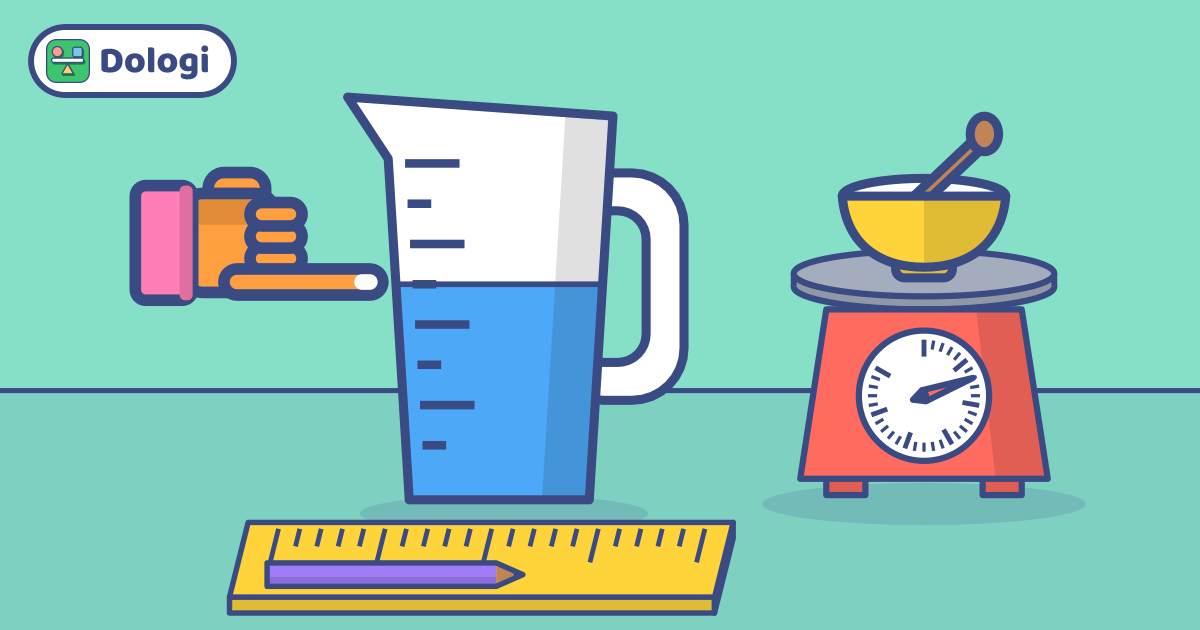
Your child measures a crayon and says "four inches." You check: it's three. Or they read the measuring cup and pour in twice as much milk as the recipe asks for. Mistakes like these rarely mean a child can't count. They usually mean nobody has explained what the lines are for. A ruler, a scale and a measuring cup all work the same way: the space between two lines is a fixed amount, and you count spaces, starting from zero.
This guide is for kids around 7 to 10, when these tools start showing up in homework and in the kitchen.
Counting lines instead of spaces
Watch your child measure something. Two habits cause most of the trouble:
- Starting at 1. The crayon goes against the line marked 1, ends at the line marked 4, and the child reads "4." But from 1 to 4 there are only three inch-long spaces.
- Counting the lines. Some children count every line they pass: 1, 2, 3, 4. That's four lines but only three spaces, so the answer comes out one too big.
A quick way to show the difference: lay a crayon on the ruler and have your child walk two fingers along it, one hop for each space between numbers. "One hop, two hops, three hops." Length is how many hops, not how many lines you stepped on.
Start at zero (and try the broken ruler)
On many rulers the zero line isn't at the very end; there's a small strip of plastic or wood first. Have your child find the 0 line and put the end of the object right on it. Then the number at the other end is the answer.
Once that feels easy, try the broken ruler trick: cover the start of the ruler with a sticky note, or pretend it snapped off. Now line the crayon up at 2. It ends at 5. How long is it? Your child can count the hops (three) or subtract (5 − 2 = 3). This is the moment it clicks that a length is the distance between the two ends, not the number where the object stops.
How much is each mark worth? Look at two numbers
Not every line is worth one. To figure out a mark, your child needs two labeled numbers next to each other:
- Pick two labels side by side, say 0 and 1, or 100 and 200.
- Count the spaces between them (not the lines).
- Divide the difference between the labels by the number of spaces.
| Where | Two labels | Spaces between | Each mark is |
|---|---|---|---|
| Centimeter side of a ruler | 0 and 1 cm | 10 | 1 mm |
| Outdoor thermometer | 60 °F and 70 °F | 5 | 2 degrees |
| Kitchen scale dial | 0 and 100 g | 5 | 20 g |
| Hanging scale in the produce aisle | 1 lb and 2 lb | 4 | 4 ounces (a quarter pound) |
| Measuring cup | 1 cup and 2 cups | 4 | ¼ cup |
The inch side of a ruler deserves its own word. Each inch is usually split into 16 tiny spaces, and the lines have different lengths: the longest one between two numbers is the half inch, the next longest are the quarters, then eighths, then sixteenths. Don't start there. First have your child find only the half-inch line, then the quarter-inch lines. Many US schools work on measuring to the nearest half and quarter inch around 3rd grade, so this is a good place to begin.
When the needle or the water lands between two lines, it's fine to say "about." Ask: "Which line is it closer to?"
In the kitchen: the scale and the measuring cup
Cooking together gives you a real reason to read marks. Before you start, look at the tools with your child:
- Zero the scale first. Put the empty bowl on, then turn the dial or press the button until the needle or display shows 0. That's the same rule as the ruler: start from zero.
- Read the measuring cup at eye level. Set the cup on the counter and have your child crouch down so their eyes are level with the line. Looking from above makes the water seem higher than it is.
- Pick one side. Many measuring cups have several scales on different sides: cups, ounces, milliliters. Choose one and stay on it.
- Let your child find the mark before you pour. For a pancake recipe that needs ¾ cup of milk, ask: "Where is ¾? How many quarter lines up from the bottom?" Your child points, you pour slowly, and they say stop.
A game: the scale with only two numbers
Draw a long line on paper and add evenly spaced marks: say ten spaces. Write 0 at one end and a number at the other: 10 the first time, then 20, then 50, then 100. Point to a mark and ask: "What number goes here?" Your child has to work out how much each space is worth before answering. Swap roles: your child draws the scale and quizzes you. Now and then, draw a sneaky scale with uneven spaces and see if your child notices.
The Math topic in Dologi has a puzzle called Fill the jug. The marks split the jug into equal spaces, and your child works out how many full cups fill it to the top. The hint says exactly what this article is about: count the empty spaces up to the top. At harder levels one cup fills two or three spaces at once, so your child first has to see how much a single cup is worth.
In short
- Length, weight and volume are read by counting spaces between lines, not the lines themselves.
- Put the object on the 0 line, not on 1 or on the end of the ruler; the broken ruler trick shows why.
- To find what one mark is worth, take two labels side by side and divide their difference by the number of spaces.
- Cooking is great practice: zero the scale, read the cup at eye level, and let your child find the mark before you pour.
Read more: Teaching children to measure: long and short, heavy and light, full and empty, Decimals for kids aged 9–11: start with a ruler and money