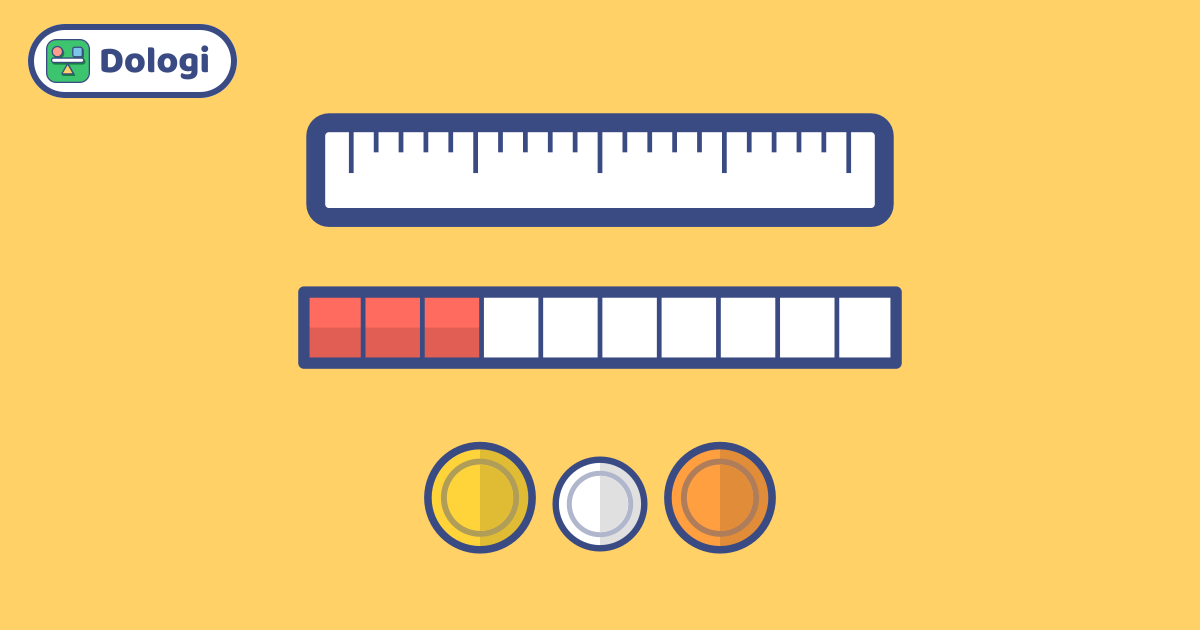
Ask your child: "Which is bigger, 0.5 or 0.45?" Plenty of fourth and fifth graders say 0.45, because "45 is bigger than 5". That is not carelessness: they are reading the digits after the point as a whole number. Decimals make much more sense when they start from things you can hold and measure: a ruler, a paper strip, prices, coins. This post is for parents of 9–11 year olds.
Start with a meter stick
Get a meter stick or a tape measure and show your child:
- 1 meter is 100 centimeters. Split it into 10 equal parts of 10 cm each. Each part is one tenth of a meter, written 0.1 m.
- Each of those parts splits again into 10 centimeters. One centimeter is one hundredth of a meter, written 0.01 m.
Then read a few lengths together:
- 1.5 m is 1 meter and 5 tenths, which is 150 cm.
- 0.3 m is 3 tenths of a meter, which is 30 cm.
- If your child is 1.35 m tall, that is 1 meter and 35 centimeters.
Let your child measure real things (the table, a window, their own height) and write each result two ways: "1 m 20 cm" and "1.2 m".
A paper strip in ten parts
Cut a long strip of paper and mark it into ten equal cells. The whole strip is 1.
- Color 3 cells: that is 3 tenths, written 0.3.
- Color 5 cells: that is 5 tenths, which is one half, written 0.5.
- Color all 10 cells: that is 10 tenths, which is 1.
The strip shows that 0.3 and 0.5 are parts of something, not a "3" and a "5" sitting behind a dot.
Dollars and cents
Money is the decimal system your child already meets every week:
- A dime is $0.10, one tenth of a dollar. Ten dimes make $1.
- A quarter is $0.25, a quarter of a dollar.
- $2.50 is 2 dollars and 50 cents, which is 250 cents.
- A snack for $1.05 costs 105 cents; a snack for $1.50 costs 150 cents.
At the store, read the price tags together and ask your child to say each one in cents. They will see that the point is just a short way of writing, and what comes after it is the part smaller than one dollar.
Comparing decimals
Back to the opening question: 0.5 or 0.45? Two ways your child can check alone:
- Turn it into cents or centimeters: $0.50 is 50 cents, $0.45 is 45 cents. So 0.5 is bigger.
- Add a zero so both have the same number of digits: 0.5 = 0.50. Compare 0.50 with 0.45: both have 0 ones, so compare the tenths digit, and 5 is bigger than 4.
The general rule: compare the whole-number part first; if it is the same, compare the digits after the point one by one, from left to right.
| Compare | Children often think | Correct | Why |
|---|---|---|---|
| 0.5 and 0.45 | 0.45 is bigger | 0.5 is bigger | 50 cents and 45 cents |
| 1.05 and 1.5 | 1.05 is bigger | 1.5 is bigger | 105 cents and 150 cents |
| 0.7 and 0.65 | 0.65 is bigger | 0.7 is bigger | 0.70 and 0.65 |
| 2.3 and 2.25 | 2.25 is bigger | 2.3 is bigger | 2.30 and 2.25 |
Two more common mistakes
- Adding in the wrong place: for 0.8 + 0.5 your child writes 0.13. Use the strip: 8 cells and 5 cells make 13 cells, one full strip and 3 more cells, which is 1.3.
- Point or comma: in English we write a decimal point (1.5), but much of the world writes a decimal comma (1,5). If your child sees "1,5" in a game or on a product label, it means the same as 1.5.
The Math topic in Dologi has a puzzle called Equal parts: "Tap every shape that is exactly half colored." Half is 0.5, five tenths of the paper strip. Your child learns to spot a half by eye first, and later sees that a decimal is just another way to write those parts.
In short
- Start with a meter stick: 0.1 m is one tenth of a meter, 10 cm; 1.5 m is 150 cm.
- A paper strip in ten parts: 0.3 is 3 tenths, 0.5 is one half.
- Dimes, quarters and price tags are where decimals show up every day.
- Comparing: whole-number part first, then each digit after the point; add a zero or switch to cents to check.
Read more: Tens and ones: teaching place value with bundles of sticks, Reading and writing big numbers