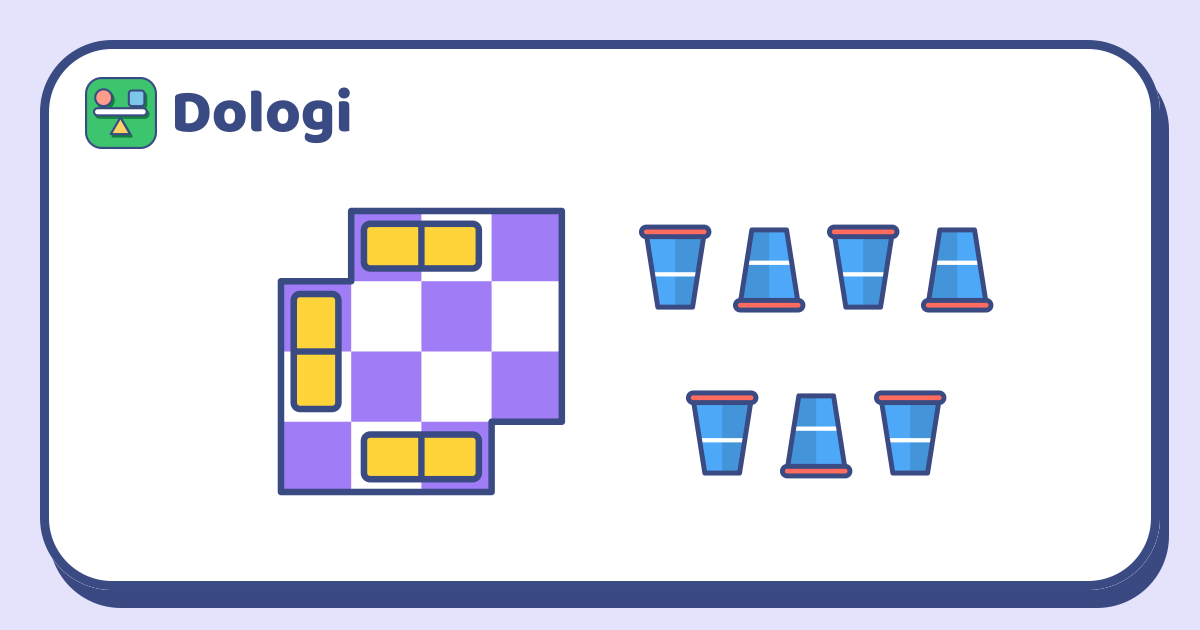
Most puzzles end with "I found it!". A few end with "it can't be done, and here is why". Those are some of the best puzzles for children of around 10 to 12, because they meet a new kind of thinking: not trying again and again, but finding a reason that covers every possible try at once. That reason is called a proof.
This post gives you two classic puzzles you can make with paper and paper cups, a few warm-ups that lead up to them, and ideas for talking about "impossible" without it feeling like failure. Ages are only a guide; younger children can enjoy the warm-ups.
Why an impossible puzzle is worth doing
When a child tries a puzzle twenty times without success, there are two possibilities: they haven't found the answer yet, or there isn't one. Twenty failed tries can't tell them which. Only an argument can.
That is a big step. Your child learns to look for something that never changes, however the pieces are moved, and to use it to rule out every attempt at once. Mathematicians call this kind of unchanging quantity an invariant. You don't need the word; the idea is what matters.
Warm-ups: cover a board with dominoes
On squared paper, draw a 4 × 4 board and cut it out. Then cut several "dominoes" from the same paper: rectangles exactly two squares long and one square wide. The rule: cover every square of the board with dominoes, with no overlaps and nothing sticking out.
- The whole board. Easy: 16 squares, 8 dominoes, for example two in each row.
- One corner cut off. Cut away one corner square. Now try again. Before your child spends too long, ask: "How many squares are left? How many squares does each domino cover?" There are 15 squares, and dominoes always cover an even number. It can't work, and counting proves it.
- Two corners on the same side cut off. Remove the top-left and top-right squares. Now there are 14 squares, an even number, so counting doesn't rule it out. Let your child try. It can be done.
The warm-ups already show both kinds of answer: "here is how" and "here is why not".
The board with two opposite corners missing
Now cut a fresh 4 × 4 board and remove two opposite corners: top-left and bottom-right. There are 14 squares again, just like warm-up 3. Ask your child to cover it with 7 dominoes.
Let them try several times. Most children start to suspect it is impossible, but counting doesn't help, because 14 is even. So what else could stop it?
The hint: color the board like a chessboard, two colors taking turns. Then ask:
- Whatever way you lay a domino, what colors are the two squares it covers?
- What color were the two corners you cut off?
- How many squares of each color are left?
The answers: every domino covers one square of each color. On a board like this, two opposite corners are always the same color. So the board now has 8 squares of one color and only 6 of the other. Seven dominoes would cover 7 of each color, so they can never fit. No need to try any more: this reason covers every possible way of laying them.
Children who enjoy this can do the same on a real 8 × 8 chessboard with two opposite corners covered: 62 squares, but 32 of one color and 30 of the other. Thirty-one dominoes can't cover it.
Seven cups that won't all turn over
Put seven paper or plastic cups upside down in a row. The rule: in each move you must turn over exactly two cups, no more and no fewer. Any two will do, even one that is already the right way up. Can you get all seven standing the right way up?
Let your child play for a while and keep count of the upside-down cups after each move. Ask: "When you turn two cups, how can that number change?"
- Both cups were upside down: the number goes down by 2.
- Both were the right way up: it goes up by 2.
- One of each: it stays the same.
So the number of upside-down cups always changes by an even amount, or not at all. It starts at 7, an odd number, and an odd number plus or minus 2 is still odd. It can never become 0, so the puzzle is impossible.
Then change one thing and the puzzle comes back to life:
- Six cups, all upside down, turning exactly two each move.
- Seven cups, but turning exactly three each move.
Ask your child to predict first: possible or not? Both turn out to be possible, and finding the smallest number of moves is a nice extra challenge.
How to talk about "it can't be done"
- Separate "I couldn't" from "it can't". "I couldn't do it" is about one person's tries. "It can't be done" needs a reason that works for everyone, every time.
- Ask what stays the same. When moves keep failing, look for something moves never change: how many squares of each color, or whether a count is odd or even.
- Get the reason into one or two sentences. For example: "Each domino covers one light and one dark square, but there are more dark squares than light ones."
- Praise the reasoning, not the speed. A child who explains why something is impossible has solved the puzzle.
In Dologi, the Space topic has "Fill it up" puzzles, where children turn blocks and place them until every empty square on the board is covered. Like the domino board, it rewards looking at the empty squares carefully before placing the first piece.
Answers
- Warm-up 3: lay one domino across the two middle squares of the top row, then fill the remaining 3 × 4 part with six dominoes, two in each row.
- Six cups: turn cups 1 and 2, then 3 and 4, then 5 and 6. Three moves.
- Seven cups, turning three at a time: turn cups 1, 2 and 3 (four left upside down: 4, 5, 6, 7). Then turn 1, 4 and 5 (upside down now: 1, 6, 7). Finally turn 1, 6 and 7. Three moves, and fewer is not possible: one move can't turn seven cups, and each move changes the number of upside-down cups by an odd amount, so after two moves that number is odd again and can't be 0.
In short
- Some puzzles have no solution, and explaining why is a real answer.
- Counting can prove a puzzle impossible: 15 squares can't be covered by tiles that each cover 2.
- When counting isn't enough, look for something that never changes: the two colors of a chessboard, or whether a number is odd or even.
- Change one rule and the impossible puzzle often becomes possible again, which is the perfect next challenge.
Read more: Five-square puzzle pieces cut from grid paper: find all twelve and fill a rectangle · Classic logic puzzles for 10-to-12-year-olds with step-by-step solutions: mislabeled boxes, three switches and one bulb