Ask an eight-year-old "Is a square a rectangle?" and you'll most likely hear a confident "No! A rectangle is long." That answer makes sense: in picture books and on classroom posters, the rectangle is always the stretched-out one and the square sits next to it as a different shape. But in math, a shape is defined by what it has, not by how it usually looks, and one shape can belong to several families at once.
This question is a small doorway into real reasoning: checking a definition instead of trusting a first impression. Here's how to explore it at home with toothpicks, a bit of clay and a sheet of paper.
Why "no" is the natural answer
Young children learn shapes the way they learn animals: by remembering a typical example. The typical rectangle is long, so a shape with equal sides "looks wrong" for that name.
The math definition is different. A rectangle is a shape with four straight sides and four right angles. That's all. Nothing in the definition says the sides must be different lengths. A square has four right angles too, so it passes the test: it is a rectangle, a special one whose four sides are also equal.
An everyday comparison helps: every dog is an animal, but not every animal is a dog. In the same way, every square is a rectangle, but not every rectangle is a square.
Build the shapes with toothpicks and clay
You'll need a box of toothpicks and some modeling clay or play dough rolled into pea-sized balls. The balls are the corners; the toothpicks are the sides. Because every toothpick is the same length, "equal sides" is built right in: one toothpick per side means all sides are equal.
Toothpicks have sharp points, so stay close by, or use cotton swabs or straws cut to the same length instead. Then build together:
- Square: four toothpicks, four balls.
- Long rectangle: six toothpicks, with two toothpicks end to end on each long side.
- Rhombus (the "diamond"): gently push the square so it leans. The sides stay equal, but the corners are no longer square.
- Parallelogram: push the long rectangle so it leans the same way.
- Triangle: three toothpicks.
To check a right angle, use the corner of an index card or a folded sheet of paper as a "corner tester." If the corner fits exactly, it's a right angle.
Make a list of what each shape has
Now turn the shapes into a table. Have your child check each one with the corner tester and by counting toothpicks.
| Shape | 4 sides | All sides equal | 4 right angles |
|---|---|---|---|
| Square | yes | yes | yes |
| Long rectangle | yes | no | yes |
| Rhombus | yes | yes | no |
| Parallelogram | yes | no | no |
| Triangle | no | yes | no |
Then ask: "Does the square have everything a rectangle needs?" Read across the rows: four sides, four right angles. Yes. The square just has one extra feature, equal sides. And it also has everything a rhombus needs, so a square is a rhombus too.
Sort them into two overlapping circles
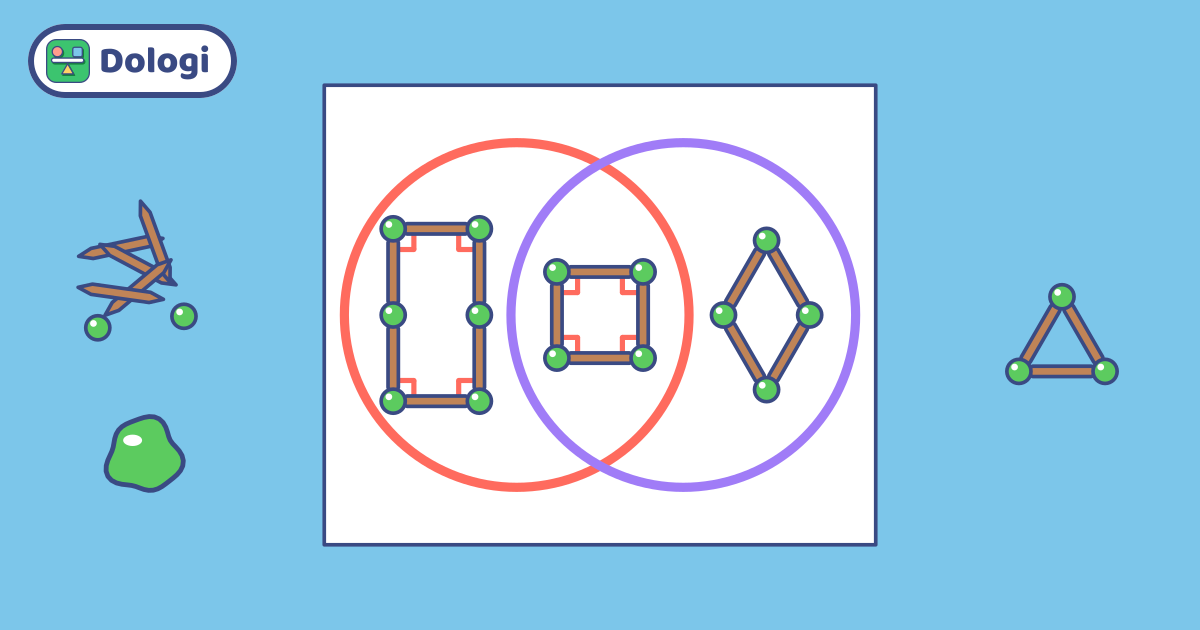
Draw two big overlapping circles on a sheet of paper, or lay two loops of yarn on the floor. One circle means "four right angles," the other "four equal sides." Label each circle with words or a small drawing, like a little square corner for right angles.
Place the shapes one at a time:
- The long rectangle goes in the right-angle circle only.
- The rhombus goes in the equal-sides circle only.
- The square fits both rules, so it goes in the middle, where the circles overlap.
- The triangle and the parallelogram fit neither rule, so they go outside both circles.
Now the picture answers the question better than words can. Point to the right-angle circle: "Everything in here is a rectangle. Is the square in here?" Most children see it right away. The middle is part of both circles.
Play "I have four right angles. Who am I?"
One player thinks of a shape and gives clues one at a time; the other guesses.
- "I have four sides." (Could be many shapes.)
- "All my sides are the same length." (Rhombus or square.)
- "I have four right angles." (Only the square is left.)
Then switch roles. Try a tricky one: if the only clue is "I have four right angles," both "rectangle" and "square" are correct answers. Children enjoy discovering that some clues aren't enough and learning to give a clue that rules things out. That's exactly how definitions work.
In the US, kids usually meet squares, rectangles and rhombuses as kinds of quadrilaterals in 3rd grade and learn to sort shapes into a hierarchy like this in 5th grade. At home, there's no rush: the circles and the guessing game work whenever your child is ready.
In Dologi's Logic topic, a puzzle called Two rings uses the same idea: children drag each thing into the ring whose label fits it, or into the middle where the rings overlap if it fits both. At higher levels a label can be a number of sides, and things that fit neither ring go in a box outside.
In short
- A rectangle is any four-sided shape with four right angles; a square has four right angles, so it's a special rectangle.
- Build shapes from toothpicks and clay, and check corners with the corner of an index card.
- Sort them into two overlapping circles: the square lands where they overlap, in both families at once.
- "Who am I?" clue games show children that a good definition is a list of properties that rules other shapes out.
Read more: Sorting by two features at once: color and shape, Stick puzzles for children: move a stick, make a new shape