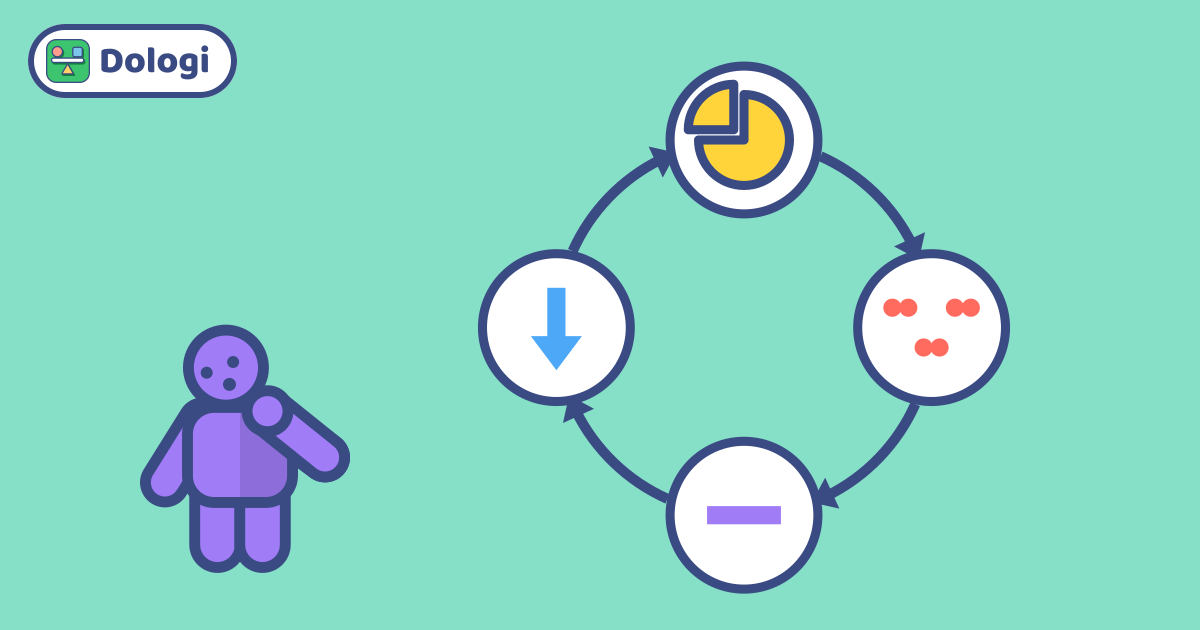
Your child works out 2436 ÷ 6 and writes 46. The right answer is 406. Forgetting the zero in the quotient is one of the most common mistakes when children aged 9 to 11 learn long division. It's not that their mental math is weak: they've skipped one step in a long chain. This article helps your child see division as a loop, understand what the zero in the quotient means, and check the answer themselves.
Why the zero goes missing
In 2436 ÷ 6, after 24 ÷ 6 = 4, your child brings down the 3. But 6 doesn't go into 3. Many kids think "it doesn't go, so skip it," bring down the 6 straight away to make 36, divide to get 6, and write 46.
The skipped step is: 6 goes into 3 zero times, so write 0 in the quotient. That zero holds the tens place in the answer, just like the zero in 105.
Long division is a four-step loop
Every round goes through all four steps, with none left out, even when the answer is 0:
- Divide: divide the current number by the divisor.
- Multiply: multiply that answer by the divisor.
- Subtract: take the product away from the current number to get the remainder.
- Bring down: bring the next digit down next to the remainder.
A popular way to remember the order is "Dad, Mom, Sister, Brother": divide, multiply, subtract, bring down.
For 2436 ÷ 6:
| Round | Divide | Multiply | Subtract | Bring down |
|---|---|---|---|---|
| 1 | 24 ÷ 6 = 4, write 4 | 4 × 6 = 24 | 24 − 24 = 0 | bring down 3, making 3 |
| 2 | 3 ÷ 6 = 0, write 0 | 0 × 6 = 0 | 3 − 0 = 3 | bring down 6, making 36 |
| 3 | 36 ÷ 6 = 6, write 6 | 6 × 6 = 36 | 36 − 36 = 0 | nothing left |
Quotient: 406. An easy rule: after the first round, every time you bring down a digit, the quotient gets one more digit. Bring down twice, and the quotient has three digits.
Try it with play money first
Before writing anything, share out real-looking money so your child can see the zero. Take 412 ÷ 4: share $412 among 4 people using play money, 4 hundred-dollar bills, 1 ten-dollar bill and 2 one-dollar bills:
- Hundreds: 4 bills shared among 4 people, 1 each. The quotient has a 1 in the hundreds place.
- Tens: there's only 1 ten-dollar bill, not enough for 4 people, so each person gets 0 tens. The quotient has a 0 in the tens place. Swap that ten for 10 one-dollar bills.
- Ones: those 10 plus the 2 you already had make 12, shared among 4 people, 3 each.
Each person gets $103. Your child sees with their own hands that the zero means: in the tens place, everyone got none. No play money? Bundles of sticks (hundreds, tens and single sticks) work too.
Writing it out the way school does
In US schools, the dividend sits inside the division bracket, the divisor outside on the left, and the quotient is written on top, with each digit above the matching digit of the dividend. Writing each quotient digit directly above its column is a big help: there's a column above the 3, so it needs a digit, and that digit is 0. (In UK schools, the "bus stop" layout for short division works the same way.)
Encourage your child to say each round out loud:
- How many 6s in 24? 4. Write 4. 4 times 6 is 24. 24 minus 24 is 0.
- Bring down 3. How many 6s in 3? 0. Write 0. 0 times 6 is 0. 3 minus 0 is 3.
- Bring down 6, making 36. How many 6s in 36? 6. Write 6. 6 times 6 is 36. 36 minus 36 is 0.
"How many 6s in 3? Zero, write 0" is the line that most often gets swallowed. When your child says it aloud, a skipped step is easy to hear.
Tick each digit as you bring it down
Each time your child brings down a digit, they make a small tick under that digit in the dividend. Each tick goes with exactly one new digit in the quotient. At the end, count: the number of ticks plus 1 (for the first round) must equal the number of digits in the quotient. For 2436 ÷ 6 there are 2 ticks, so the quotient must have 3 digits.
Estimate first, multiply back after
- Estimate: 2436 is close to 2400, and 2400 ÷ 6 = 400. So the answer should be about 400, a three-digit number. Writing 46 shows straight away that something's wrong.
- Multiply back: 6 × 406 = 2436, correct. But 6 × 46 = 276, not 2436.
- With a remainder: 1834 ÷ 9 = 203 remainder 7. Check: 9 × 203 + 7 = 1834. If your child forgets the zero and writes 23 remainder 7, the check gives 9 × 23 + 7 = 214, clearly wrong.
Three practice problems with a zero in the quotient
| Division | Answer | Check |
|---|---|---|
| 816 ÷ 8 | 102 | 8 × 102 = 816 |
| 3015 ÷ 5 | 603 | 5 × 603 = 3015 |
| 1834 ÷ 9 | 203 remainder 7 | 9 × 203 + 7 = 1834 |
Two or three problems per session is plenty. Have your child say the four words "divide, multiply, subtract, bring down" out loud each round until it becomes a habit.
The Focus topic in Dologi has a puzzle called Follow the string: "Follow the string. Which balloon is tied to the animal with the question mark?" Just like long division, your child has to follow every section to the end without jumping over any part.
In short
- Forgetting the zero in the quotient means skipping "it goes 0 times, write 0," not weak mental math.
- Every round has four steps: divide, multiply, subtract, bring down; each digit brought down adds a digit to the quotient.
- Share out play money to see that the zero means "nobody gets any" in that place.
- Estimate first and multiply back afterwards to catch a quotient that's missing a digit.
Read more: Times tables: memorize or understand first?, Rushed math mistakes: building the habit of checking