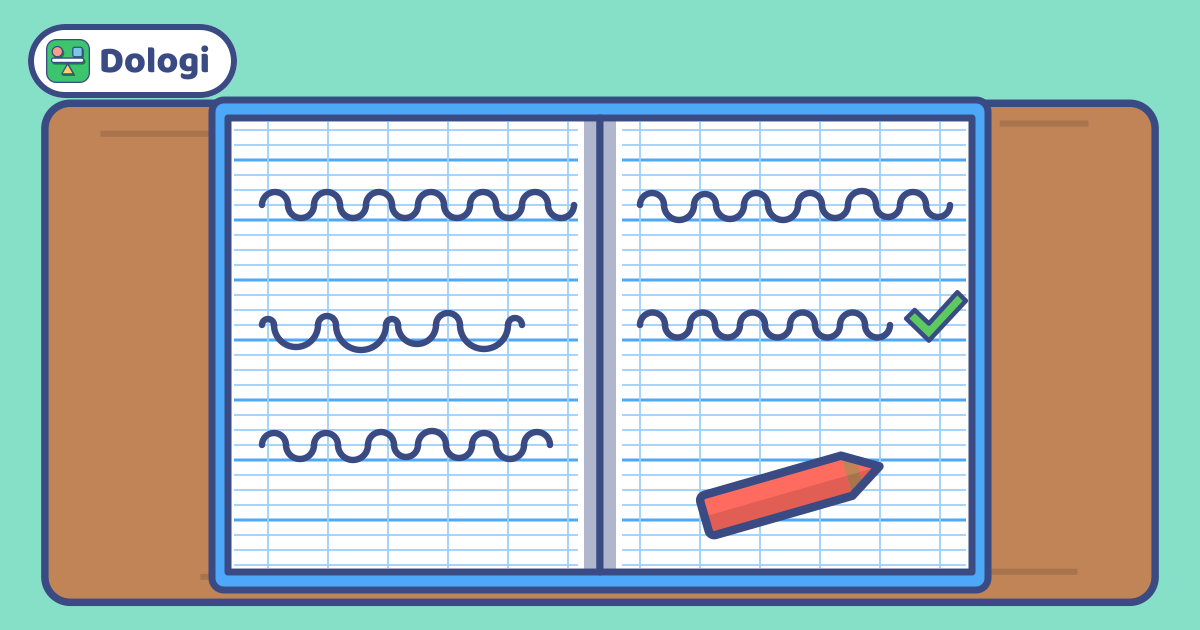
You open your child's homework folder and squint. Letters of every size, words that run together, a line that slopes down the page. It's tempting to say "Do it again, neatly," and sometimes that ends in tears for everyone.
Messy handwriting in young school children is very common, and most of it improves with time and a bit of targeted help. This article covers why handwriting takes so long to settle, how to find the one thing that makes your child's writing hard to read, and how to practice without turning it into a punishment.
Why handwriting takes years to settle
Writing by hand asks a lot of a young child at once: small finger movements, eyes and hands working together, remembering how each letter is formed, spelling, and thinking about what to say. When the thinking part is hard, the handwriting part is often the first thing to slip.
Handwriting keeps developing through elementary school. Many children write neatly when they copy slowly and messily when they write a story quickly; both are normal. In the US, many schools start with print letters, and whether and when cursive is taught depends on the state and the school. In many UK schools, children learn joined handwriting fairly early. Whatever style your child is learning, the goal for now is writing that other people can read, not writing that looks perfect.
Find the one thing that makes it hard to read
"Messy" is too big to fix. Sit with your child, look at a page they wrote recently and pick just one thing to work on.
| What you notice | What might help |
|---|---|
| Letters jump between big and small | Use lined paper and notice which letters are tall, which are short and which drop below the line |
| Words run together | Leave a "finger space": your child puts a finger after each word before writing the next |
| Letters float above or sink below the line | Trace the bottom line with a highlighter so it's easy to see |
| Some letters start in odd places | Show the letter slowly, starting at the top, and let your child copy the movement |
| Writing is rushed or pressed very hard | Try one slow "best copy" sentence, and let quick drafts stay quick |
Choose the change that would make the biggest difference, and keep the rest for later. One improvement at a time is easier to see and easier to feel proud of.
Set up a good spot for writing
A lot of messy handwriting comes from an awkward position rather than the hand itself. Check these before you check the letters:
- Feet flat on the floor or on a box, back against the chair.
- Table at about elbow height when your child sits up straight. A cushion can raise a short child.
- Paper tilted slightly in the direction of the writing hand, and the other hand holding the paper still.
- Good light from the side, so the writing hand doesn't cast a shadow on the line.
- A pencil that isn't too short or too slippery, and a grip that feels comfortable.
If you're not sure about the grip, our article on holding a pencil has simple games that build strong fingers.
Practice little and often, with real writing
Long copying sessions usually make handwriting worse, because tired hands get sloppy. Five to ten minutes is plenty.
- Big movements first. Before working on small letters, your child can draw letters in the air, on a whiteboard, or with a finger in a tray of salt or sand. Large, slow shapes help the hand learn the path.
- Then the right size. Move to paper and practice the one thing you chose, for example keeping short letters the same height.
- Write things that matter. A shopping list, a birthday card for a grandparent, labels for toy boxes, a note on the fridge. Your child cares more when someone will actually read it.
- One best copy. Once a day, your child writes a single sentence slowly and carefully. Everything else can be written at normal speed.
Praise progress, not perfection
Copying a whole page again as a punishment tends to teach children that writing is unpleasant, and the second page is rarely neater than the first. Try this instead:
- Ask your child to circle their best letter or word on the page. Choosing it makes them look carefully at their own writing.
- Praise something specific. "Your spaces between words are so clear today" helps more than "Nice writing."
- Compare with themselves. Keep a dated sample every few weeks. Looking back after a couple of months often shows real progress that's hard to see day to day.
If writing stays very hard for your child for a long time, if it hurts, if they avoid writing whenever they can, or if they are much slower than their classmates over several months, talk to their teacher. The teacher sees many children write and can suggest whether it's worth asking a specialist for advice.
In Dologi's Focus topic, Follow the string puzzles show tangled strings, and your child follows one string with their eyes to find which balloon is tied to the animal with the question mark; the hint suggests sliding a finger along the string. It isn't handwriting practice, but it's a calm way to practice following a line slowly and carefully, the same patience neat writing needs.
In short
- Messy handwriting is common in young school children and keeps improving through elementary school; aim for writing others can read, not perfect writing.
- Look at a page together and work on just one thing: size, spaces, the line, where letters start or speed.
- Check posture, table height, light and paper position, then practice for five to ten minutes with big movements first and real things to write.
- Praise specific progress, skip copying pages as punishment, and talk to the teacher if writing stays very hard or painful for a long time.
Read more: Holding a pencil well: building strong little hands before writing, Why does my child write letters and numbers backwards? b, d and a reversed 3, How to praise your child: praise effort and specific actions