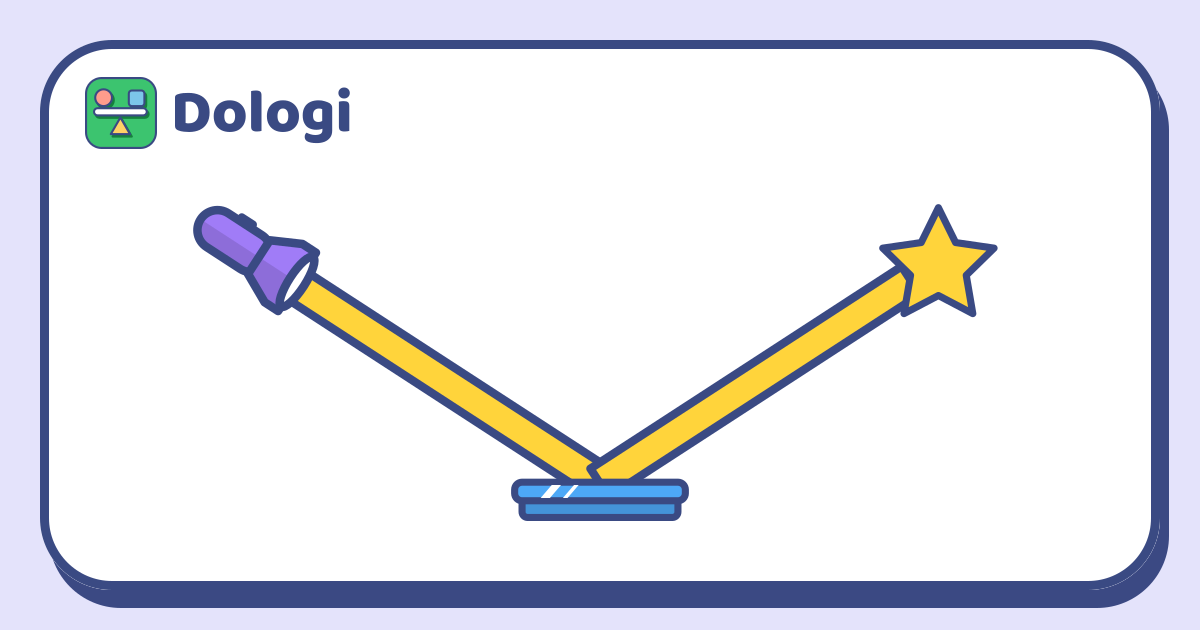
Children love catching a patch of light on the ceiling with a watch face or a spoon. This game turns that into a challenge: a paper star on the wall, a flashlight that stays in one place, and a small mirror. Can your child send the light onto the star?
It sounds simple, and with one mirror it soon is. With two mirrors and an obstacle in the way, it becomes a real planning puzzle. Along the way, children aged about 7 to 12 discover the one rule that light follows when it bounces, and learn to draw a path before they try it.
What you need and staying safe
- A flashlight with a narrow beam. Lay it on a pile of books so it stays still and shines along the table.
- One or two small mirrors that can't break, such as plastic craft mirrors. Avoid glass mirrors for this game.
- A target: a paper star or circle taped to a wall, roughly at the height of the table.
- Something to stand the mirrors up, such as a lump of modeling clay.
- A darkened room, so the spot of light is easy to see.
Two safety rules before you start: never shine the flashlight or its reflection into anyone's eyes, and only use a flashlight, never sunlight. A mirror can bounce sunlight into someone's eyes, and it is far too bright to look at.
The first challenge: one mirror
Place the flashlight so it shines along the table, and tape the star on a side wall where the beam doesn't reach. Now give your child one mirror.
Before they touch anything, ask:
- "Where do you think the mirror should go?"
- "Which way should it face?"
Let them point and explain, then try it. Most children first put the mirror in the beam and then twist it slowly until the spot of light slides across the wall onto the star. Notice together how a tiny turn of the mirror makes the spot travel a long way on the far wall.
The bounce rule
After a few tries, ask your child to look carefully at the beam coming in and going out. Light bounces off a mirror the same way a ball bounces off a wall when you roll it at an angle: it leaves at the same angle as it arrived, just on the other side.
- Roll a ball against a wall at a slant and watch it roll away at the same slant. That is the bounce rule.
- A useful tip follows from it: the mirror needs to face halfway between the flashlight and the target.
- If the light comes straight at the mirror, it goes straight back towards the flashlight.
People use this rule every day: the mirrors on a car or a bicycle show what is behind you, and a periscope uses two mirrors to see over a wall.
Two mirrors and an obstacle
Now make it harder. Stand a big book or a box between the flashlight and the star so that no single mirror can reach the target. The light has to go around the obstacle, so your child needs two mirrors.
This time, plan first on paper. Draw the table as seen from above: the flashlight, the box and the star. Then:
- With a ruler, draw the beam coming out of the flashlight as a straight line.
- Choose a spot for the first mirror and draw a short line for it.
- Draw the next straight piece of the path towards a spot where the second mirror could go.
- Draw the last straight piece from the second mirror to the star.
Light travels in straight lines between mirrors, so the whole path is made of straight pieces with a bend at each mirror. Then set up the real mirrors in the places on the drawing and see how close the plan was. Small adjustments are normal; the drawing gets you close, and twisting the mirrors does the rest.
Making it easier or harder
The ages below are only a rough guide; every child is different.
- Around 7 to 8: one mirror, a big target and plenty of time to twist and try. Ask your child to say "left" or "right" to steer you while you hold the mirror.
- Around 9 to 10: two mirrors and an obstacle, with the path drawn on paper first.
- Around 11 to 12: measure the angles on the drawing with a protractor and check that the angle in equals the angle out at each mirror. Or set a rule like "the light must pass over the cup on its way".
You can also swap roles: your child sets up the obstacle and the star, and you have to guide the light.
In Dologi, the "Place the mirrors" puzzles in the Space topic work the same way: your child drags mirrors onto a board so that the light from a flashlight reaches the thing with the flag.
In short
- A flashlight, a small unbreakable mirror and a paper star on the wall make a light-aiming game; never shine light into eyes and never use sunlight.
- Ask your child to predict where the mirror goes and which way it faces before trying.
- Light leaves a mirror at the same angle it arrives, so the mirror faces halfway between the flashlight and the target.
- With two mirrors, draw the path on paper first as straight lines with a bend at each mirror.
Read more: Light and shadow experiments for kids: a flashlight, a few objects and a homemade sundial