Some puzzles don't have a hard calculation in them at all. Every step is simple, the numbers are small, and still the ending makes no sense: a coin seems to have disappeared into thin air. Children aged around 10 to 12 love this kind of puzzle, because it feels like a magic trick, and it's even more satisfying when they work out the trick themselves.
The secret isn't in the arithmetic. It's in a sum that adds two numbers which shouldn't be added together. Below is the puzzle, three ways to untangle it with your child, and two more puzzles of the same kind for them to crack alone.
The puzzle
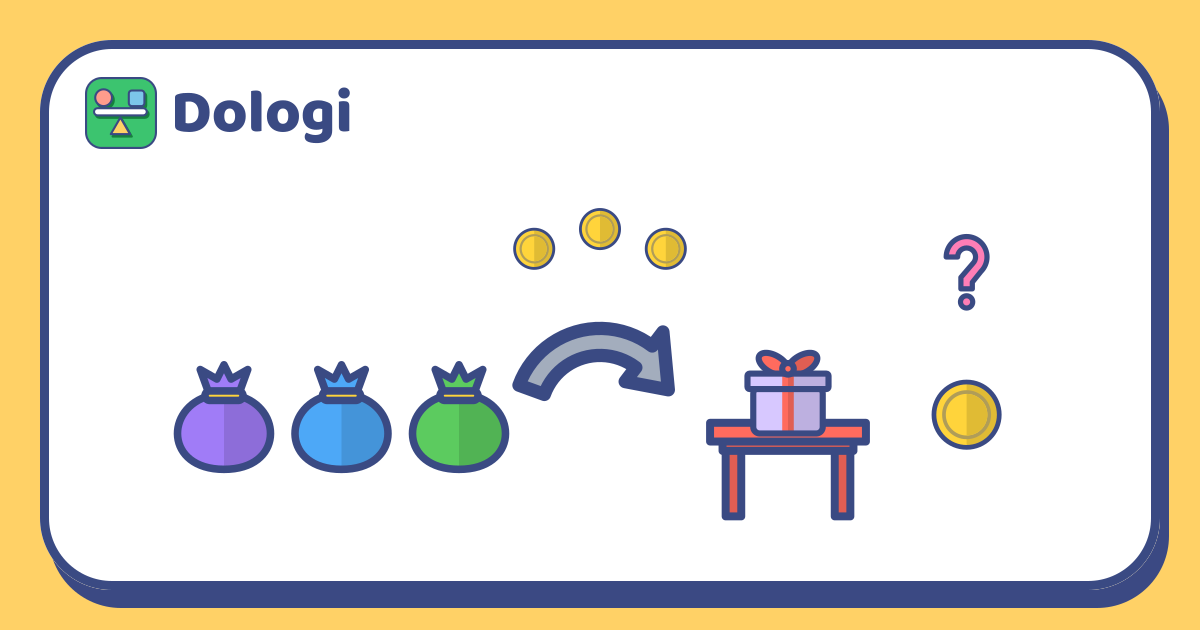
Three friends want to buy a board game from a market stall. The price tag says 30 coins, so each friend puts in 10 coins and they pay.
As they walk away, the stallholder remembers that the game is on offer today: it should have cost 25 coins. He gives 5 coins to his helper and asks him to run after the friends.
Five coins can't be shared equally between three people. So the friends each take 1 coin back and tell the helper to keep the other 2 for his trouble.
Now count. Each friend paid 10 coins and got 1 back, so each paid 9. Three times 9 is 27. The helper has 2. That's 27 + 2 = 29. But at the start there were 30 coins. Where did the 30th coin go?
Let your child think about it for a while before reading on. Many adults get stuck on this one too.
Act it out with toy coins
The quickest way to see what is happening is to move real things. You need 30 coins, buttons or dried beans, three cups for the friends, a box for the stall and one more cup for the helper.
- Put 10 coins in each friend's cup.
- The friends pay: all 30 coins go into the stall's box.
- The stall gives 5 coins to the helper.
- The helper gives 1 coin to each friend and keeps 2.
After each step, ask your child to count every place and add them up. The total is always 30. Not a single coin leaves the table, so nothing can have vanished. The problem must be in the way the story counts.
Draw who holds what
Next, put the same steps on paper in a table. One row per step, one column per person.
| Step | Friends | Stall | Helper | Total |
|---|---|---|---|---|
| Start | 30 | 0 | 0 | 30 |
| Friends pay | 0 | 30 | 0 | 30 |
| Stall sends change | 0 | 25 | 5 | 30 |
| Helper hands back 3 | 3 | 25 | 2 | 30 |
Look at the last row. The 30 coins are made of 25 in the stall, 2 with the helper and 3 back with the friends. There is no 29 anywhere in this table.
Find the wrong sum
Now go back to the story's calculation and ask: "What does the 27 stand for?"
The 27 coins are what the friends paid in the end. Where did those 27 coins go? 25 went to the stall and 2 went to the helper. So the helper's 2 coins are already inside the 27.
That's the trick. Adding the helper's 2 to the 27 counts those 2 coins twice. The result, 29, doesn't mean anything; it isn't the number of coins anywhere. Two sums do make sense:
- What the friends paid = where it went: 27 = 25 + 2.
- What the friends paid + what they got back = what they started with: 27 + 3 = 30.
The lesson is bigger than this one puzzle. Before adding two numbers, check what each one stands for. Coins someone has and coins someone paid can't simply be mixed together.
Two more puzzles to untangle
Give your child these to solve alone, with coins or a table if they like.
- The borrowed coins. You borrow 10 coins from Mom and 10 from Dad, and buy a book for 17 coins. You have 3 left, so you give 1 back to Mom, 1 back to Dad and keep 1. Now you owe Mom 9 and Dad 9: that's 18. Add the 1 you kept and you get 19. But you borrowed 20. Where is the 20th coin?
- Buy, sell, buy, sell. You buy a toy car for 6 coins and sell it for 7. Then you buy it back for 8 and sell it again for 9. Did you make money, lose money, or break even? How much?
Answers
- Nothing is missing. The 18 coins you owe went into the book (17) and your pocket (1): 18 = 17 + 1. Adding the 1 again counts it twice, just like the helper's coins. A sum that works: 20 borrowed = 17 for the book + 2 given back + 1 kept.
- You made 2 coins. Follow your purse. If it starts with 20 coins: 20 − 6 = 14, then 14 + 7 = 21, then 21 − 8 = 13, then 13 + 9 = 22. You end with 2 more than you started with. Another way to see it: these are two separate deals, buy at 6 and sell at 7, then buy at 8 and sell at 9, and each one makes 1 coin.
Helping your child crack puzzles like these
- Put a label on every number. "27 coins paid", "2 coins with the helper". Labels make the double counting visible.
- Ask where things are right now. A who-holds-what table is a strong tool for any story with money moving around.
- Let them explain it to someone else. Telling the puzzle to a friend or grandparent, and then giving the answer, shows whether they really understand the trick.
- Make up a new version. Change the numbers (four friends, 40 coins) and check that the trick still works.
In Dologi, the "Balance scales" puzzles in the Logic topic ask which number goes on the weight with the question mark. Children add up the pan without the question mark first and remember that a level scale means both sides weigh the same: the same habit of checking that both sides of a sum really match.
In short
- In the missing-coin puzzle, no coin disappears: 25 are in the stall, 2 with the helper and 3 with the friends.
- The trick is adding the helper's 2 coins to the 27 the friends paid, when those 2 coins are already part of the 27.
- Acting it out with toy coins and drawing a who-holds-what table show that the total stays the same at every step.
- Before adding numbers, ask what each one stands for; that habit cracks this whole family of puzzles.