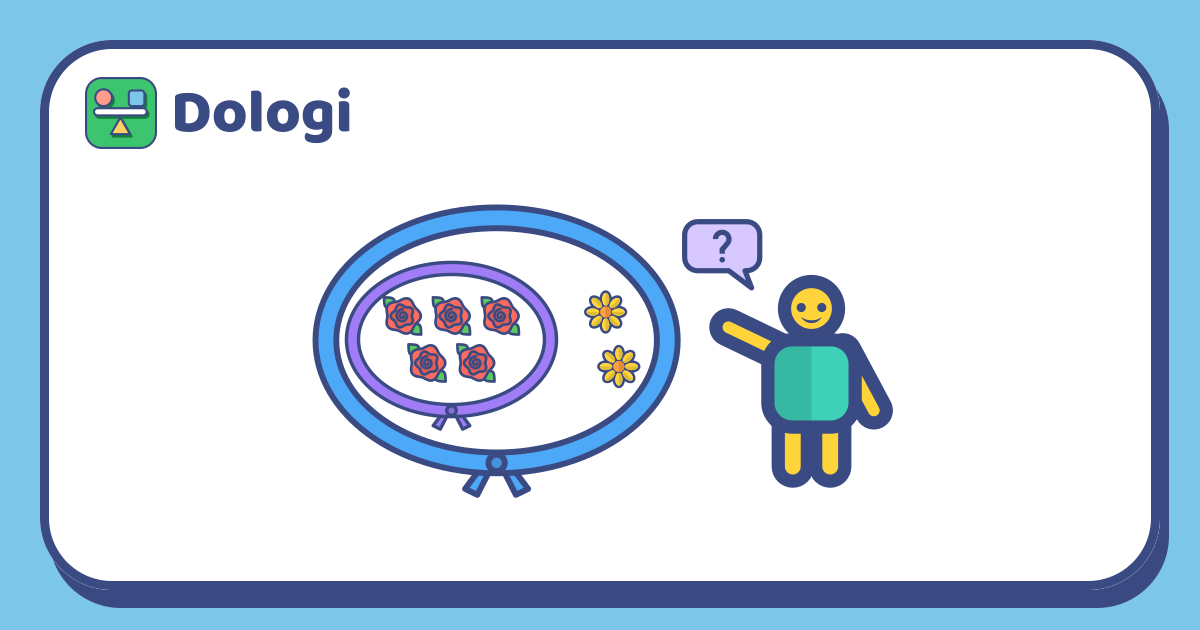
Lay five roses and two daisies on the table. Your child counts them happily: five roses, two daisies. Then you ask, "Are there more flowers or more roses?" Many children of five or six answer straight away, and with total confidence: "More roses!"
Your child can count, and knows perfectly well that a rose is a flower. So what is going on? This article explains why the question is tricky, what you can do at home when your child gets it "wrong", and a few games that help them see that a small group sits inside a bigger one.
Why your child says "more roses"
When your child looks at the table, they see two piles: roses and daisies. Those two piles are easy to compare, and the roses are clearly the bigger one. So without noticing, your child answers a different question: "more roses or more daisies?"
To answer the real question, your child has to hold two ideas at once: each rose is a rose, and it is also a flower. The flowers are not a third pile next to the other two. They are all seven together, roses included.
Thinking about a part and the whole at the same time takes practice. Many children start to answer this kind of question correctly somewhere around seven or eight, but that is only a rough guide: some get there sooner, some later, and the same child may get it right with flowers and wrong with animals. A "roses" answer isn't a mistake to correct. It shows you what your child is paying attention to.
Try the flower question at home
You don't need real flowers. Buttons in two colors, toy cars and lorries, or pictures cut from a magazine all work.
- Put out two groups of different sizes, for example five red buttons and two blue ones. Let your child count each group.
- Ask the question: "Are there more buttons or more red buttons?"
- If your child says "red buttons", don't say "wrong". Ask instead: "Show me all the buttons." Your child sweeps up the whole lot. "Now show me all the red buttons." Only part of the pile moves.
- Ask an "if" question: "If I take away all the red buttons, are there any buttons left? And if I take away all the buttons, are there any red buttons left?"
- Count together: red buttons first, then all the buttons. Let your child say which number is bigger, and why.
Change the things you use each time, because a child who has worked it out with buttons may still stumble with something new.
| Things on the table | The question |
|---|---|
| 4 dogs and 1 cat (toys or pictures) | More animals or more dogs? |
| 6 apples and 2 bananas | More fruit or more apples? |
| 5 spoons and 3 forks | More cutlery or more spoons? |
| 4 toy cars and 2 toy lorries | More vehicles or more cars? |
Older children enjoy turning the tables: they set out the things and ask you the question. Get it wrong now and then, and let them explain why.
Boxes inside boxes and string loops
Your child understands nesting more easily when they can see and touch it.
- Boxes inside boxes: put the roses (or red buttons) in a small box. Put that small box inside a big box, then add the daisies to the big box. "Which box has more flowers in it?" When your child sees the small box sitting inside the big one, the answer comes more easily.
- Big and small string loops: lay a big loop of string on the floor round all the toys, and a small loop round just the cars. Ask your child to stand "inside the toys" and then "inside the cars". If they are standing inside the cars loop, they are also inside the toys loop. They can feel it with their feet.
- Sorting toys in two rounds: first, sort everything that is an animal into a basket. Then, from that basket, take out just the dogs and put them on a plate inside the basket. "Are all the dogs animals? Are all the animals dogs?"
The picture at the top of this article shows the string loops: the small loop around the five roses sits inside the big loop around the whole bunch.
A sentence to practice
Once your child has played with real things, help them put the idea into words with one sentence:
"All … are …, but not all … are …"
| Sentence | Example that shows it |
|---|---|
| All roses are flowers, but not all flowers are roses. | A daisy is a flower but not a rose |
| All dogs are animals, but not all animals are dogs. | A cat is an animal but not a dog |
| All apples are fruit, but not all fruit are apples. | A banana is fruit but not an apple |
Take turns making up new sentences at breakfast or in the car. When your child says something that doesn't work, such as "all animals are dogs", ask for one example that shows it isn't true. One example is enough.
What to try at each age
| Rough age | What to try |
|---|---|
| 5–6 | Real things in two groups; count each group, then count all of them together |
| 6–7 | Boxes inside boxes, string loops, sorting toys in two rounds |
| 7–8 | The "all…, but not all…" sentence; your child sets the question for you |
Ages are only a rough guide. Start where your child succeeds, and if they are tired or getting frustrated, stop and play again another day.
In Dologi, "Two rings" puzzles in the Logic topic ask your child to place things into rings according to their labels, another short way to practice deciding which group something belongs to.
In short
- A child who answers "more roses" is usually comparing roses with daisies, not roses with all the flowers.
- Ask your child to show you "all the flowers" and "all the roses", then count both, rather than saying "wrong".
- Boxes inside boxes and string loops let your child see and touch the small group inside the big one.
- Practice the sentence "All… are…, but not all… are…", and change the things you use each time.
Read more: Groups inside groups: sorting animals, food and everyday things with children, Sorting and comparing: the first thinking skills children use