Plenty of children pick up a shortcut for word problems: "more" or "altogether" means add, "fewer," "less" or "left" means subtract. It works on simple problems, so they keep using it. Then one day they meet this one:
Sam has 9 marbles. That's 3 more than Mia has. How many marbles does Mia have?
Your child spots "more," writes 9 + 3 = 12, and it's wrong. Mia has fewer marbles than Sam, so she has 9 − 3 = 6. This post is for parents of 7- to 10-year-olds: why keyword hunting misleads children, and how to help your child see the problem before choosing the operation.
Why keyword hunting goes wrong
The word "more" in that problem doesn't say anyone gets extra marbles. It only tells you who has more and who has fewer: Sam has more, Mia has fewer. And the question asks about the person with fewer. To find the smaller amount, you take the bigger amount and remove the difference.
In other words, the operation isn't hiding in any single word. It lives in the relationship between the numbers. When children only hunt for words, they skip exactly the part that matters.
Three ways to help your child see the problem
1. Read slowly, then answer one question before the real one. Read the whole problem once, then ask: "Who has more marbles?" Only when your child can say "Sam does" do you ask: "Whose marbles is the question about? Do they have more or fewer?"
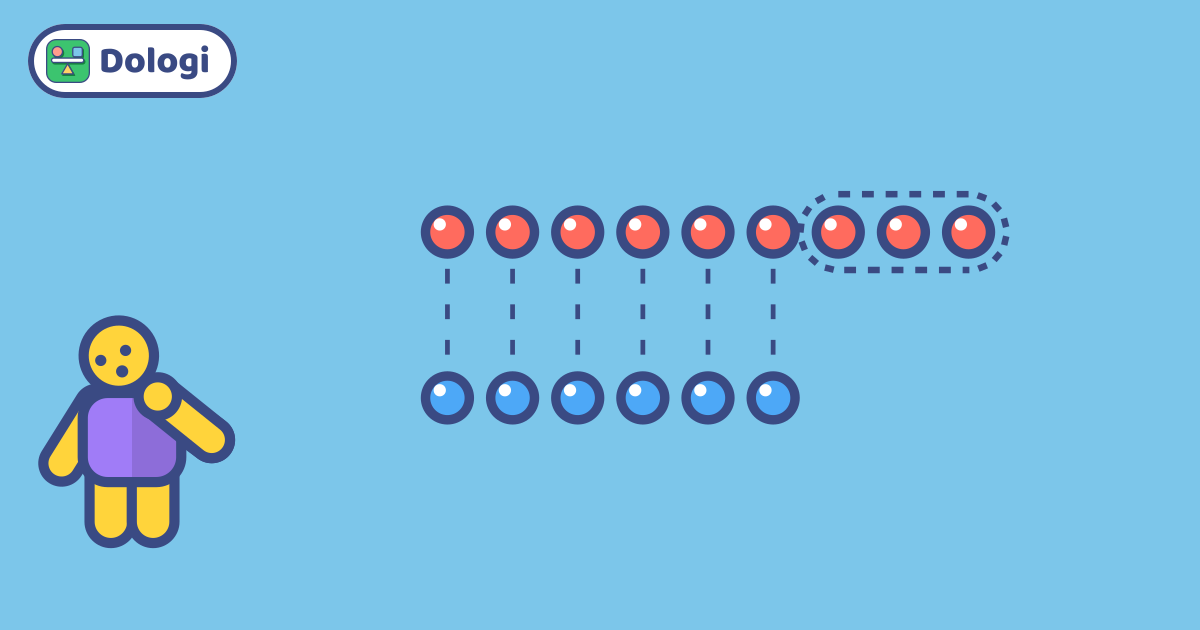
2. Set out real objects. Grab dried beans, bottle caps or marbles. Line up 9 for Sam. "Mia has 3 fewer than Sam, so how does her row look?" Your child builds a second row right under Sam's and stops before the last 3. Count the bottom row: 6.
3. Draw two rows of dots, then two bars. Once objects feel easy, your child draws two rows of dots on paper, the longer row for the person with more. Children of 9 or 10 can move on to two bars, one long and one short, with the difference circled. One look at the picture shows whether to add or subtract.
Pairs of problems that look alike but mean different things
This is the best practice: two problems with almost the same words but opposite operations. Have your child solve each pair, then ask, "What's different about these two?"
| Problem | Operation | Answer |
|---|---|---|
| Sam has 9 marbles. Mia has 3 more than Sam. How many does Mia have? | 9 + 3 | 12 |
| Sam has 9 marbles. That's 3 more than Mia has. How many does Mia have? | 9 − 3 | 6 |
| Lily has 7 sweets. Jack has 2 fewer than Lily. How many does Jack have? | 7 − 2 | 5 |
| Lily has 7 sweets. That's 2 fewer than Jack has. How many does Jack have? | 7 + 2 | 9 |
| Class A planted 12 trees and Class B planted 8. How many more trees did Class A plant? | 12 − 8 | 4 |
| Ella gave away 4 stickers and has 10 left. How many did she have at the start? | 10 + 4 | 14 |
Notice: one problem says "fewer" but needs adding, and others say "more" or "gave away" yet need the opposite of what the word suggests.
The checking habit
After solving, have your child put the answer back into the problem: "Mia has 6, Sam has 9. Does Sam have 3 more than Mia?" 9 − 6 = 3, yes. If your child had written 12, the check gives it away at once: with 12, Mia would have more than Sam, which contradicts the problem.
Practicing at home, no worksheets needed
- Which operation? Read a problem aloud; your child doesn't calculate, just says "add" or "subtract" and explains why.
- Parent gets it wrong: solve a problem with the opposite operation on purpose, and let your child find the mistake by setting out objects.
- Your child writes the problems: they make up a pair of look-alike problems with different operations for you to solve. Writing one pair like that shows real understanding.
The Math topic in Dologi has a puzzle called Which bin has the most?: "When the machine stops, which bin has the most marbles?" Your child has to follow where each marble goes and then compare the bins, rather than guess by feel. Just like in word problems, looking closely at the relationships is what leads to the right answer.
In short
- The "more means add" shortcut fails on problems that ask about the person with fewer.
- Before calculating, your child answers: "Who has more? Who is the question about?"
- Set out objects, draw two rows of dots or two bars to see the difference.
- Practice with look-alike pairs that mean different things, and check the answer by putting it back into the problem.
Read more: Word problems: helping your child understand what the question is asking, Rushed math mistakes: building the habit of checking