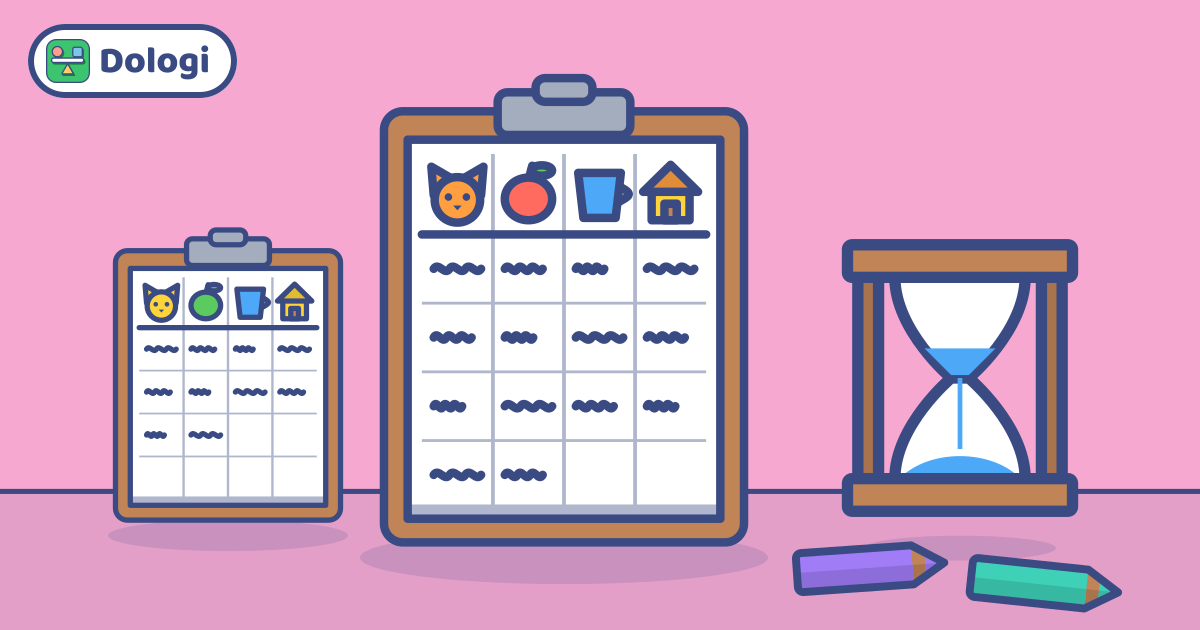
You may know it as "Name, Place, Animal, Thing", or simply as "the category game". Everyone gets a sheet of paper, someone picks a letter, and the race is on: an animal that starts with S, a food that starts with S, something in the house, a place. Snake, spaghetti, spoon, Seattle. Then the timer runs out and the arguing begins: does "sandwich" beat "salad"? Is "sea" a place?
It needs nothing more than paper, pencils and a timer, it works for a mix of ages, and children who can write a little can join in on equal terms. This article explains how to play, which rules to agree on before you start, how to keep score and how to adapt the game for children from about 5 to 12.
How to play
Give each player a sheet of paper and a pencil. Rule the sheet into columns and write a heading at the top of each. Four columns are enough to start:
- Animals: pets, farm animals, wild animals, birds, fish.
- Food: fruit, vegetables, dishes, snacks.
- Things: objects you might find at home or at school.
- Places: cities, states, countries, or everyday places like a park or a library.
Once your child knows the game, add columns the family likes: first names, colors, jobs, sports, things in the kitchen.
Each round goes like this:
- Pick a letter. Write letters on small slips of paper, fold them and put them in a cup. One player draws a slip each round.
- Start the timer. Turn over an hourglass or set a phone timer for one to two minutes.
- Write one word per column that starts with that letter. When time is up, pencils down.
- Read out one column at a time. Everyone reads their animal, then everyone reads their food, and so on.
- Score. A word nobody else wrote gets 2 points. A word someone else also wrote gets 1 point. An empty box or a word that doesn't fit gets 0.
Play five or six rounds with different letters and add up the points. You can write the points next to each box or add a narrow score column on the right.
Rules to agree on before you start
Most arguments in this game come from rules nobody said out loud. Settle these first, and write them down if your family likes rules on paper.
- Leave out the hard letters. Take Q, X and Z out of the cup at first. You can put them back later as a "bonus round" with extra time.
- "A" and "the" don't count. "A banana" is a B word, not an A word.
- The first letter has to be right. "Fone" doesn't count for F. For younger children, let other spelling slips go as long as the first letter is correct.
- Names count in the places column. Cities, states and countries are fine. Agree whether made-up words or brand names count. Most families say no.
- One word per box. If someone writes two, only the first one counts.
Easy letters to start with: S, B, C, M, P, T. Some sample answers for B: bear, banana, ball, Boston. For M: monkey, muffin, mug, Miami.
Levels by age
These ages are only rough guides. Every child is different, so try a level and move up or down.
| Age (approx.) | How to play |
|---|---|
| 5 to 6 | Play by the first sound instead of the letter. Say answers out loud or draw them. Two columns (animals, food), no timer or extra time. A parent writes if your child wants |
| 7 to 9 | Four columns, two minutes per round, easy letters only. Misspelled words count if the first letter is right |
| 10 to 12 | Six or more columns, harder letters, less time. A bonus point for answers nobody would expect |
With mixed ages, give the youngest more time or let them team up with an adult. Adults should write ordinary answers too: the game is more fun when a child can win.
What the game practices
The game looks simple, but each round asks for quite a lot at once:
- Finding words with two conditions at the same time. The word has to start with the right letter and fit the column. That is a different way of searching your memory than in everyday talk.
- Thinking about groups. Is a tomato a fruit or a vegetable? Is a whale a fish? Children have to decide where something belongs.
- First letters and spelling. Reading answers aloud turns into a natural spelling check, without feeling like homework.
- Listening to the others. To know whether their word is a duplicate, children have to listen carefully while everyone reads, not just wait for their own turn.
- Judging fairly. Every disputed word is practice in giving a reason and sticking to the rules everyone agreed on.
Arguments, and keeping it fun
Disagreements are part of this game. Handled well, they can be the best part:
- Agree first, judge later. When a new case comes up, take a family vote and add it to your rules for next time.
- Look it up together. Not sure whether a whale is a fish? Grab a dictionary, a book or a map. An argument becomes a small research moment.
- Don't laugh at spelling. If your child misspells a word, show the right spelling quietly and keep playing.
- Let your child invent a column. "Toys", "things that are green" or "characters from fairy tales" chosen by your child often make the game more exciting.
- Keep the sheets. Look at them again in a few months, and your child can see how many more words they find now.
In Dologi, the Logic topic has a puzzle called "Sort into groups": your child drags each thing into the box with the same color, shape or number. Just like filling in the columns of this game, every thing has to find its group.
In short
- Each player gets a sheet with columns (animals, food, things, places). Draw a letter and fill in every column before the hourglass runs out.
- Agree on the rules first: which letters are in the cup, whether "a" and "the" count, how strict to be about spelling.
- Younger children play by the first sound with two columns and more time. Older children get more columns, harder letters and less time.
- Settle arguments with a vote or a dictionary, and never laugh at a child's spelling.
Read more: Thinking games for car rides, lines and waiting for food (no phone needed), Make a homemade crossword about your child's favorite topic, Family game night: games for the whole family after dinner